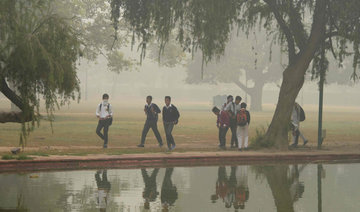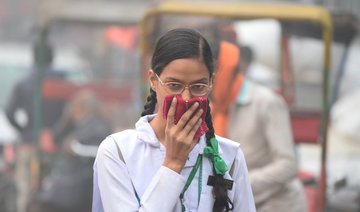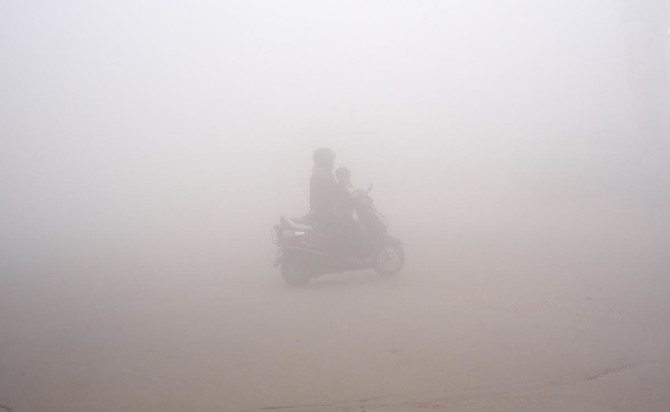
NEW DELHI: India's capital banned all construction, barred lorries from entering the city and announced stringent restrictions on private car use on Thursday, seeking to combat a massive spike in pollution across large swathes of India and Pakistan.
Tens of thousands of schools in Delhi and surrounding states remained closed as a hazardous fog of toxic pollution cloaked the region for a third day, bringing growing calls for urgent government action to tackle what doctors are calling a public health emergency.
“The situation in Delhi is so bad and if the pollution can be brought down in any way, we will do it,” the city’s transport minister Kailash Gahlot told reporters as he announced plans to limit private car use to alternate days from next Monday.
Authorities in the city had earlier ordered a ban on all construction work and barred lorries from entering the city as public pressure on the government mounted.
Around 50,000 mostly diesel-fueled lorries pass through India’s capital every night and they are a major contributor to the pollution plaguing the city.
Air quality typically worsens before the onset of winter as cooler air traps pollutants near the ground and prevents them from dispersing into the atmosphere, a phenomenon known as inversion.
Low winds and the annual post-harvest burning of crop stubble in the northern farming states of Punjab and Hariyana have caused the levels of dangerous pollutants in the air to spike to many times the levels considered safe.
Figures on the US embassy website showed levels of PM2.5 — the smallest particulates that cause most damage to health — spiked at over 1,000 on Wednesday afternoon in Delhi, though by Thursday afternoon they had fallen to 400.
The World Health Organization’s guidelines say 25 is the maximum level of PM2.5 anyone can safely be exposed to over a 24-hour period.
Doctors say the microscopic particles can penetrate deep into the lungs, increasing the risk of heart attacks and strokes.
“Delhi once again has become a veritable gas chamber with denizens finding it difficult to breathe,” The Times of India said Thursday, joining growing calls for government action to curb the chronic pollution, which the Indian Medical Association this week termed a public health emergency.
“Air pollution during winter months has become a catastrophe for large parts of north India,” the country’s most read English-language newspaper said in an editorial blaming “political apathy.”
In neighboring Pakistan’s second largest city Lahore, near the Indian border, hundreds flocked to hospitals seeking treatment for respiratory illnesses and eye infections caused by the pollution.
The PakAirQuality network, which publishes unofficial air reports on social media, said the concentration of PM 2.5 in the city had topped 300.
Motorcycle riders wore green face masks and goggles as they tried to cope with the smog, but for some the protection was not enough.
“I am feeling burning in my eyes,” said laborer Zawar Hussain. “I will visit a doctor in the evening.”
It is the second year running that Delhi — now the world’s most polluted capital with air quality worse than Beijing — has faced such high levels of PM2.5.
Media reports said the thick smog had also led to a series of road accidents in north India.
Eight students were killed late Wednesday when a truck plowed into them as they waited for a bus on a roadside in Punjab.
Since 2014, when WHO figures showed the extent of the crisis, authorities in Delhi have closed power plants temporarily and experimented with taking some cars off the road.
But the temporary measures have had little effect.
Under pressure to respond, Delhi’s Chief Minister Arvind Kejriwal on Thursday sought to blame stubble burning by farmers in neighboring states.
“We we will continue facing this every year until the neighboring state governments resolve the issue of crop burning,” he told reporters in Delhi.
The practice of burning crop stubble remains commonplace in north India despite an official ban.