In Asia, Trump briefly baffled by group handshake

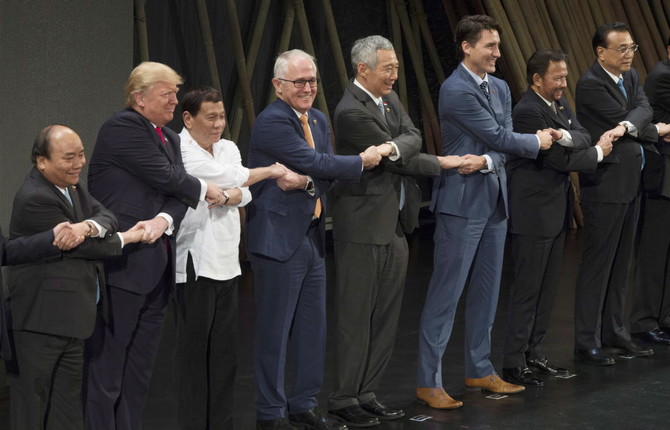
Canadian Prime Minister Justin Trudeau, center, and Donald Trump take part in a handshake with other leaders at the opening ceremony for the Association for Southeast Asian Nations (ASEAN) conference in Manila, Philippines, Monday, Nov. 13, 2017. (AP)
Updated 13 November 2017
Follow

In Asia, Trump briefly baffled by group handshake

MANILA, Philippines: President Donald Trump is known for his long, at times aggressive, handshakes with world leaders. But at an international summit in the Philippines on Monday, he struggled briefly with a different kind of handshake.
Trump, in Manila, attended the opening ceremonies of the Association for Southeast Asian Nations conference, which began with pageantry and a group photo of the leaders. Then, the announcer intoned that it was time for the leaders to take part in the "traditional" ASEAN handshake. It's a cross-body exercise, during which each leader extends their right arm over their left and shakes the opposite hands of those next to him.
The announcer's instructions briefly baffled Trump, who at first simply crossed his hands in front of him.
Then, looking around, he turned to the leaders that flanked him — Vietnamese Prime Minister Nguyen Xuan Phuc to his right, Philippine President Rodrigo Duterte to his left — and simply extended his arms outward, only to find that wasn't quite right either.
Then he laughed, crossed his arms and reached to the correct sides. He grimaced at first, particularly when bending down to reach the hands of the two shorter leaders next to him.
And then, with an exaggerated smile, he vigorously gripped their hands.
Handshakes have become a Trump trademark in his first year in office. He often pulls the other person toward him and pats or yanks in a sign meant to set a tone for the meeting ahead.
He pulled Japan Prime Minister Shinzo Abe's hand toward him and then held onto it for a long time, prompting an eye roll from Abe as Trump looked away. Trump and French President Emmanuel Macron engaged in a white-knuckle handshake. And Canadian Prime Minister Justin Trudeau, meanwhile, short-circuited Trump's attempt at dominance, using his left arm to hold onto to Trump to prevent being pulled toward him.


Researchers find 10,000-year-old rock art site in Sinai

Updated 13 February 2026
Follow

Researchers find 10,000-year-old rock art site in Sinai

  • The natural rock shelter’s ceiling features numerous red-pigment drawings of animals and symbols, as well as inscriptions in Arabic and Nabataean
  • Some engravings reflect the lifestyles and economic activities of early human communities

CAIRO: Archeologists have discovered a 10,000-year-old site with rock art in Egypt’s Sinai Peninsula, the country’s Ministry of Tourism and Antiquities said.
The previously unknown site on the Umm Irak Plateau features a 100-meter-long rock formation whose diverse carvings trace the evolution of human artistic expression from prehistoric times to the Islamic era.
The Supreme Council of Antiquities “has uncovered one of the most important new archeological sites, of exceptional historical and artistic value,“the ministry said in a statement.
Its chronological diversity makes it “an open-air natural museum,” according to the council’s secretary-general, Hisham El-Leithy.
The natural rock shelter’s ceiling features numerous red-pigment drawings of animals and symbols, as well as inscriptions in Arabic and Nabataean.
Some engravings “reflect the lifestyles and economic activities of early human communities,” the ministry said.
Inside, animal droppings, stone partitions, and hearth remains confirm that the shelter was used as a refuge for a long time.
These “provide further evidence of the succession of civilizations that have inhabited this important part of Egypt over the millennia,” Tourism and Antiquities Minister Sherif Fathi said.
He described the discovery as a “significant addition to the map of Egyptian antiquities.”
The site is located in southern Sinai, where Cairo is undertaking a vast megaproject aimed at attracting mass tourism to the mountain town of Saint Catherine, a UNESCO World Heritage site and home to Bedouin who fear for their ancestral land.