

Berlusconi claims win for center-right in Sicily vote

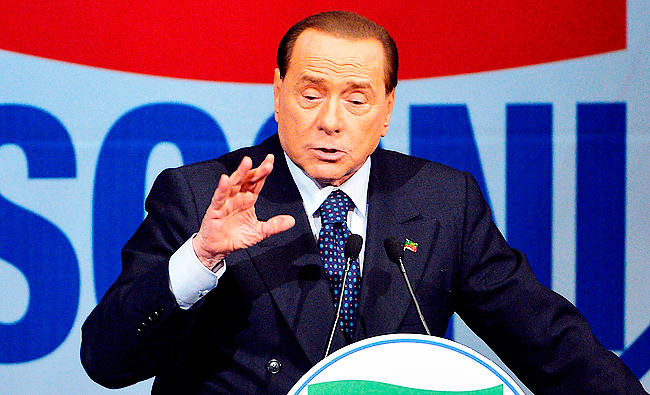
This file photo taken on May 22, 2014 shows Former Italian Prime Minister and president of the Italian center-right Forza Italia (FI) party, Silvio Berlusconi during a rally. (AFP)
Updated 07 November 2017
Follow

Berlusconi claims win for center-right in Sicily vote

PALERMO, Italy: Former Italian Prime Minister Silvio Berlusconi was poised for for a stunning political comeback on Monday, as he claimed victory in an election in Sicily that puts him and his rightist allies in pole position for a national vote due by next May.
With about 85 percent of the votes counted, a center-right bloc backed by the four-times prime minister was running five percentage points ahead of the anti-establishment 5-Star Movement, with the center-left a distant third.
“Sicily, just as I asked, has chosen the path of real, serious, constructive change, based on honesty, competence and experience,” the 81 year-old said in a video posted on Facebook.
The result puts Berlusconi back on the political map after years of sex scandals and graft allegations. By contrast, it deals a stinging blow to another former prime minister, Matteo Renzi, head of the ruling Democratic Party (PD), which is locked in feuding with erstwhile leftist partners.
After a raft of vote setbacks in recent years, Renzi has many critics inside the PD who may now try to mount a challenge to his leadership.
The regional Sicilian ballot, held on Sunday, is seen as a dry run for the national vote, with many of the island’s problems reflecting those of the country as a whole — high unemployment, a debt mountain and sluggish economic growth.

“A WINNING MODEL“
Sicily is traditionally a center-right stronghold which was poached by the PD in 2012 thanks to splits in the conservative bloc. This time Berlusconi reunited the coalition behind a widely respected leader with a far-right background.
Nello Musumeci, the center-right’s candidate for governor of the island, had 39.8 percent of the vote, while the 5-Star’s Giancarlo Cancelleri had 34.7 percent. The center-left’s Fabrizio Micari was lagging on 18.5 percent.
“From Sicily we will demonstrate that this is a winning model that can triumph at a national level,” said Giorgia Meloni, the leader of the right-wing Brothers of Italy party which is the junior partner in the center-right alliance.
The maverick 5-Star, founded by comedian Beppe Grillo, had campaigned relentlessly for months in Sicily, looking to take charge of its first region after a string of successes in municipal ballots in recent years, including in Rome and Turin.
Its leader Luigi Di Maio said the party had been penalized in Sicily by low turnout — less than half of those eligible cast a vote.
“In two or three months I think many of those who abstained will regret not going to vote,” Di Maio said, insisting that if turnout had been 3 or 4 points higher it could have tilted the result in the movement’s favor.
Although defeat is a blow, the 5-Star can take comfort from the fact that it is the largest single political force, taking at least 30 percent of a separate vote on Sicily for party lists against less than 15 percent for its nearest rival — Berlusconi’s Forza Italia (Go Italy!)

Top UN court to hear Rohingya genocide case against Myanmar

Updated 6 sec ago
Follow

Top UN court to hear Rohingya genocide case against Myanmar

THE HAGUE: Did Myanmar commit genocide against its Rohingya Muslim minority? That’s what judges at the International Court of Justice will weigh during three weeks of hearings starting Monday.
The Gambia brought the case accusing Myanmar of breaching the 1948 Genocide Convention during a crackdown in 2017.
Legal experts are watching closely as it could give clues for how the court will handle similar accusations against Israel over its military campaign in Gaza, a case brought to the ICJ by South Africa.
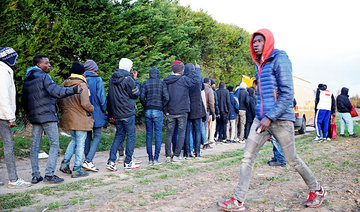
Hundreds of thousands of Rohingya Muslims fled violence by the Myanmar army and Buddhist militias, escaping to neighboring Bangladesh and bringing harrowing accounts of mass rape, arson and murder.
Today, 1.17 million Rohingya live crammed into dilapidated camps spread over 8,000 acres in Cox’s Bazar in Bangladesh.
From there, mother-of-two Janifa Begum told AFP: “I want to see whether the suffering we endured is reflected during the hearing.”
“We want justice and peace,” said the 37-year-old.

’Senseless killings’

The Gambia, a Muslim-majority country in West Africa, brought the case in 2019 to the ICJ, which rules in disputes between states.
Under the Genocide Convention, any country can file a case at the ICJ against any other it believes is in breach of the treaty.
In December 2019, lawyers for the African nation presented evidence of what they said were “senseless killings... acts of barbarity that continue to shock our collective conscience.”
In a landmark moment at the Peace Palace courthouse in The Hague, Nobel Peace laureate Aung San Suu Kyi appeared herself to defend her country.
She dismissed Banjul’s argument as a “misleading and incomplete factual picture” of what she said was an “internal armed conflict.”
The former democracy icon warned that the genocide case at the ICJ risked reigniting the crisis, which she said was a response to attacks by Rohingya militants.
Myanmar has always maintained the crackdown by its armed forces, known as the Tatmadaw, was justified to root out Rohingya insurgents after a series of attacks left a dozen security personnel dead.

‘Physical destruction’

The ICJ initially sided with The Gambia, which had asked judges for “provisional measures” to halt the violence while the case was being considered.
The court in 2020 said Myanmar must take “all measures within its power” to halt any acts prohibited in the 1948 UN Genocide Convention.
These acts included “killing members of the group” and “deliberately inflicting on the group conditions of life calculated to bring about its physical destruction in whole or in part.”
The United States officially declared that the violence amounted to genocide in 2022, three years after a UN team said Myanmar harbored “genocidal intent” toward the Rohingya.
The hearings, which wrap up on January 30, represent the heart of the case.
The court had already thrown out a 2022 Myanmar challenge to its jurisdiction, so judges believe they have the power to rule on the genocide issue.
A final decision could take months or even years and while the ICJ has no means of enforcing its decisions, a ruling in favor of The Gambia would heap more political pressure on Myanmar.
Suu Kyi will not be revisiting the Peace Palace. She has been detained since a 2021 coup, on charges rights groups say were politically motivated.
The ICJ is not the only court looking into possible genocide against the Rohingya.
The International Criminal Court, also based in The Hague, is investigating military chief Min Aung Hlaing for suspected crimes against humanity.
Another case is being heard in Argentina under the principle of universal jurisdiction, the idea that some crimes are so heinous they can be heard in any court.