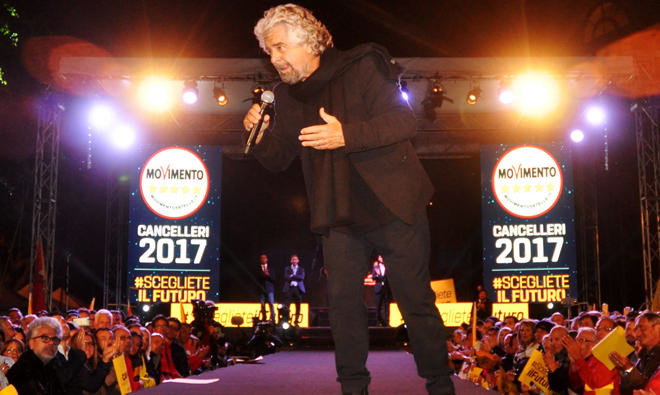
CATANIA, Italy: Sicilians cast their ballots on Sunday in a regional vote seen as a barometer for Italy’s general election next year, with the populist Five Star Movement (M5S) challenging a resurgent right as a divided left flounders.
“The vote is considered decisive not just by the party leaders pounding the streets of the main cities, and not just for the island’s future, but for the future of Italy and even Europe,” editorialist Marcello Sorgi wrote in La Stampa daily.
A victory in Sicily would give M5S its first region, a boost supporters say could propel it all the way to national leadership.
“The choice is simple: Us or them, the future or the past, hope or failure, citizens or traditional political parties,” comedian Beppe Grillo, the movement’s outspoken founder, wrote on his blog.
M5S candidate Giancarlo Cancelleri, 42, is expected to have just one real challenger for the victory podium: Nello Musumeci, 62, who was leading the race in recent opinion polls and could snap up the region for the right.
A bitterly feuding left is expected to fail to get anywhere near the top.
Analysts say the political dynamic on the Mediterranean island mirrors the situation nationally, and the vote is being closely watched in the euro zone’s third-largest economy for indications of how the general election, due before May, will go.
Votes will be counted on Monday. “The polling stations open under a dark cloud, amid controversy over the risk of vote-rigging,” La Repubblica daily said, referring to claims the decision to wait overnight before beginning the count increased the chances of fraud.
The Interior Ministry was tightening controls in response to the fears, it said.
All eyes were on turnout figures, with low participation known to have rewarded M5S in the past. Only 47 percent of Sicily’s eligible voters turned out for the last regional election in 2012, a record low.
A victory for Musumeci could be a boost for billionaire former premier Silvio Berlusconi, who recently shrugged off scandals to return to the political fray, portraying himself as a pro-European moderate and the only real defense against populism.
His center-right Forza Italia (Go Italy) party joined forces with its traditional rightist allies the Northern League and the Brothers of Italy for the Sicily vote — a powerful combination which pollsters say could steal the show at the national elections.
The anti-immigrant Northern League, meanwhile, sees Sicily as a testing ground for expanding its reach beyond Italy’s northern regions.
But the ruling Democratic Party (PD) is braced for an embarrassing defeat that could have serious implications not just for the left nationally but also for Matteo Renzi, the former prime minister who wants his old job back.
“Renzi is preparing for the probable Sicilian nosedive like a man whose enemies are at the door and the supplies are running out,” political commentator Tommaso Ciriaco said in La Repubblica daily.
The 42-year old has been accused of causing a debilitating rift in the left, and has largely abandoned the party’s candidate, Fabrizio Micari, 54, on the campaign trail.

Italy eyes populist party’s performance in Sicily vote
UN rights chief appeals for $400 million as crises mount and funding shrinks
- The UN office is appealing for $100 million less than last year, after a significant scale back of its work in some areas
- Volker Turk’s office undertook less than half the number of human rights monitoring missions compared to 2024
GENEVA: UN human rights chief Volker Turk appealed for $400 million on Thursday to address mounting human rights needs in countries such as Sudan and Myanmar, after donor funding cuts drastically reduced the work of his office and left it in “survival mode.”
The UN office is appealing for $100 million less than last year, after a significant scale back of its work in some areas due to a fall in contributions from countries including the US and Europe.
“We are currently in survival mode, delivering under strain,” Turk told delegates in a speech in Geneva, urging countries to step up support.
In the last year, Turk’s office raised alarm about human rights violations in Gaza, Sudan, the Democratic Republic of the Congo, Ukraine, and Myanmar, among others.
However, due to slashes in funding, Turk’s office undertook less than half the number of human rights monitoring missions compared to 2024, and reduced its presence in 17 countries, he said. Last year it received $90 million less in funding than it needed, which resulted in 300 job cuts, directly impacting the office’s work, Turk said in December.
“We cannot afford a human rights system in crisis,” he stated.
Turk listed examples of the impacts of cuts, noting the Myanmar program was cut by more than 60 percent in the last year, limiting its ability to gather evidence.
A UN probe into possible war crimes in the Democratic Republic of the Congo is also struggling to become fully operational due to limited funding, while work to prevent gender-based violence and protect the rights of LGBTIQ+ people globally has been cut up to 75 percent, the office said.
“This means more hate speech and attacks, and fewer laws to stop them,” Turk stated.
The UN human rights office is responsible for investigating rights violations. Its work contributes to UN Security Council deliberations and is widely used by international courts, according to the office.
The UN office is appealing for $100 million less than last year, after a significant scale back of its work in some areas due to a fall in contributions from countries including the US and Europe.
“We are currently in survival mode, delivering under strain,” Turk told delegates in a speech in Geneva, urging countries to step up support.
In the last year, Turk’s office raised alarm about human rights violations in Gaza, Sudan, the Democratic Republic of the Congo, Ukraine, and Myanmar, among others.
However, due to slashes in funding, Turk’s office undertook less than half the number of human rights monitoring missions compared to 2024, and reduced its presence in 17 countries, he said. Last year it received $90 million less in funding than it needed, which resulted in 300 job cuts, directly impacting the office’s work, Turk said in December.
“We cannot afford a human rights system in crisis,” he stated.
Turk listed examples of the impacts of cuts, noting the Myanmar program was cut by more than 60 percent in the last year, limiting its ability to gather evidence.
A UN probe into possible war crimes in the Democratic Republic of the Congo is also struggling to become fully operational due to limited funding, while work to prevent gender-based violence and protect the rights of LGBTIQ+ people globally has been cut up to 75 percent, the office said.
“This means more hate speech and attacks, and fewer laws to stop them,” Turk stated.
The UN human rights office is responsible for investigating rights violations. Its work contributes to UN Security Council deliberations and is widely used by international courts, according to the office.
© 2026 SAUDI RESEARCH & PUBLISHING COMPANY, All Rights Reserved And subject to Terms of Use Agreement.