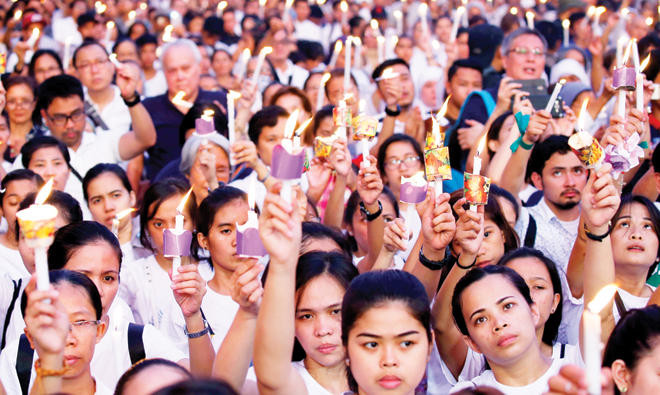
MANILA: Catholic bishops on Sunday led thousands of Philippine worshippers in calling for an end to killings in President Rodrigo Duterte’s drug war as they urged police and troops to stop the violence.
The killing of three teenagers in August triggered rare public protests against Duterte’s anti-drugs campaign, with rights groups accusing him of committing crimes against humanity in a crackdown that has claimed thousands of lives.
The Catholic Church, which counts 80 percent of Filipinos as followers, has been one of the leading critics of the war on drugs and has launched campaigns to stop the killings, including one starting on Sunday dubbed “Heal Our Land.”
The church organized a mass and procession along a historic Manila highway called EDSA, where a bloodless popular revolt ended the iron rule of dictator Ferdinand Marcos in 1986.
About 3,000 people — including opposition lawmakers, students and church groups — joined the event, according to police. They carried candles and placards reading, “Stop the Killings. Start the Healing.”
“Peace to you in the armed forces and the police. Stop the violence and uphold the law,” Archbishop Socrates Villegas, the president of the Catholic Bishops’ Conference of the Philippines, said at the mass.
“If we do not stop the killings, there will be a punishment for a nation that kills its own people.”
Duterte, 72, won elections last year after campaigning on a law-and-order platform and since then police have reported killing more than 3,900 “drug personalities.”
Duterte’s spokesman on Sunday said he did not condone extrajudicial killings, adding the government was investigating another 2,243 deaths in unsolved “drug-related” cases.
“The president himself made a clear stance that any violation committed by the police during operations would be dealt with accordingly,” Harry Roque said.
Villegas said the killings tested the nation and cited the case of 17-year-old student Kian Delos Santos, who died in a police anti-drug raid in August.
“Please stop. I still have a test tomorrow,” Villegas quoted Delos Santos as saying following witness accounts that he had begged for his life.

Philippine bishops call end to killings in rally against drug war
ASEAN should adhere to rule of law in face of ‘unilateral actions,’ Philippines’ top diplomat says
- Several ASEAN members have expressed deep concern over the US strike that resulted in the arrest of Venezuelan leader Nicolas Maduro
- Philippines’ top envoy: ‘Across our region, we continue to see tensions at sea, protracted internal conflicts and unresolved border and humanitarian concerns’
CEBU, Philippines: Southeast Asian countries should steadfastly maintain restraint and adhere to international law as acts of aggression across Asia and “unilateral actions” elsewhere in the world threaten the rules-based global order, Manila’s top diplomat said Thursday.
Philippine Foreign Secretary Theresa Lazaro did not provide details of the geopolitical alarm she raised before her counterparts in the 11-nation Association of Southeast Asian Nations who were holding their first major closed-door meetings this year in the Philippines’ central seaside city of Cebu.
Several ASEAN members, however, have expressed deep concern over the secretive US strike that resulted in the arrest of Venezuelan leader Nicolas Maduro on orders from US President Donald Trump. China’s intensifying aggressive stance on Taiwan and in the disputed South China Sea have also troubled the region for years.
Calling out the US and China, among the largest trading and defense partners of ASEAN countries, have been a dilemma and diplomatic tightrope.
“Across our region, we continue to see tensions at sea, protracted internal conflicts and unresolved border and humanitarian concerns,” Lazaro said in her opening speech before ASEAN counterparts.
“At the same time, developments beyond Southeast Asia, including unilateral actions that carry cross-regional implications, continue to affect regional stability and erode multilateral institutions and the rules- based international order,” she said.
“These realities underscore the interim importance of ASEAN’s time-honored principles of restraint, dialogue and adherence to international law in seeking to preserve peace and stability to our peoples.”
The Philippines holds ASEAN’s rotating chair this year, taking what would have been Myanmar’s turn after the country was suspended from chairing the meeting after its army forcibly ousted Aung San Suu Kyi’s democratically elected government in 2021.
Founded in 1967 in the Cold War era, ASEAN has an unwieldy membership of diverse countries that range from vibrant democracies like the Philippines, a longtime treaty ally of Washington, to authoritarian states like Laos and Cambodia, which are close to Beijing.
The regional bloc adopted the theme “Navigating our future, Together” this year but that effort to project unity faced its latest setback last year when deadly fighting erupted between two members, Thailand and Cambodia, over a longtime border conflict.
Aside from discussing the deadly fighting that embroiled Thailand and Cambodia before both forged a US-backed ceasefire last year, the ASEAN foreign ministers will deliberate how to push a five-point peace plan for the war in Myanmar, issued by the regional bloc’s leaders in 2021. The plan demanded, among others, an immediate end to fighting and hostilities, but it has failed to end the violence or foster dialogue among contending parties.
ASEAN foreign ministers are also under pressure to conclude negotiations with China ahead of a self-imposed deadline this year on a so-called “code of conduct” to manage disputes over long-unresolved territorial rifts in the South China Sea. China has expansive claims in the waterway, a key global trade route, that overlap with those of four ASEAN members, the Philippines, Malaysia, Vietnam and Brunei.
Philippine Foreign Secretary Theresa Lazaro did not provide details of the geopolitical alarm she raised before her counterparts in the 11-nation Association of Southeast Asian Nations who were holding their first major closed-door meetings this year in the Philippines’ central seaside city of Cebu.
Several ASEAN members, however, have expressed deep concern over the secretive US strike that resulted in the arrest of Venezuelan leader Nicolas Maduro on orders from US President Donald Trump. China’s intensifying aggressive stance on Taiwan and in the disputed South China Sea have also troubled the region for years.
Calling out the US and China, among the largest trading and defense partners of ASEAN countries, have been a dilemma and diplomatic tightrope.
“Across our region, we continue to see tensions at sea, protracted internal conflicts and unresolved border and humanitarian concerns,” Lazaro said in her opening speech before ASEAN counterparts.
“At the same time, developments beyond Southeast Asia, including unilateral actions that carry cross-regional implications, continue to affect regional stability and erode multilateral institutions and the rules- based international order,” she said.
“These realities underscore the interim importance of ASEAN’s time-honored principles of restraint, dialogue and adherence to international law in seeking to preserve peace and stability to our peoples.”
The Philippines holds ASEAN’s rotating chair this year, taking what would have been Myanmar’s turn after the country was suspended from chairing the meeting after its army forcibly ousted Aung San Suu Kyi’s democratically elected government in 2021.
Founded in 1967 in the Cold War era, ASEAN has an unwieldy membership of diverse countries that range from vibrant democracies like the Philippines, a longtime treaty ally of Washington, to authoritarian states like Laos and Cambodia, which are close to Beijing.
The regional bloc adopted the theme “Navigating our future, Together” this year but that effort to project unity faced its latest setback last year when deadly fighting erupted between two members, Thailand and Cambodia, over a longtime border conflict.
Aside from discussing the deadly fighting that embroiled Thailand and Cambodia before both forged a US-backed ceasefire last year, the ASEAN foreign ministers will deliberate how to push a five-point peace plan for the war in Myanmar, issued by the regional bloc’s leaders in 2021. The plan demanded, among others, an immediate end to fighting and hostilities, but it has failed to end the violence or foster dialogue among contending parties.
ASEAN foreign ministers are also under pressure to conclude negotiations with China ahead of a self-imposed deadline this year on a so-called “code of conduct” to manage disputes over long-unresolved territorial rifts in the South China Sea. China has expansive claims in the waterway, a key global trade route, that overlap with those of four ASEAN members, the Philippines, Malaysia, Vietnam and Brunei.
© 2026 SAUDI RESEARCH & PUBLISHING COMPANY, All Rights Reserved And subject to Terms of Use Agreement.