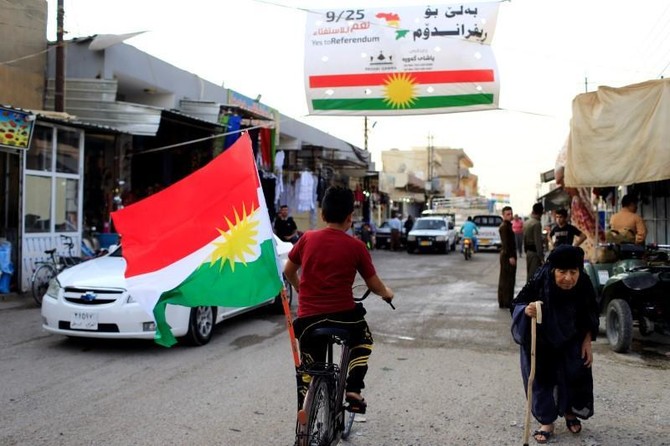
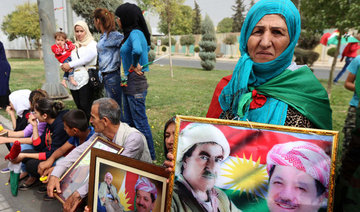
BAGHDAD: Iraq’s Kurdistan region said on Thursday it has offered a joint Kurdish-Iraqi deployment at a strategic crossing into Turkey, with the participation of the US-led coalition that was helping fight Daesh.
The offer was disclosed hours after Iraqi armed forces accused the Kurdistan Regional Government (KRG) of delaying the handover to Iraq of control of the borders with Turkey, Iran and Syria, and threatened to resume operations to capture Kurdish-held areas.
The KRG defense department said the offer was part of a “deconfliction” proposal made to the Iraqi government on Oct. 31.
The other points included a cease-fire on all fronts, continued cooperation in the fight against Daesh and a joint deployment in so-called disputed territories, which are areas claimed by both the KRG and the Iraqi central government.
The KRG “continues to welcome a permanent cease-fire on all fronts, deconfliction and the start of a political dialogue” with Baghdad, the Kurdish statement said.
Iraqi Prime Minister Haider Al-Abadi ordered economic and military retaliation after Iraqi Kurds voted for independence in a referendum held in September that Baghdad declared illegal.
He insists that the KRG cancel the referendum’s outcome as a pre-condition for any dialogue. Iran and Turkey back his measures against Iraq’s Kurds, fearing the drive for independence will spread to their own Kurdish populations.
The joint deployment at the strategic Fish-Khabur crossing was meant “as a goodwill gesture and trust-building exercise that ensures a limited and temporary arrangement until an agreement is reached in accordance with the Iraqi Constitution,” the Kurdish statement said.
Fish-Khabur is strategically important for the Kurdistan region because it is the point where its oil pipeline crosses into Turkey.
Iraq’s entire land border with Turkey is located inside the Kurdish autonomous region and has been controlled by the Kurds since before the fall of Saddam Hussein in 2003.
Abadi declared a pause on Friday in an offensive that began on Oct. 16 to take over the disputed areas. The oil-rich city of Kirkuk fell on the same day without much fighting.
The Iraqi Joint Operations Command accused the KRG on Wednesday of using the talks that started on Friday to “buy time” to strengthen Kurdish lines.
“We will not allow it; the federal forces are mandated to secure (the disputed) areas and borders,” it said in a statement.
The Kurdish Peshmerga command also accused Iraqi forces on Wednesday of massing weapons and threatening force to resolve “domestic political differences.”
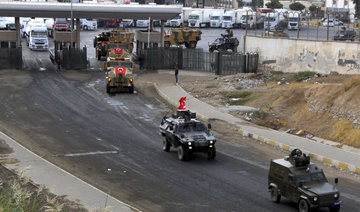
Iraqi troops set up positions between Turkish and Iraqi Kurdish checkpoints on Tuesday at the Habur border crossing, between the Turkish town of Silopi and the Iraqi town of Zakho.
That meant vehicles crossing the border were subject to three separate checks. Eight members of Turkey’s security forces and five Kurdistan Workers Party (PKK) militants were killed in a clash early on Thursday near the border between northern Iraq and southeast Turkey, Turkish security and hospital sources said.
The PKK launched a separatist insurgency in 1984 and more than 40,000 people have been killed in the conflict.

Kurds offer joint border deployment as Iraq threatens to resume military operations
Turkiye’s Kurdish party says Syria deal leaves Ankara ‘no excuses’ on peace process
ANKARA: Turkiye’s pro-Kurdish DEM Party said on Monday that the Turkish government had no more “excuses” to delay a peace process with the Kurdistan Workers Party (PKK) now that a landmark integration deal was achieved in neighboring Syria.
On Sunday in Syria, the Kurdish-led Syrian Democratic Forces (SDF) agreed to come under the control of authorities in Damascus — a move that Ankara had long sought as integral to its own peace effort with the PKK. “For more than a year, the government has presented the SDF’s integration with Damascus as the biggest obstacle to the process,” Tuncer Bakirhan, co-leader of the DEM Party, told Reuters, in some of the party’s first public comments on the deal in Syria.
“The government will no longer have any excuses left. Now it is the government’s turn to take concrete steps.” Bakirhan cautioned President Tayyip Erdogan’s government against concluding that the rolling back Kurdish territorial gains in Syria negated the need for a peace process in Turkiye. “If the government calculates that ‘we have weakened the Kurds in Syria, so there is no longer a need for a process in Turkiye,’ it would be making a historic mistake,” he said in the interview.
Turkish officials said earlier on Monday that the Syrian integration deal, if implemented, could
advance the more than year-long process with the PKK, which is based in northern Iraq. Erdogan urged
swift integration of Kurdish fighters into Syria’s armed forces. Turkiye, the strongest foreign backer of Damascus, has since 2016 repeatedly sent forces into northern Syria to curb the gains of the SDF — which after the 2011–2024 civil war had controlled more than a quarter of Syria while fighting Islamic State with strong US backing.
The United States has built close ties with Damascus over the last year and was closely involved in mediation between it and the SDF toward the deal.
Bakirhan said progress required recognition of Kurdish rights on both sides of the border.
“What needs to be done is clear: Kurdish rights must be recognized in both Turkiye and Syria, democratic regimes must be established, and freedoms must be guaranteed,” he said.
On Sunday in Syria, the Kurdish-led Syrian Democratic Forces (SDF) agreed to come under the control of authorities in Damascus — a move that Ankara had long sought as integral to its own peace effort with the PKK. “For more than a year, the government has presented the SDF’s integration with Damascus as the biggest obstacle to the process,” Tuncer Bakirhan, co-leader of the DEM Party, told Reuters, in some of the party’s first public comments on the deal in Syria.
“The government will no longer have any excuses left. Now it is the government’s turn to take concrete steps.” Bakirhan cautioned President Tayyip Erdogan’s government against concluding that the rolling back Kurdish territorial gains in Syria negated the need for a peace process in Turkiye. “If the government calculates that ‘we have weakened the Kurds in Syria, so there is no longer a need for a process in Turkiye,’ it would be making a historic mistake,” he said in the interview.
Turkish officials said earlier on Monday that the Syrian integration deal, if implemented, could
advance the more than year-long process with the PKK, which is based in northern Iraq. Erdogan urged
swift integration of Kurdish fighters into Syria’s armed forces. Turkiye, the strongest foreign backer of Damascus, has since 2016 repeatedly sent forces into northern Syria to curb the gains of the SDF — which after the 2011–2024 civil war had controlled more than a quarter of Syria while fighting Islamic State with strong US backing.
The United States has built close ties with Damascus over the last year and was closely involved in mediation between it and the SDF toward the deal.
Bakirhan said progress required recognition of Kurdish rights on both sides of the border.
“What needs to be done is clear: Kurdish rights must be recognized in both Turkiye and Syria, democratic regimes must be established, and freedoms must be guaranteed,” he said.
© 2026 SAUDI RESEARCH & PUBLISHING COMPANY, All Rights Reserved And subject to Terms of Use Agreement.