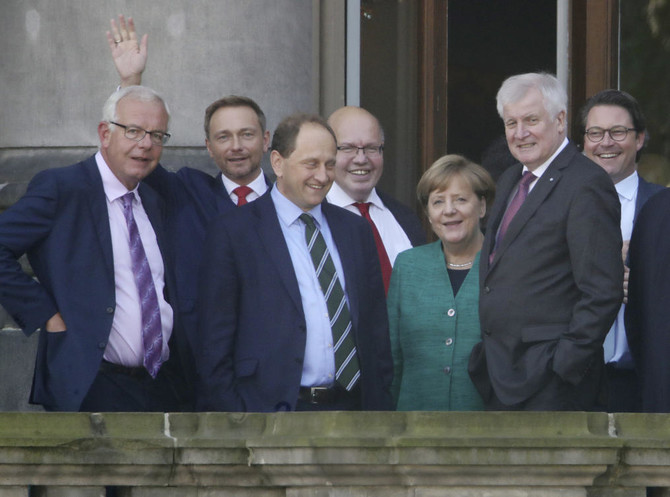
BERLIN: German Chancellor Angela Merkel was due to meet with possible coalition partners on Sunday to kickstart the process of forming a government after talks got off to a rocky start last week, media reported.
Merkel, whose conservative alliance came first but lost seats in the Sept. 24 national election, is trying to forge a three-way coalition with the pro-business Free Democrats (FDP) and environmental Greens that is untested at a national level.
The process is proving tricky, with disputes about climate and immigration policy played out in German media over the weekend after what one negotiator described as a “big clash” between participants on Thursday.
Bild am Sonntag newspaper said Merkel would try to “rescue” the talks by meeting with Horst Seehofer, who heads the conservative Bavarian CSU party, two officials from the Greens and FDP leader Christian Lindner at an undisclosed location.
The political mood remained stormy.
Bild am Sonntag said Lindner, for instance, had argued that he should be allowed to bring a second FDP official to the high-level meeting since the Greens were also bringing both Cem Ozdemir and Katrin Goering-Eckardt.
The exploratory talks are due to continue Monday after the three sides failed to reach agreement on immigration and climate issues during an 11-hour session on Thursday.
The possible partners in a so-called Jamaica coalition — a name chosen because the parties’ black, yellow and green colors mirror those of the Jamaican flag — are at odds over ending coal production to lower carbon dioxide emissions and migrant caps.
Many conservatives want to take a harder line on immigration, blaming their election setback on Merkel’s decision to allow in more than a million migrants in 2015 and 2016. They want to limit refugee numbers, but the Greens reject such a cap.
Other issues such as pensions and labor regulations — which could be on the agenda on Monday — appear less contentious.
The three blocs are also moving toward agreement on the issue of legalizing marijuana through licensed distributors, such as pharmacies, the Stuttgarter Zeitung newspaper reported on Sunday.
Fritz Becker, head of the German pharmacists association, said his group was ready to take on the job, and had let the parties know its position.
Better to legalize marijuana with “consultation about risks and side effects, good customer service and clean merchandise,” he told the newspaper.
Alexander Lambsdorff, deputy leader of the FDP parliamentary group, told the Welt am Sonntag newspaper that exploratory talks on forming a coalition were in “a difficult phase” but said that was not unexpected at such an early stage in the negotiations.
“Of course there will still be different interpretations and the occasional rumble,” he said.
He said the FDP and Greens had “no choice but to talk to each other” given the current circumstances in the Bundestag, or lower house of parliament.
“In the end, everyone will have to see if they can support the result. No one will be served if a coalition emerges that is at odds for four years,” he told the newspaper.
The Social Democrats, junior partner to the conservatives over the last four years, have vowed to stay in opposition.

Merkel said to kickstart German coalition talks
EU leaders to reassess US ties despite Trump U-turn on Greenland
- Diplomats stressed that, although Thursday’s emergency EU talks in Brussels would now lose some of their urgency, the longer-term issue of how to handle the relationship with the US remained
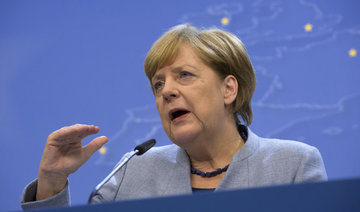
BRUSSELS: EU leaders will rethink their ties with the US at an emergency summit on Thursday after Donald Trump’s threat of tariffs and even military action to acquire Greenland badly shook confidence in the transatlantic relationship, diplomats said.
Trump abruptly stepped back on Wednesday from his threat of tariffs on eight European nations, ruled out using force to take Greenland, a semi-autonomous territory of NATO ally Denmark, and suggested a deal was in sight to end the dispute.
German Chancellor Friedrich Merz, welcoming Trump’s U-turn on Greenland, urged Europeans not to be too quick to write off the transatlantic partnership.
But EU governments remain wary of another change of mind by a mercurial president who is increasingly seen as a bully that Europe will have to stand up to, and they are focused on coming up with a longer-term plan on how to deal with the United States under this administration and possibly its successors too.
“Trump crossed the Rubicon. He might do it again. There is no going back to what it was. And leaders will discuss it,” one EU diplomat said, adding that the bloc needed to move away from its heavy reliance on the US in many areas.
“We need to try to keep him (Trump) close while working on becoming more independent from the US It is a process, probably a long one,” the diplomat said.
EU RELIANCE ON US
After decades of relying on the United States for defense within the NATO alliance, the EU lacks the needed intelligence, transport, missile defense and production capabilities to defend itself against a possible Russian attack. This gives the US substantial leverage.
The US is also Europe’s biggest trading partner, making the EU vulnerable to Trump’s policies of imposing tariffs to reduce Washington’s trade deficit in goods, and, as in the case of Greenland, to achieve other goals.
“We need to discuss where the red lines are, how we deal with this bully across the Atlantic, where our strengths are,” a second EU diplomat said.
“Trump says no tariffs today, but does that mean also no tariffs tomorrow, or will he again quickly change his mind? We need to discuss what to do then,” the second diplomat said.
The EU had been considering a package of retaliatory tariffs on 93 billion euros ($108.74 billion) on US imports or anti-coercive measures if Trump had gone ahead with his own tariffs, while knowing such a step would harm Europe’s economy as well as the United States.
WHAT’S THE GREENLAND DEAL?
Several diplomats noted there were still few details of the new plan for Greenland, agreed between Trump and NATO Secretary General Mark Rutte late on Wednesday on the sidelines of the World Economic Forum in Davos, Switzerland.
“Nothing much changed. We still need to see details of the Greenland deal. We are a bit fed up with all the bullying. And we need to act on a few things: more resiliency, unity, get our things together on internal market, competitiveness. And no more accepting tariff bullying,” a third diplomat said.
Rutte told Reuters in an interview in Davos on Thursday that under the framework deal he reached with Trump the Western allies would have to step up their presence in the Arctic.
He also said talks would continue between Denmark, Greenland and the US on specific issues.
Diplomats stressed that, although Thursday’s emergency EU talks in Brussels would now lose some of their urgency, the longer-term issue of how to handle the relationship with the US remained.
“The approach of a united front in solidarity with Denmark and Greenland while focusing on de-escalation and finding an off-ramp has worked,” a fourth EU diplomat said.
“At the same time it would be good to reflect on the state of the relationship and how we want to shape this going forward, given the experiences of the past week (and year),” he said.