Belgium could offer Catalan leader asylum

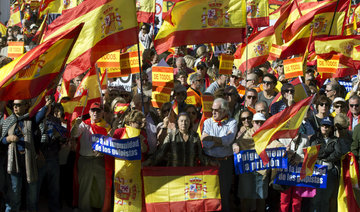
A man holds a banner reading in Spanish “Puigdemont go to prison” as nationalist activists protest during a mass rally against Catalonia’s declaration of independence, in Barcelona, Spain on Sunday, October 29, 2017. (File photo by AP)
Updated 29 October 2017
Follow

Belgium could offer Catalan leader asylum

BRUSSELS: Belgium could offer asylum to Catalan separatist leader Carles Puigdemont, the country’s immigration minister has suggested, as the Spanish political crisis rages.
Puigdemont was officially deposed by Madrid as president of the Calatan region on Friday after its parliament unilaterally declared independence from Spain, and now faces possible criminal charges of rebellion.
Belgian Immigration Minister Theo Francken, a member of the Flemish separatist N-VA party, questioned whether Puigdemont could be sure of a fair trial and said he could be given asylum in Belgium if he asked for it.
“It’s not unrealistic (that Belgium could protect Puigdemont), looking at the current situation,” Francken told Flemish-language broadcaster VTM on Saturday.
“Looking at the repression by Madrid and the jail sentences that are being proposed, the question can be asked whether he still has the chance for an honest court hearing.”
So far there has been no indication that Puidgemont will seek to leave Catalonia, and on Sunday his deputy insisted he “is and will remain” the president of the regional government.
The unprecedented Catalan crisis was triggered by a banned independence referendum on October 1 that was shunned by many, and marred by police violence, after which the regional parliament voted on Friday to declare independence from Spain.
Madrid dissolved the regional government in response and called an election to replace them, while the international community has spurned the independence declaration and united behind Spanish Prime Minister Mariano Rajoy.
There was trenchant support for Madrid from London, Paris, Berlin and the European Union, but Belgian Prime Minister Charles Michel — who governs in coalition with the separatist N-VA — gave a more measured response, calling for “a peaceful solution respecting the national and international order.”


Bondi Beach shooting suspect conducted firearms training with his father, Australian police say

Updated 57 min 50 sec ago
Follow

Bondi Beach shooting suspect conducted firearms training with his father, Australian police say

  • Naveed Akram and his father began their attack by throwing four improvised explosive devices toward a crowd celebrating an annual Jewish event at Bondi Beach, but the devices failed to explode, the documents said

MELBOURNE, Australia: A man accused of killing 15 people at Sydney’s Bondi Beach conducted firearms training in an area of New South Wales state outside of Sydney with his father, according to Australian police documents released on Monday.
The documents, made public following Naveed Akram’s video court appearance from a Sydney hospital where he has been treated for an abdominal injury, said the two men recorded footage justifying the meticulously planned attack.
Officers wounded Akram at the scene of the Dec. 14 shooting and killed his father, 50-year-old Sajid Akram.
The state government confirmed Naveed Akram was transferred Monday from a hospital to a prison. Authorities identified neither facility.
The 24-year-old and his father began their attack by throwing four improvised explosive devices toward a crowd celebrating an annual Jewish event at Bondi Beach, but the devices failed to explode, the documents said.
Police described the devices as three aluminum pipe bombs and a tennis ball bomb containing an explosive, gunpowder and steel ball bearings. None detonated, but police described them as “viable” IEDs.
The pair had rented a room in the Sydney suburb of Campsie for three weeks before they left at 2:16 a.m. on the day of the attack. CCTV recorded them carrying what police allege were two shotguns, a rifle, five IEDs and two homemade Daesh group flags wrapped in blankets.
Police also released images of the gunmen shooting from a footbridge, providing them with an elevated vantage point and the protection of waist-high concrete walls.
The largest IED was found after the gunbattle near the footbridge in the trunk of the son’s car, which had been left draped with the flags.
Authorities have charged Akram with 59 offenses, including 15 counts of murder, 40 counts of causing harm with intent to murder in relation to the wounded survivors and one count of committing a terrorist act.
The antisemitic attack at the start of the eight-day Hanukkah celebration was Australia’s worst mass shooting since a lone gunman killed 35 people in Tasmania state in 1996.
The New South Wales government introduced draft laws to Parliament on Monday that Premier Chris Minns said would become the toughest in Australia.
The new restrictions would include making Australian citizenship a condition of qualifying for a firearms license. That would have excluded Sajid Akram, who was an Indian citizen with a permanent resident visa.
Sajid Akram also legally owned six rifles and shotguns. A new legal limit for recreational shooters would be a maximum of four guns.
Police said a video found on Naveed Akram’s phone shows him with his father expressing “their political and religious views and appear to summarise their justification for the Bondi terrorist attack.”
The men are seen in the video “condemning the acts of Zionists” while they also “adhere to a religiously motivated ideology linked to Islamic State,” police said, using another term for the Daesh Group.
Video shot in October shows them “firing shotguns and moving in a tactical manner” on grassland surrounded by trees, police said.
“There is evidence that the Accused and his father meticulously planned this terrorist attack for many months,” police allege.
An impromptu memorial that grew near the Bondi Pavilion after the massacre, as thousands of mourners brought flowers and heartfelt cards, was removed Monday as the beachfront returned to more normal activity. The Sydney Jewish Museum will preserve part of the memorial.
Victims’ funerals continued Monday with French national Dan Elkayam’s service held in the nearby suburb of Woollahra, at the heart of Sydney’s Jewish life. The 27-year-old moved from Paris to Sydney a year ago.
The health department said 12 people wounded in the attack remained in hospitals on Monday.