Snap election not enough to solve crisis, Spain tells Catalan leader

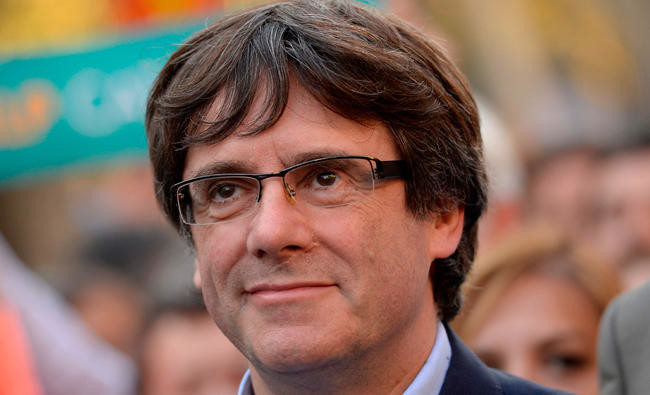
Catalan regional President Carles Puigdemont. (AFP)
Updated 24 October 2017
Follow

Snap election not enough to solve crisis, Spain tells Catalan leader

MADRID: Catalonia’s leader cannot solve its political crisis with Madrid just by calling regional elections, Spain’s justice minister said on Tuesday, dampening hopes of a quick fix for a dispute that has rattled investors and fractured the country.
The Spanish government says it will impose direct rule on Catalonia from Friday to counter an illegal independence push, invoking never-before-used powers to fire the government of the northeastern region that is critical to the country’s economy.
The Catalan Parliament will meet on Thursday to agree on a response to Madrid, something many analysts said could pave the way for a formal declaration of independence.
Secessionists in Catalonia say that an independence referendum held on Oct. 1 — which drew only a 43 percent turnout and was mostly shunned by Catalans who wish to remain in Spain — has accorded them a mandate to claim statehood.
Catalonia said on Monday it was confident all officials including police would defy attempts by Madrid to enforce direct rule, raising fears among Spain’s European allies of separatist contagion affecting other parts of the continent.
Spanish political leaders, influential business lobbies and most Catalonia newspapers have urged Puigdemont to call a regional election before he is stripped out of his authority.
They say direct rule from Madrid, which was the norm during the dictatorship of Francisco Franco, would be a humiliation for Catalonia and pose a serious risk of social and economic unrest.
Puigdemont has remained silent on the matter of elections. Some of his senior advisers have said holding a vote is a possibility while others have ruled it out. His pro-secession allies are also divided.
The Spanish government said a snap election would be a first step but Puigdemont would also have to withdraw an ambiguous declaration of independence he made earlier this month.
“When the government proposes an option so extreme as Article 155 (powers to cancel Catalonia’s autonomous status), it’s because we believe that there has been a serious failure by Puigdemont to meet his obligations,” Justice Minister Rafael Catala said during a radio interview.
“Everything is not fixed just by calling an election.”
Catala said that if Puigdemont appeared before the Spanish Senate, which plans to authorize direct rule on Friday, it would be a positive step in finding a solution to the conflict.
The Madrid government has refused to meet with the Catalan leader until he drops the call for independence, however, and Catala said any appearance by Puigdemont had to be within a legal and constitutional framework.
“If his appearance is within the constitution and the law we’ll be delighted... But if it’s just to ratify his position on Catalonia’s independence, sadly we will not be able to do anything else than continuing with the measures already set by the government,” said Catala.


Moscow made an offer to France regarding a French citizen imprisoned in Russia, says Kremlin

Updated 5 sec ago
Follow

Moscow made an offer to France regarding a French citizen imprisoned in Russia, says Kremlin

  • Laurent Vinatier, an adviser for Swiss-based adviser Center for Humanitarian Dialogue, Vinatier was arrested in Moscow in June 2024
  • He is accused of failing to register as a “foreign agent” while collecting information about Russia’s “military and military-technical activities” 

The Kremlin on Thursday said it was in contact with the French authorities over the fate of a French political scholar serving a three-year sentence in Russia and reportedly facing new charges of espionage.
Kremlin spokesman Dmitry Peskov told reporters that Russia has made “an offer to the French” regarding Laurent Vinatier, arrested in Moscow last year and convicted of collecting military information, and that “the ball is now in France’s court.” He refused to provide details, citing the sensitivity of the matter.
French President Emmanuel Macron is following Vinatier’s situation closely, his office said in a statement. French Foreign Ministry spokesperson Pascal Confavreux said Thursday that all government services are fully mobilized to pay provide consular support to Vinatier and push for his liberation as soon as possible.
Peskov’s remarks come after journalist Jérôme Garro of the French TF1 TV channel asked President Vladimir Putin during his annual news conference on Dec. 19 whether Vinatier’s family could hope for a presidential pardon or his release in a prisoner exchange. Putin said he knew “nothing” about the case, but promised to look into it.
Vinatier was arrested in Moscow in June 2024. Russian authorities accused him of failing to register as a “foreign agent” while collecting information about Russia’s “military and military-technical activities” that could be used to the detriment of national security. The charges carry a maximum penalty of five years in prison.
The arrest came as tensions flared between Moscow and Paris following French President Emmanuel Macron’s comments about the possibility of deploying French troops in Ukraine.
Vinatier’s lawyers asked the court to sentence him to a fine, but the judge in October 2024 handed him a three-year prison term — a sentence described as “extremely severe” by France’s Foreign Ministry, which called for the scholar’s immediate release.
Detentions on charges of spying and collecting sensitive data have become increasingly frequent in Russia and its heavily politicized legal system since Moscow invaded Ukraine in February 2022.
In addition to criticizing his sentence, the French Foreign Ministry urged the abolition of Russia’s laws on foreign agents, which subject those carrying the label to additional government scrutiny and numerous restrictions. Violations can result in criminal prosecution. The ministry said the legislation “contributes to a systematic violation of fundamental freedoms in Russia, like the freedom of association, the freedom of opinion and the freedom of expression.”
Vinatier is an adviser for the Center for Humanitarian Dialogue, a Switzerland-based nongovernmental organization, which said in June 2024 that it was doing “everything possible to assist” him.
While asking the judge for clemency ahead of the verdict, Vinatier pointed to his two children and his elderly parents he has to take care of.
The charges against Vinatier relate to a law that requires anyone collecting information on military issues to register with authorities as a foreign agent.
Human rights activists have criticized the law and other recent legislation as part of a Kremlin crackdown on independent media and political activists intended to stifle criticism of the war in Ukraine.
In August 2025, Russian state news agency Tass reported that Vinatier was also charged with espionage, citing court records but giving no details. Those convicted of espionage in Russia face between 10 and 20 years in prison.
Russia in recent years has arrested a number of foreigners — mainly US citizens — on various criminal charges and then released them in prisoner swaps with the United States and other Western nations. The largest exchange since the Cold War took place in August 2024, when Moscow freed journalists Evan Gershkovich and Alsu Kurmasheva, fellow American Paul Whelan, and Russian dissidents in a multinational deal that set two dozen people free.