

Hiroshima survivor to accept Nobel Peace Prize for nuclear watchdog

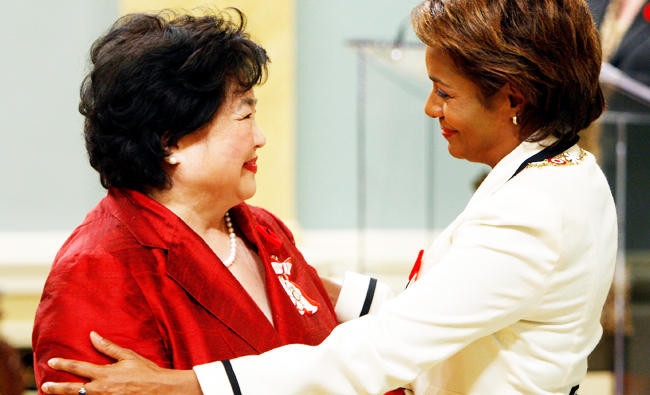
Setsuko Thurlow (L), a survivor of the Hiroshima atomic bombing, is congratulated after being awarded the rank of Member in the Order of Canada by Governor General Michaelle Jean at Rideau Hall in Ottawa, in this October 26, 2007 file photo. (Reuters)
Updated 28 October 2017
Follow

Hiroshima survivor to accept Nobel Peace Prize for nuclear watchdog

OTTAWA: Setsuko Thurlow was 13 years old and standing only a mile away from ground zero when the United States dropped an atomic bomb on the Japanese city of Hiroshima in 1945.
More than 62 years after that horrific day, she will jointly accept the Nobel Peace Prize on behalf of this year’s laureate, the International Campaign to Abolish Nuclear Weapons (ICAN), an organization in which she has played a major role.
“I remember a bluish-white flash. My body was flung into the air, and I remember a sensation of floating,” she said in an interview with AFP, describing the day of the bombing.
Thurlow suddenly found herself pinned under a collapsed building with dozens of others people. A stranger eventually pulled her out.
“The city I saw was almost indescribable,” she said.
It was 8:15 am in Hiroshima and the sun had been up for nearly two hours, yet darkness covered the ruins.
“It was like the morning had turned to night,” Thurlow said. “The dirt and particles from the mushroom cloud had prevented the sun’s rays from getting through.”
It was eerily quiet: “Nobody was yelling, nobody was running. Survivors didn’t have the physical or psychological strength. All they could muster was a faint whisper, begging for water.”
Thurlow said she looked around and saw thousands of people who were “badly burned and swollen. They no longer looked human. That image burned into my retina.”
“As a 13-year-old high school student, I witnessed my city destroyed. It had become a city of death.”
An estimated 140,000 people were killed in the atomic blast on August 6, 1945. Another 80,000 would die in the bombing of Nagasaki three days later.

Now 85 and living in Canada, Thurlow tells her story widely — to school children and diplomats alike — in order to bring attention to the horrors of nuclear war in the hope of stemming nuclear proliferation.
She has been a leading figure in ICAN since its launch in 2007 and played a pivotal role in the UN negotiations that led to a treaty outlawing nuclear weapons in July, the group said in a statement.
“I keep recalling these painful memories so that people who have never experienced such devastation can understand,” she said.
“It’s very difficult for many people to understand, but it’s extremely important that we use our ability to imagine (these horrors), and together we can stop this from ever happening again.”
Reflecting on the current state of affairs, Thurlow lamented the proliferation of nuclear weapons to nearly 15,000 since the World War II, although arsenals are down significantly from a peak in the mid-1980s.
“The world is a much more dangerous place now,” she said.
Thurlow condemned US President Donald Trump and North Korean leader Kim Jong-Un’s threats of war and personal insults that have sparked global alarm.
And she rebuked Canadian Prime Minister Justin Trudeau for not signing the Treaty on the Prohibition of Nuclear Weapons in July.
A spokesman for Canada’s foreign ministry said, “progress on nuclear disarmament and non-proliferation must involve states with nuclear weapons,” which Ottowa does not have.
The situation on the Korean peninsula, Thurlow said, “is very frightening, even for a person like me who experienced the first atomic bombing.”
“I’m very worried.”
The octogenarian urged citizens of the world to get involved in nuclear anti-proliferation efforts.
“We all have to do our part,” she said. “Don’t just leave it to the fading memories of Hiroshima and Nagasaki survivors.”
“No other human being should ever experience the violence of nuclear weapons. Never again.”


North Korea accuses South of another drone incursion

Updated 12 sec ago
Follow

North Korea accuses South of another drone incursion

  • The North Korean military tracked a drone “moving northwards” over the South Korean border county of Ganghwa
  • South Korea said it had no record of the flight

SEOUL: North Korea accused the South on Saturday of flying another spy drone over its territory this month, a claim that Seoul denied.
The North Korean military tracked a drone “moving northwards” over the South Korean border county of Ganghwa in early January before shooting it down near the North Korean city of Kaesong, a spokesperson said in a statement carried by the state-run Korean Central News Agency (KCNA).
“Surveillance equipment was installed” on the drone and analysis of the wreckage showed it had stored footage of the North’s “important targets” including border areas, the spokesperson said.
Photos of the alleged drone released by KCNA showed the wreckage of a winged craft lying on the ground next to a collection of grey and blue components it said included cameras.
South Korea said it had no record of the flight, and Defense Minister Ahn Gyu-back said the drone in the photos was “not a model operated by our military.”
The office of South Korean President Lee Jae Myung said a national security meeting would be held on Saturday to discuss the matter.
Lee had ordered a “swift and rigorous investigation” by a joint military-police investigative team, his office said in a later statement.
On the possibility that civilians operated the drone, Lee said: “if true, it is a serious crime that threatens peace on the Korean Peninsula and national security.”
Located northwest of Seoul, Ganghwa County is one of the closest South Korean territories to North Korea.
KCNA also released aerial images of Kaesong that it said were taken by the drone.
They were “clear evidence” that the aircraft had “intruded into (our) airspace for the purpose of surveillance and reconnaissance,” Pyongyang’s military spokesperson said.
They added that the incursion was similar to one in September when the South flew drones near its border city of Paju.
Seoul would be forced to “pay a dear price for their unpardonable hysteria” if such flights continued, the spokesperson said.
South Korea is already investigating alleged drone flights over the North in late 2024 ordered by then-President Yoon Suk Yeol. Seoul’s military has not confirmed those flights.
Prosecutors have indicted Yoon on charges that he acted illegally in ordering them, hoping to provoke a response from Pyongyang and use it as a pretext for his short-lived bid to impose martial law.

- Cheap, commercial drone -

Flight-path data showed the latest drone was flying in square patterns over Kaesong before it was shot down, KCNA said.
But experts said the cheap, commercially available model was unlikely to have come from Seoul’s armed forces.
“The South Korean military already has drones capable of transmitting high-resolution live feeds,” said Hong Min, an analyst at the Korea Institute for National Unification.
“Using an outdated drone that requires physical retrieval of a memory card, simply to film factory rooftops clearly visible on satellite imagery, does not hold up from a military planning perspective.”