

Hiroshima survivor to accept Nobel Peace Prize for nuclear watchdog

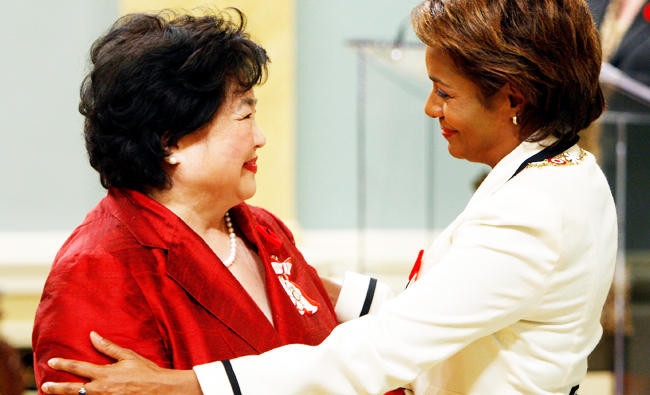
Setsuko Thurlow (L), a survivor of the Hiroshima atomic bombing, is congratulated after being awarded the rank of Member in the Order of Canada by Governor General Michaelle Jean at Rideau Hall in Ottawa, in this October 26, 2007 file photo. (Reuters)
Updated 28 October 2017
Follow

Hiroshima survivor to accept Nobel Peace Prize for nuclear watchdog

OTTAWA: Setsuko Thurlow was 13 years old and standing only a mile away from ground zero when the United States dropped an atomic bomb on the Japanese city of Hiroshima in 1945.
More than 62 years after that horrific day, she will jointly accept the Nobel Peace Prize on behalf of this year’s laureate, the International Campaign to Abolish Nuclear Weapons (ICAN), an organization in which she has played a major role.
“I remember a bluish-white flash. My body was flung into the air, and I remember a sensation of floating,” she said in an interview with AFP, describing the day of the bombing.
Thurlow suddenly found herself pinned under a collapsed building with dozens of others people. A stranger eventually pulled her out.
“The city I saw was almost indescribable,” she said.
It was 8:15 am in Hiroshima and the sun had been up for nearly two hours, yet darkness covered the ruins.
“It was like the morning had turned to night,” Thurlow said. “The dirt and particles from the mushroom cloud had prevented the sun’s rays from getting through.”
It was eerily quiet: “Nobody was yelling, nobody was running. Survivors didn’t have the physical or psychological strength. All they could muster was a faint whisper, begging for water.”
Thurlow said she looked around and saw thousands of people who were “badly burned and swollen. They no longer looked human. That image burned into my retina.”
“As a 13-year-old high school student, I witnessed my city destroyed. It had become a city of death.”
An estimated 140,000 people were killed in the atomic blast on August 6, 1945. Another 80,000 would die in the bombing of Nagasaki three days later.

Now 85 and living in Canada, Thurlow tells her story widely — to school children and diplomats alike — in order to bring attention to the horrors of nuclear war in the hope of stemming nuclear proliferation.
She has been a leading figure in ICAN since its launch in 2007 and played a pivotal role in the UN negotiations that led to a treaty outlawing nuclear weapons in July, the group said in a statement.
“I keep recalling these painful memories so that people who have never experienced such devastation can understand,” she said.
“It’s very difficult for many people to understand, but it’s extremely important that we use our ability to imagine (these horrors), and together we can stop this from ever happening again.”
Reflecting on the current state of affairs, Thurlow lamented the proliferation of nuclear weapons to nearly 15,000 since the World War II, although arsenals are down significantly from a peak in the mid-1980s.
“The world is a much more dangerous place now,” she said.
Thurlow condemned US President Donald Trump and North Korean leader Kim Jong-Un’s threats of war and personal insults that have sparked global alarm.
And she rebuked Canadian Prime Minister Justin Trudeau for not signing the Treaty on the Prohibition of Nuclear Weapons in July.
A spokesman for Canada’s foreign ministry said, “progress on nuclear disarmament and non-proliferation must involve states with nuclear weapons,” which Ottowa does not have.
The situation on the Korean peninsula, Thurlow said, “is very frightening, even for a person like me who experienced the first atomic bombing.”
“I’m very worried.”
The octogenarian urged citizens of the world to get involved in nuclear anti-proliferation efforts.
“We all have to do our part,” she said. “Don’t just leave it to the fading memories of Hiroshima and Nagasaki survivors.”
“No other human being should ever experience the violence of nuclear weapons. Never again.”


China overturns death sentence for Canadian in drug case

Updated 4 sec ago
Follow

China overturns death sentence for Canadian in drug case

TORONTO: China has overturned the death sentence of Canadian Robert Lloyd Schellenberg, a Canadian official told AFP Friday, in a possible sign of a diplomatic thaw as Prime Minister Mark Carney seeks to boost trade ties with Beijing.
Schellenberg’s lawyer Zhang Dongshuo, reached by AFP over the phone in Beijing on Saturday, confirmed the decision was announced Friday by China’s highest court.
Schellenberg was detained on drug charges in 2014 before China-Canada ties nosedived following the 2018 arrest in Vancouver of Huawei chief financial officer Meng Wanzhou.
That arrest infuriated Beijing, which detained two Canadians — Michael Spavor and Michael Kovrig — on espionage charges that Ottawa condemned as retaliatory.
Then, in January 2019, a court in northeast China retried Schellenberg, who was 36 at the time, sentencing him to death while declaring that his 15?year prison term for drug trafficking had been too lenient.
The court said he had been a central player in a scheme to ship narcotics to Australia, in a one-day retrial that Amnesty International called “a flagrant violation of international law.”
Schellenberg has denied wrongdoing.
The Canadian official requested anonymity in confirming the decision by China’s highest court to overturn Schellenberg’s death sentence.
Schellenberg, who has been held in northeastern Dalian since 2014, will be retried by the Liaoning High People’s Court, his lawyer Zhang said. The timing for the retrial has not yet been set.
Zhang said he met with Schellenberg in Dalian on Friday, and said the Canadian appeared relatively relaxed.
Carney, who took office last year, visited China in January as part of his global effort to broaden Canada’s export markets to reduce trade reliance on the United States.
“Global Affairs Canada (GAC) is aware of a decision issued by the Supreme People’s Court of the People’s Republic of China in Mr. Robert Schellenberg’s case,” foreign ministry spokesperson Thida Ith said in a statement sent to AFP.
Ith said the ministry “will continue to provide consular services to Mr. Schellenberg and to his family,” adding: “Canada has advocated for clemency in this case, as it does for all Canadians who are sentenced to the death penalty.”

New partners 

Key sectors of the Canadian economy have been hammered by US President Donald Trump’s tariffs, and Carney has said Canada can no longer count on the United States as a reliable trading partner.
Carney says that despite ongoing tensions, including allegations of Chinese interference in Canadian elections, Ottawa needs a functioning relationship with Beijing to safeguard its economic future.
When in Beijing last month, Carney met Chinese President Xi Jinping and heralded an improved era in relations — saying the two countries had struck a “new strategic partnership” and a preliminary trade deal.
Global Affairs Canada did not comment on whether diplomacy during Carney’s visit related to Schellenberg’s case impacted the Chinese court decision.
“Due to privacy considerations, no further information can be provided,” Ith said.
Schellenberg’s lawyer Zhang said Carney’s visit raised his hopes that the Chinese court would announce a relatively positive outcome for his client.
Meng, who had initially been charged with scheming to evade US sanctions on Iran, was freed in September 2021.
Spavor and Kovrig were released the same month.