Xi’s grip on China tightens with new term and no heir in sight

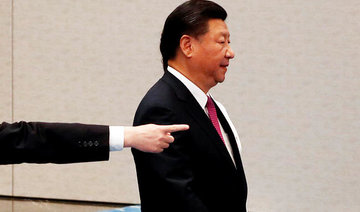
Chinese President Xi Jinping speaks as he introduces the Communist Party of China’s new Politburo Standing Committee, the nation’s top decision-making body at the Great Hall of the People in Beijing on October 25. (AFP)
Updated 25 October 2017
Follow

Xi’s grip on China tightens with new term and no heir in sight

BEIJING: President Xi Jinping was formally handed a second term Wednesday, with no clear successor emerging in a revamped ruling council, cementing his grip on power and setting the stage for him to dominate China for decades to come.
In a highly choreographed event, Xi led the new members of the elite Politburo Standing Committee in front of television cameras at Beijing’s massive Great Hall of the People after their selection by 204 party officials in a closed-door vote.
Xi, 64, secured a second five-year term as general secretary of the Communist Party after his eponymous political theory was enshrined in its constitution, giving him an inviolable mandate to rule and possibly positioning him to retain power for much longer.
He was also reappointed head of the country’s Central Military Commission.
Premier Li Keqiang, 62, retained his seat on the seven-member committee while five other men — all little known outside China — replaced comrades who had reached an informal retirement age of 68.
In a speech, as the other members stood expressionless in dark suits, Xi heralded a “new era” for the country under his rule and said the party “must get a new look and more importantly make new accomplishments.”
But the new ruling council looked decidedly old, raising doubts that any could succeed Xi.
“Xi Jinping doesn’t want to share power. He doesn’t want someone breathing down his neck, preparing the succession,” Jean-Pierre Cabestan, China specialist at Hong Kong Baptist University, told AFP.

“He wants to keep pressure on everybody and enjoy power for five or 10 years without having his hands tied.”
All the committee’s members are at least 60 years of age. Under the current rules, they would be too old to serve the customary two terms as the party’s leader at the next congress in 2022.
Xi was elevated to the committee in 2007, when he was 54, and succeeded Hu Jintao as general secretary and president five years later.
The new committee members are Xi confidant Li Zhanshu, 67, vice premier Wang Yang, 62, leading Communist Party theoretician Wang Huning, 62, party organization department head Zhao Leji, 60, and Shanghai party chief Han Zheng, 63.
Despite their promotion to the nation’s highest leadership circle, they are likely to have much less influence than their predecessors under a newly empowered Xi.
His reappointment capped a twice-a-decade congress of the Communist Party that gave him a freer hand to accomplish his ambition of turning China into a global superpower with a world-class military by mid-century.
The constitutional amendment, which the congress passed Tuesday, has put Xi in the rarefied company of the nation’s founder Mao Zedong, and Deng Xiaoping, the architect of its economic reforms.
“He will use this boost to push forward his ambitious agenda,” said Matthias Stepan of Germany’s Mercator Institute for China Studies.
“It will guarantee him a place in the history books.”
The accolade firmly establishes Xi as the country’s locus of power, potentially upending the collective model of leadership promoted by Deng and embraced by Xi’s two predecessors, Hu Jintao and Jiang Zemin, who both stepped down after two terms.


Trump set to repeal scientific finding that serves as basis for US climate change policy

Updated 7 sec ago
Follow

Trump set to repeal scientific finding that serves as basis for US climate change policy

  • The endangerment finding is the legal underpinning of nearly all climate regulations under the Clean Air Act for motor vehicles, power plants and other pollution sources that are heating the planet

WASHINGTON: The Trump administration on Thursday will revoke a scientific finding that long has been the central basis for US action to regulate greenhouse gas emissions and fight climate change, the White House announced.
The Environmental Protection Agency will issue a final rule rescinding a 2009 government declaration known as the endangerment finding. That Obama-era policy determined that carbon dioxide and other greenhouse gases endanger public health and welfare.
President Donald Trump and EPA Administrator Lee Zeldin will “formalize the rescission of the 2009 Obama-era endangerment finding” at a White House ceremony, White House press secretary Karoline Leavitt said Tuesday.
The action “will be the largest deregulatory action in American history, and it will save the American people $1.3 trillion in crushing regulations,” she said. The bulk of the savings will stem from reduced costs for new vehicles, with the EPA projecting average per vehicle savings of more than $2,400 for popular light-duty cars, SUVs and trucks. Leavitt said.
The endangerment finding is the legal underpinning of nearly all climate regulations under the Clean Air Act for motor vehicles, power plants and other pollution sources that are heating the planet. It is used to justify regulations, such as auto emissions standards, intended to protect against threats made increasingly severe by climate change — deadly floods, extreme heat waves, catastrophic wildfires and other natural disasters in the United States and around the world.
Legal challenges would be certain for any action that effectively would repeal those regulations, with environmental groups describing the shift as the single biggest attack in US history on federal efforts to address climate change.
EPA press secretary Brigit Hirsch said the Obama-era rule was “one of the most damaging decisions in modern history” and said EPA “is actively working to deliver a historic action for the American people.”
Trump, who has called climate change a “hoax,” previously issued an executive order that directed EPA to submit a report on “the legality and continuing applicability” of the endangerment finding. Conservatives and some congressional Republicans have long sought to undo what they consider overly restrictive and economically damaging rules to limit greenhouse gases that cause global warming.
Zeldin, a former Republican congressman who was tapped by Trump to lead EPA last year, has criticized his predecessors in Democratic administrations, saying they were “willing to bankrupt the country” in an effort to combat climate change.
Democrats “created this endangerment finding and then they are able to put all these regulations on vehicles, on airplanes, on stationary sources, to basically regulate out of existence ... segments of our economy,″ Zeldin said in announcing the proposed rule last July. ”And it cost Americans a lot of money.”
Peter Zalzal, a lawyer and associate vice president of the Environmental Defense Fund, countered that the EPA will be encouraging more climate pollution, higher health insurance and fuel costs and thousands of avoidable premature deaths.
Zeldin’s push “is cynical and deeply damaging, given the mountain of scientific evidence supporting the finding, the devastating climate harms Americans are experiencing right now and EPA’s clear obligation to protect Americans’ health and welfare,” he said.
Zalzal and other critics noted that the Supreme Court ruled in a 2007 case that planet-warming greenhouse gases, caused by burning of oil and other fossil fuels, are air pollutants under the Clean Air Act.
Since the high court’s decision, in a case known as Massachusetts v. EPA, courts have uniformly rejected legal challenges to the endangerment finding, including a 2023 decision by the US Court of Appeals for the District of Columbia Circuit.
Following Zeldin’s proposal to repeal the rule, the National Academies of Sciences, Engineering, and Medicine reassessed the science underpinning the 2009 finding and concluded it was “accurate, has stood the test of time, and is now reinforced by even stronger evidence.”
Much of the understanding of climate change that was uncertain or tentative in 2009 is now resolved, the NAS panel of scientists said in a September report. “The evidence for current and future harm to human health and welfare created by human-caused greenhouse gases is beyond scientific dispute,” the panel said.