Trump set to repeal scientific finding that serves as basis for US climate change policy

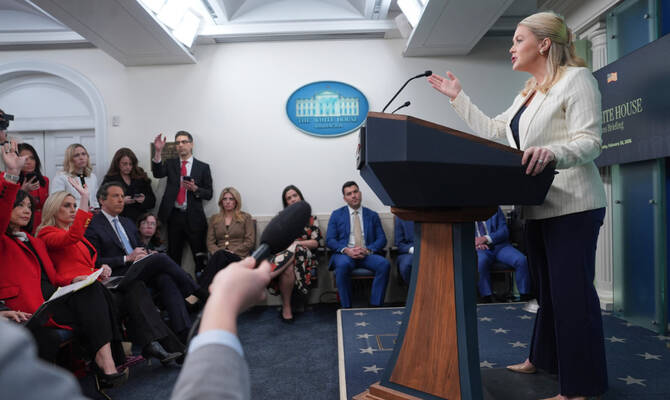
White House press secretary Karoline Leavitt speaks during a briefing at the White House, Tuesday, Feb. 10, 2026, in Washington. (AP)
Short Url
Updated 11 February 2026
Follow

Trump set to repeal scientific finding that serves as basis for US climate change policy

  • The endangerment finding is the legal underpinning of nearly all climate regulations under the Clean Air Act for motor vehicles, power plants and other pollution sources that are heating the planet

WASHINGTON: The Trump administration on Thursday will revoke a scientific finding that long has been the central basis for US action to regulate greenhouse gas emissions and fight climate change, the White House announced.
The Environmental Protection Agency will issue a final rule rescinding a 2009 government declaration known as the endangerment finding. That Obama-era policy determined that carbon dioxide and other greenhouse gases endanger public health and welfare.
President Donald Trump and EPA Administrator Lee Zeldin will “formalize the rescission of the 2009 Obama-era endangerment finding” at a White House ceremony, White House press secretary Karoline Leavitt said Tuesday.
The action “will be the largest deregulatory action in American history, and it will save the American people $1.3 trillion in crushing regulations,” she said. The bulk of the savings will stem from reduced costs for new vehicles, with the EPA projecting average per vehicle savings of more than $2,400 for popular light-duty cars, SUVs and trucks. Leavitt said.
The endangerment finding is the legal underpinning of nearly all climate regulations under the Clean Air Act for motor vehicles, power plants and other pollution sources that are heating the planet. It is used to justify regulations, such as auto emissions standards, intended to protect against threats made increasingly severe by climate change — deadly floods, extreme heat waves, catastrophic wildfires and other natural disasters in the United States and around the world.
Legal challenges would be certain for any action that effectively would repeal those regulations, with environmental groups describing the shift as the single biggest attack in US history on federal efforts to address climate change.
EPA press secretary Brigit Hirsch said the Obama-era rule was “one of the most damaging decisions in modern history” and said EPA “is actively working to deliver a historic action for the American people.”
Trump, who has called climate change a “hoax,” previously issued an executive order that directed EPA to submit a report on “the legality and continuing applicability” of the endangerment finding. Conservatives and some congressional Republicans have long sought to undo what they consider overly restrictive and economically damaging rules to limit greenhouse gases that cause global warming.
Zeldin, a former Republican congressman who was tapped by Trump to lead EPA last year, has criticized his predecessors in Democratic administrations, saying they were “willing to bankrupt the country” in an effort to combat climate change.
Democrats “created this endangerment finding and then they are able to put all these regulations on vehicles, on airplanes, on stationary sources, to basically regulate out of existence ... segments of our economy,″ Zeldin said in announcing the proposed rule last July. ”And it cost Americans a lot of money.”
Peter Zalzal, a lawyer and associate vice president of the Environmental Defense Fund, countered that the EPA will be encouraging more climate pollution, higher health insurance and fuel costs and thousands of avoidable premature deaths.
Zeldin’s push “is cynical and deeply damaging, given the mountain of scientific evidence supporting the finding, the devastating climate harms Americans are experiencing right now and EPA’s clear obligation to protect Americans’ health and welfare,” he said.
Zalzal and other critics noted that the Supreme Court ruled in a 2007 case that planet-warming greenhouse gases, caused by burning of oil and other fossil fuels, are air pollutants under the Clean Air Act.
Since the high court’s decision, in a case known as Massachusetts v. EPA, courts have uniformly rejected legal challenges to the endangerment finding, including a 2023 decision by the US Court of Appeals for the District of Columbia Circuit.
Following Zeldin’s proposal to repeal the rule, the National Academies of Sciences, Engineering, and Medicine reassessed the science underpinning the 2009 finding and concluded it was “accurate, has stood the test of time, and is now reinforced by even stronger evidence.”
Much of the understanding of climate change that was uncertain or tentative in 2009 is now resolved, the NAS panel of scientists said in a September report. “The evidence for current and future harm to human health and welfare created by human-caused greenhouse gases is beyond scientific dispute,” the panel said.


Trump revokes basis of US climate regulation, ends vehicle emission standards

Updated 3 sec ago
Follow

Trump revokes basis of US climate regulation, ends vehicle emission standards

  • US president repeals finding that greenhouse gas emissions endanger human health
  • It ‌is most weeping climate change policy rollback by the administration to date
WASHINGTON: The administration of President Donald Trump on Thursday announced the repeal of a scientific finding that greenhouse gas emissions endanger human health, and eliminated federal tailpipe emissions standards for cars and trucks.
It is the most sweeping climate change policy rollback by the administration to date, after a string of regulatory cuts and other moves intended to unfetter fossil fuel development and stymie the rollout of clean energy.
“Under the process just completed by the EPA, we are officially terminating the so-called endangerment finding, a disastrous Obama-era policy that severely damaged the American auto industry and drove up prices for American consumers,” Trump said, saying it was the biggest deregulatory action in US history.
The Environmental Protection Agency said in a press release the endangerment finding had relied on an incorrect interpretation of federal clean air laws meant to protect Americans from pollutants that do harm through local or regional exposure, not through warming the global climate.
“This flawed legal theory took the agency outside the scope of its statutory authority in multiple respects,” it said. Trump announced the repeal beside EPA Administrator Lee Zeldin and White House budget director Russ Vought, who has long sought to revoke the finding and was a key architect of conservative policy blueprint Project 2025. Trump has said he believes climate change is a “con job,” and has withdrawn the United States from the Paris Agreement, leaving the world’s largest historic contributor to global warming out of international efforts to combat it. He has also signed ‌legislation killing Biden-era tax ‌credits aimed at accelerating deployment of electric cars and renewable energy.
Former President Barack Obama blasted the move on X, saying without ‌the endangerment ⁠finding, “we’ll be ⁠less safe, less healthy and less able to fight climate change — all so the fossil fuel industry can make even more money.”
“Holy grail”
Zeldin said the Trump administration took on the most consequential climate policy of the last 15 years, something that the agency avoided during his first term amid industry concern about legal and regulatory uncertainty.
“Referred to by some as the holy grail of federal regulatory overreach, the 2009 Obama EPA endangerment finding is now eliminated,” he said.
The endangerment finding was first adopted by the United States in 2009, and led the EPA to take action under the Clean Air Act of 1963 to curb emissions of carbon dioxide, methane, and four other heat-trapping air pollutants from vehicles, power plants and other industries.
It came about after the Supreme Court ruled in 2007 in the Massachusetts vs. EPA case that the agency has authority to regulate carbon dioxide and other greenhouse gas emissions under the Clean Air Act.
Its repeal would remove the regulatory requirements to measure, report, certify, and comply ⁠with federal greenhouse gas emission standards for cars, but may not initially apply to stationary sources such as power plants.
The transportation and ‌power sectors are each responsible for around a quarter of US greenhouse gas output, according to EPA figures.
The EPA said ‌the repeal and end of vehicle emission standards will save US taxpayers $1.3 trillion, while the prior administration said the rules would have net benefits to consumers through lower fuel costs and other savings.
The Alliance ‌for Automotive Innovation, representing major automakers, did not endorse the action but said “automotive emissions regulations finalized in the previous administration are extremely challenging for automakers to achieve given the current ‌marketplace demand for EVs.”
The Environmental Defense Fund said that the repeal will end up costing Americans more, despite EPA’s statement that climate regulations have driven up costs for consumers.
“Administrator Lee Zeldin has directed EPA to stop protecting the American people from the pollution that’s causing worse storms, floods, and skyrocketing insurance costs,” said EDF President Fred Krupp. “This action will only lead to more of this pollution, and that will lead to higher costs and real harms for American families.” Under former President Joe Biden, the EPA aimed to cut passenger vehicle fleetwide tailpipe emissions by nearly 50 percent by 2032 compared with 2027 projected levels and forecast ‌between 35 percent and 56 percent of new vehicles sold between 2030 and 2032 would need to be electric.
The agency then estimated that the rules would result in net benefits of $99 billion annually through 2055, including $46 billion in reduced fuel costs, and $16 billion in ⁠reduced maintenance and repair costs for drivers.
Consumers were expected ⁠to save an average of $6,000 over the lifetime of new vehicles from reduced fuel and maintenance costs.
The coal industry celebrated the announcement on Thursday saying it would help stave off retirements of aging coal-fired power plants.
“Utilities have announced plans to retire more than 55,000 megawatts of coal-fired generation over the next five years. Reversing these retirement decisions could help offset the need to build new, more expensive electricity sources and prevent the loss of reliability attributes, such as fuel security, that the coal fleet provides,” said America’s Power President and CEO Michelle Bloodworth.
Uncertainty unbound
While many industry groups back the repeal of stringent vehicle emission standards, others have been reluctant to show public support for rescinding the endangerment finding because of the legal and regulatory uncertainty it could unleash. Legal experts said the policy reversal could, for example, lead to a surge in lawsuits known as “public nuisance” actions, a pathway that had been blocked following a 2011 Supreme Court ruling that GHG regulation should be left in the hands of the Environmental Protection Agency instead of the courts.
“This may be another classic case where overreach by the Trump administration comes back to bite it,” said Robert Percival, a University of Maryland environmental law professor.
Environmental groups have slammed the proposed repeal as a danger to the climate. Future US administrations seeking to regulate greenhouse gas emissions likely would need to reinstate the endangerment finding, a task that could be politically and legally complex.
But environmental groups are confident that the courts will continue their track record of backing the EPA’s authority to use the Clean Air Act to regulate greenhouse gases.
Several environmental groups, including the Natural Resources Defense Council and Earthjustice, have said they will challenge the reversal in court, setting off what could be a years-long legal battle up to the Supreme Court.
“There’ll be a lawsuit brought almost immediately, and we’ll see in them in court. And we will win,” said David Doniger, senior attorney at the NRDC.