Spain gives Catalan leader 8 days to drop independence

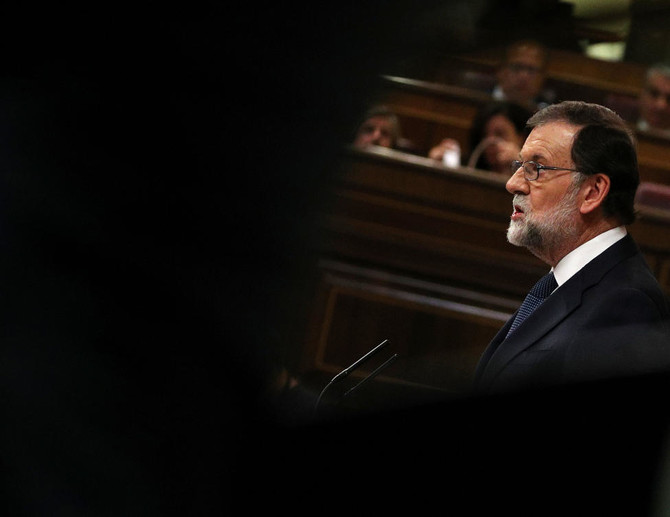
Prime Minister Mariano Rajoy told Spain’s parliament the Catalan government had until Monday, October 16 at 0800 GMT to answer. (Reuters)
Updated 12 October 2017
Follow

Spain gives Catalan leader 8 days to drop independence

MADRID/BARCELONA: Spanish Prime Minister Mariano Rajoy on Wednesday gave the Catalan government eight days to drop an independence bid, failing which he would suspend Catalonia’s political autonomy and rule the region directly.
His move could deepen the confrontation between Madrid and the northeastern region but also signals a way out of Spain’s biggest political crisis since a failed military coup in 1981.
Rajoy would probably call a snap regional election after activating Article 155 of the constitution that would allow him to sack the Catalan regional government.
Catalan leader Carles Puigdemont issued a symbolic declaration of independence from Spain on Tuesday night but then immediately suspended it and called for negotiations with the Madrid government.
“The cabinet has agreed this morning to formally request the Catalan government to confirm whether it has declared the independence of Catalonia, regardless of the deliberate confusion created over its implementation,” Rajoy said in a televised address after a cabinet meeting called to consider the government’s response.
He later told Spain’s parliament the Catalan government had until Monday, October 16 at 0800 GMT to answer. If Puigdemont was to confirm he did declare independence, he would be given an additional three days to rectify it, until Thursday, October 19 at 0800 GMT. Failing this, Article 155 would be triggered.
It is not yet clear if the Catalan government will answer the requirement but it now faces a conundrum, analysts say.
If Puigdemont says he did proclaim independence, the central government will step in. If he says he did not declare it, then far-left party CUP would probably withdraw its support for his minority government.
“Rajoy has two objectives: if Puigdemont remains ambiguous, the pro-independence movement will get more fragmented; if Puigdemont insists on defending independence then Rajoy will be able to apply Article 155,” said Antonio Barroso, deputy director of the London-based research firm Teneo Intelligence.
“Either way, Rajoy’s aim would be to first restore the rule of law in Catalonia and this could at some point lead to early elections in the region.”
The stakes are high — losing Catalonia, which has its own language and culture, would deprive Spain of a fifth of its economic output and more than a quarter of exports.
Puigdemont had been widely expected to unilaterally declare Catalonia’s independence on Tuesday after the Catalan government said 90 percent of Catalans had voted for a breakaway in an October 1 referendum. Central authorities in Madrid had declared the referendum illegal and most opponents of independence boycotted it, reducing turnout to around 43 percent.
Madrid responded angrily to Puigdemont’s speech to Catalonia’s parliament, saying his government could not act on the results of the referendum.
“Neither Mr. Puigdemont nor anyone else can claim, without returning to legality and democracy, to impose mediation... Dialogue between democrats takes place within the law,” Deputy Prime Minister Soraya Saenz de Santamaria said.


Trump insists he struck Iran on his own terms

Updated 04 March 2026
Follow

Trump insists he struck Iran on his own terms

  • “We are now a nation divided between those who want to fight wars for Israel and those who just want peace and to be able to afford their bills and health insurance,” Marjorie Taylor Greene posted on X.
  • Rubio himself doubled down on Tuesday after meeting with US House and Senate members, while insisting that “No, I told you this had to happen anyway”

WASHINGTON, United States: President Donald Trump and his team scrambled Tuesday to reclaim the narrative on why he decided to attack Iran, after his top diplomat suggested the US struck only after learning of an imminent Israeli strike.
Secretary of State Marco Rubio alarmed Democrats — who say only Congress can declare war — as well as many of Trump’s MAGA supporters on Monday when he said: “We knew that there was going to be an Israeli action.”
“We knew that that would precipitate an attack against American forces, and we knew that if we didn’t pre-emptively go after them before they launched those attacks, we would suffer higher casualties,” Rubio told reporters.
Administration officials quickly backpedalled, insisting Trump authorized the strikes because Tehran was not seriously negotiating an accord on limiting its nuclear ambitions, and the United States needed to destroy Iran’s missile capabilities.
“No, Marco Rubio Didn’t Claim That Israel Dragged Trump into War with Iran,” White House Press Secretary Karoline Leavitt posted Tuesday on X.
At an Oval Office meeting later with Germany’s chancellor, Trump went further, saying that “Based on the way the negotiation was going, I think they (Iran) were going to attack first. And I didn’t want that to happen.”
“So, if anything, I might have forced Israel’s hand.”

- Had to happen? -

Rubio himself doubled down on Tuesday after meeting with US House and Senate members, while insisting that “No, I told you this had to happen anyway.”
“The president made a decision. The decision he made was that Iran was not going to be allowed to hide... behind this ability to conduct an attack.”
Critics seized on the muddied messaging to accuse Trump of precipitating the country into a war without a clear rationale, without informing Congress — and without a clear idea of how it might end.
They noted that just two weeks ago, Israel Prime Minister Benjamin Netanyahu pressed Trump again in Washington to take a hard line, in their seventh meeting since Trump’s return to power last year.
Some Republican allies rallied behind the president, with Senator Tom Cotton, chairman of the Senate Intelligence Committee, insisting that “No one pushes or drags Donald Trump anywhere.”
“He acts in the vital national security interest of the United States,” Cotton told the “Fox & Friends” morning show.
But as crucial US midterm elections approach that could see Republicans lose their congressional majority, Trump risks shedding supporters who had welcomed his pledge to end foreign military interventions.
“We are now a nation divided between those who want to fight wars for Israel and those who just want peace and to be able to afford their bills and health insurance,” Marjorie Taylor Greene, a top former Trump ally and a major figure in the populist and isolationist hard right, posted on X.