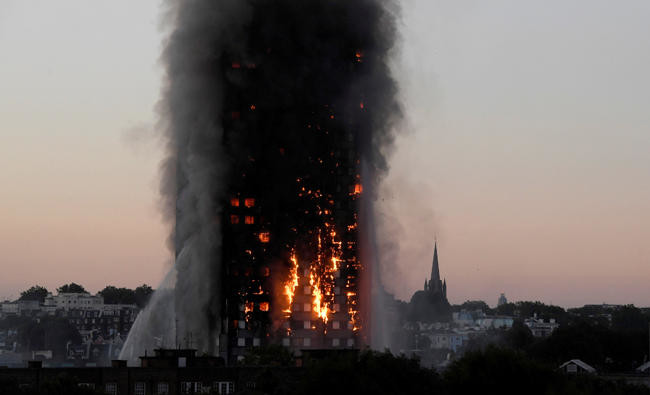
LONDON: Insurers are considering raising premiums for tall buildings in Britain with flammable cladding panels and no sprinklers or even excluding related risks following the Grenfell fire in London earlier this year.
Inquiries into the tragedy, which killed up to 80 people in the 24-story social housing block in June, are expected to take several years, but property insurers are not waiting for that, or for subsequent changes to the law.
While they cannot change existing insurance cover, renewals, many of which fall due in Jan or April 2018, will give them a chance to adjust prices or policy wordings to mitigate their risks.
Grenfell was coated with combustible panels and had no sprinklers, two factors which experts have said helped the fire to spread. The building’s Norwegian insurer Protector estimated gross property and liability insurance claims of £50 million ($65.87 million).
The type of cladding used on Grenfell Tower and many other buildings has failed government safety tests following the fire and some insurers are now reluctant to cover them, industry experts say, particularly for buildings under construction.
“We have seen some draft exclusions, or partial exclusions, for claims in respect of cladding used on tall buildings where it does not comply with building regulations,” Andrew Rose, claims specialist at insurance broker Miller, told a recent industry briefing.
Rose added this was “something which certain insurers have put forward in relation to their renewals for construction operations,” without specifying the insurers.
Insurers who spoke to Reuters, however, said they were not planning to exclude cladding.
“We should not be relying on exclusions, we should be looking at the property, giving advice, making recommendations,” David Williams, technical director at AXA said. AXA is one of the biggest insurers of large properties in Britain. Others include FM Global, Zurich, Allianz and Aviva.
Williams said AXA had upgraded its administration so that information on the number of tall buildings it insures or the type of cladding they are using is more easily available, helping to identify risks quickly.
Zurich Municipal has recommended its clients review their fire risk assessments and said its “strong recommendation” was the use of fire resistant or non-combustible insulation.
“We will not be withdrawing any existing cover for our customers,” said Allison Whittington, head of housing at Zurich Municipal, adding that the firm would work with customers “to help them manage these exposures.”
Building regulations do not set proscribed standards, lawyers say, leading to greater uncertainty over how to implement the regulations following the fire.
“Interpretation of the building regulations will change,” Catherine Gelder, partner at law firm Berwin Leighton Paisner, told the same briefing.
The Association of British Insurers (ABI), which warned of the dangers of cladding made from combustible material in May, a month before the Grenfell fire, called last week for an immediate end to its use on new and refurbished buildings.
Insurers have also commissioned the Fire Protection Association, Britain’s national fire safety organization, to examine issues including cladding and sprinklers in residential buildings.
Excluding such cladding from policies was one option for insurers, along with other options such as raising premiums, John Ludlow, chief executive of UK insurance buyers’ group Airmic said.
“There are different ways the insurers will deal with cladding — all are justified,” he said. “If you have a property you need to make sure you are responsible — you need to deal with it.”
Insurers previously looked at cladding in the context of overall fire safety, so the risks of combustible cladding panels could be mitigated by other positive factors such as well-fitting fire doors and ample fire escapes.
Insurers and their clients will now be looking more closely at cladding specifically, said Peter Wallace, construction underwriter at Castel Underwriting Agencies.
“We will be drilling down, checking, is this OK?“
Insurers could ask landlords to take down inappropriate cladding at their own expense to improve the safety of their buildings, a move which would cut premiums.
“It definitely affects pricing — it can be cost-effective,” Williams at AXA said.
In contrast, if insurers were unhappy with the level of information they received from clients or the efforts they were making to improve safety, prices could rise, said Jason Cash, divisional director at insurance broker Howden.
“Comments which insurers make will probably be listened to in more detail now than they were before,” he said.
Sprinklers are also a priority for insurers, and instaling them, even into older buildings, can cut premiums.
Chris Johnson, executive vice president at specialist property insurer FM Global, said the cost of fitting sprinklers was “the same as the cost of a well-fitted carpet and underlay, which provides protection and support.”


![]()
UK insurers review tower premiums after Grenfell blaze cladding fears
UK insurers review tower premiums after Grenfell blaze cladding fears
Latest updates





© 2026 SAUDI RESEARCH & PUBLISHING COMPANY, All Rights Reserved And subject to Terms of Use Agreement.