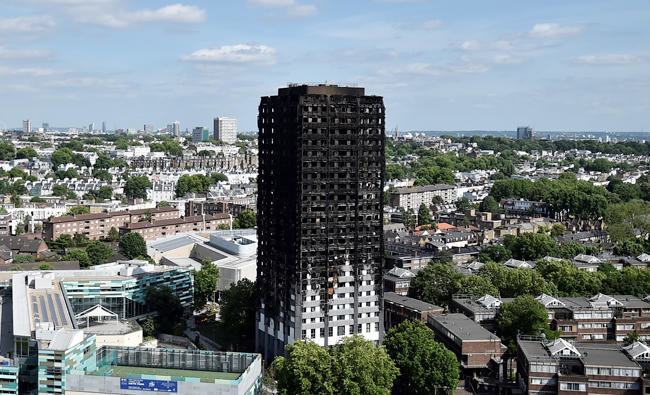
LONDON: The Grenfell Tower blaze has triggered a flurry of building inspections in the UK, but it is the cities of the Gulf region that contain the biggest concentration of the deadly cladding panels that fueled the blaze.
It took the deaths of at least 80 people in a London tower block, among them Arabs fleeing war and terror in the hope of a better life, for the world to wake up to the dangers posed by panels packed with highly flammable plastic material.
But the real lessons need to be learned in the modern capitals of the Gulf, where aluminum-clad buildings form the vast majority of those completed in the last decade.
“These buildings should first of all be identified so the authorities are aware of their location and where high-risk issues may lie,” said Craig Ross, head of project and building consultancy at Cavendish Maxwell. “Each building should then be individually audited so the unique risks are exposed and understood.”
There are thousands of skyscrapers across the Middle East that are covered with panels that will burn with ferocious speed when ignited by a stray cigarette, an abandoned shisha coal, or an electrical short circuit.
Cladding blazes are instantly recognizable because of the speed with which the flames travel in a strip up or down a building. Witnesses tend to reveal their shock at the speed with which the fires spread.
They describe buildings as being lit up like “candles” or “fireworks.” It took just a few minutes on New Year’s Eve in 2015 for a fire to leap dozens of stories at the Address Downtown Dubai hotel. That was beamed live to millions of viewers around the world and triggered a number of changes to fire regulations in the UAE.
However, dozens of less eye-catching cladding blazes in previous years went largely unreported beyond local media organizations.
The fire industry may also have been lulled into a false sense of security by the nature of exterior cladding fires, which until Grenfell tended not to be associated with large numbers of casualties — because they affect building exteriors first.
Wulf Binder, a now retired cladding consultant from Germany, was among those experts who have been warning about the dangers posed by plastic-filled cladding for many years.
In a 2007 interview with the Dubai-based journal Construction Week, he pointed out that a 5000 square meters building facade covered with cladding is the equivalent of 19,000 liters of fuel — almost the capacity of two fuel tanker trucks. And just 1 kilo of polyethylene can generate 2,300 cubic meters of toxic smoke.
Local authorities in London used the panels to beautify and modernize the 1960s and 1970s-built eyesore tower blocks with smooth and sleek exteriors, highlighting the tragic architectural folly of choosing form over function.
In the Gulf, the panels were specified on new buildings rather than old, but also for largely the same aesthetic reasons.
While the causes and circumstances of each cladding fire are unique, the broader narrative remains the same. The cost difference between a panel that will burn and one that will not is often just a few dollars say manufacturers, but as they tend to be specified late in the project life cycle when costs may have already overrun, the cheapest products are usually the ones selected.
Both the UAE and Saudi Arabia have introduced measures to limit the risk posed by combustible cladding but the real challenge in both countries is to ensure they are implemented and enforced.
While in the UK the problem may be measured in dozens of buildings, countries such as the UAE, Saudi Arabia and Qatar must contemplate a solution for hundreds of aluminum composite panel-clad buildings — many less than a decade old.
Saudi Arabia this year told building owners to replace combustible cladding within a year. Owners must sign an undertaking to replace the material on the renewal of their trade licenses. At the same time, owners of buildings under construction must stop using such cladding and cannot get a trade license until obtaining a certificate showing that the materials used are fire retardant.
The Saudi Arabian Monetary Agency (SAMA) has also published a circular warning insurers that they must obtain a valid Civil Defense license before placing cover.
In cases where a license has not been provided, the policy should contain a warranty requiring the policyholder to get one within three months or risk suspension of cover, says Clyde & Co., a legal firm, in a briefing note to clients.
One of the quickest and most comprehensive responses to a cladding blaze occurred in Australia following the Lacrosse Apartments blaze in Melbourne on Nov. 25, 2014.
The Victorian Building Authority identified and audited some 170 buildings and found that about half of them had non-compliant cladding.
The Grenfell fire revived concerns about fire safety in tall buildings and triggered more investigations by municipal authorities in Australia and New Zealand.
“In New Zealand, all territorial authorities have been ordered to audit their buildings and in the state of Victoria in Australia, our minister has also ordered to fast track building audits,” said Dr. Tony Enright, a Melbourne-based expert on cladding fires.
“I know that funds and building owners with large portfolios of high-rise residential here in Australia have sat up very quickly and are paying attention.”
Yet many consultants, lawyers and insurers privately express doubts about the political or financial will to face the financial reality of replacing the facades of hundreds of high-rise buildings and the ruinously expensive costs involved.
It was because of money these deadly panels were used in the first place and it may be because of money that many are likely to remain on the sides of high-rise buildings worldwide — long after the memories of the Grenfell tragedy fades in the public consciousness.


![]()
Grenfell highlights Gulf cladding time bomb
Grenfell highlights Gulf cladding time bomb
Latest updates


Recommended


© 2026 SAUDI RESEARCH & PUBLISHING COMPANY, All Rights Reserved And subject to Terms of Use Agreement.