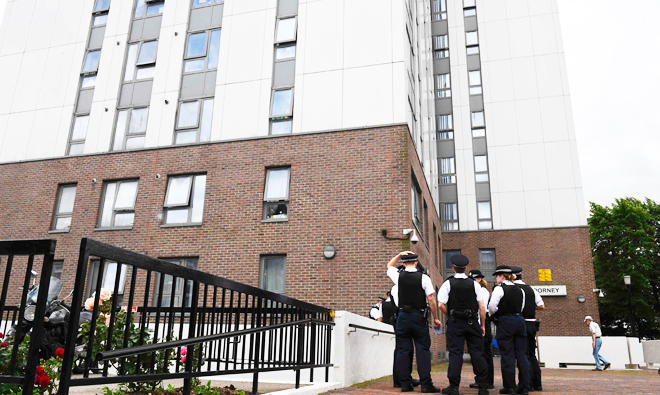
LONDON: Britain’s government urged local officials across the country Sunday to urgently submit samples of tower block cladding after tests found that all samples tested so far have failed fire safety standards.
In London, officials tried to complete the evacuation of hundreds of apartments in four towers deemed unsafe, but faced resistance as several families refused to budge.
The government has collected 34 samples of external cladding — panels widely used to insulate buildings and improve their appearance — and all failed a “combustibility test,” Community Secretary Sajid Javid said. The national testing was ordered after a June 14 fire engulfed Grenfell Tower in London, killing at least 79 people. The tower’s cladding was believed to have rapidly spread that blaze.
The samples came from 17 different locations around the country, including London, Manchester, Plymouth and Portsmouth.
A public inquiry is due to determine how the unsafe cladding was allowed to be fitted onto Grenfell in the first place.
In north London, Camden Council ordered residents at Chalcots Estate to leave some 600 apartments late Friday as a precaution after fire inspectors found problems with the blocks’ fire doors and gas pipes. The council said those issues, combined with the flammable cladding that encased the buildings, meant residents had to leave immediately.
Now hundreds of residents face up to four weeks in temporary accommodations as workers try to upgrade the buildings’ fire safety features. Around 20 families wanted to stay put, but council leader Georgia Gould say they must leave.
Refurbishment of the Chalcots towers was overseen by Rydon, the same company involved in the recent renovation of the now-devastated Grenfell Tower.
London Mayor Sadiq Khan backed Camden Council’s decision to evacuate the apartment blocks.
“I think they’ve done the right thing. Look, you’ve got to err on the side of caution. You can’t play Russian roulette with people’s safety,” he told Sky News.

UK officials: All building cladding samples tested failed fire safety
Vietnam’s ruling Communist Party re-elects To Lam as general secretary
HANOI: Vietnam’s leader To Lam was re-elected Friday as the general secretary of its ruling Communist Party, securing a new five-year term in the country’s most powerful position and pledging to rev up economic growth in the export powerhouse.
Lam, 68, was reappointed unanimously by the party’s 180-member Central Committee at the conclusion of the National Party Congress, the country’s most important political conclave.
In a speech, he said he wanted to build a system grounded in “integrity, talent, courage, and competence,” with officials to be judged on merit rather than seniority or rhetoric.
No announcement was made about whether Lam will also become president. If he were to get both positions, he would be the country’s most powerful leader in decades, similar to Chinese leader Xi Jinping.
The Congress was framed by Vietnam’s defining national question: whether the country can transform itself into a high-income economy by 2045. During the meeting, Vietnam set a target of average annual GDP growth of 10 percent or more from 2026 to 2030.
The gathering brought together nearly 1,600 delegates to outline Vietnam’s political and economic direction through 2031. It also confirmed a slate of senior appointments, electing 19 members to the Politburo, the country’s top leadership body.
Beyond settling the question of who will lead Vietnam for the coming years, the Congress will also determine how the country’s single-party system responds to world grown increasingly turbulent as China and the United States wrangle over trade and Washington under President Donald Trump challenges a longstanding global order.
Vietnam’s transformation into a global manufacturing hub for electronics, textiles, and footwear has been striking. Poverty has declined and the middle class is growing quickly.
But challenges loom as the country tries to balance rapid growth with reforms, an aging population, climate risks, weak institutions and US pressure over its trade surplus. At the same time it must balance relations with major powers. Vietnam has overlapping territorial claims with China, its largest trading partner, in the South China Sea.
Lam has overseen Vietnam’s most ambitious bureaucratic and economic reforms since the late 1980s, when it liberalized its economy. Under his leadership, the government has cut tens of thousands of public-sector jobs, redrawn administrative boundaries to speed decision-making, and initiated dozens of major infrastructure projects.
Lam spent decades in the Ministry of Public Security before becoming its minister in 2016. He led an anti-corruption campaign championed by his predecessor, Nguyen Phu Trong. During his rise, Vietnam’s Politburo lost six of its 18 members during an anti-graft campaign, including two former presidents and Vietnam’s parliamentary head.
Lam, 68, was reappointed unanimously by the party’s 180-member Central Committee at the conclusion of the National Party Congress, the country’s most important political conclave.
In a speech, he said he wanted to build a system grounded in “integrity, talent, courage, and competence,” with officials to be judged on merit rather than seniority or rhetoric.
No announcement was made about whether Lam will also become president. If he were to get both positions, he would be the country’s most powerful leader in decades, similar to Chinese leader Xi Jinping.
The Congress was framed by Vietnam’s defining national question: whether the country can transform itself into a high-income economy by 2045. During the meeting, Vietnam set a target of average annual GDP growth of 10 percent or more from 2026 to 2030.
The gathering brought together nearly 1,600 delegates to outline Vietnam’s political and economic direction through 2031. It also confirmed a slate of senior appointments, electing 19 members to the Politburo, the country’s top leadership body.
Beyond settling the question of who will lead Vietnam for the coming years, the Congress will also determine how the country’s single-party system responds to world grown increasingly turbulent as China and the United States wrangle over trade and Washington under President Donald Trump challenges a longstanding global order.
Vietnam’s transformation into a global manufacturing hub for electronics, textiles, and footwear has been striking. Poverty has declined and the middle class is growing quickly.
But challenges loom as the country tries to balance rapid growth with reforms, an aging population, climate risks, weak institutions and US pressure over its trade surplus. At the same time it must balance relations with major powers. Vietnam has overlapping territorial claims with China, its largest trading partner, in the South China Sea.
Lam has overseen Vietnam’s most ambitious bureaucratic and economic reforms since the late 1980s, when it liberalized its economy. Under his leadership, the government has cut tens of thousands of public-sector jobs, redrawn administrative boundaries to speed decision-making, and initiated dozens of major infrastructure projects.
Lam spent decades in the Ministry of Public Security before becoming its minister in 2016. He led an anti-corruption campaign championed by his predecessor, Nguyen Phu Trong. During his rise, Vietnam’s Politburo lost six of its 18 members during an anti-graft campaign, including two former presidents and Vietnam’s parliamentary head.
© 2026 SAUDI RESEARCH & PUBLISHING COMPANY, All Rights Reserved And subject to Terms of Use Agreement.