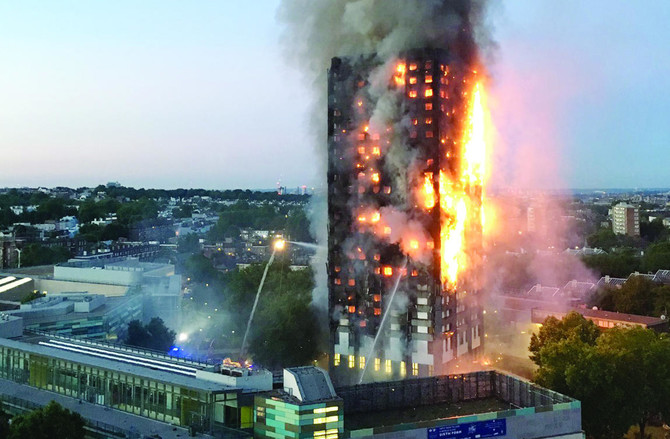
LONDON: Owners of high-rise hotels across the Gulf should review their evacuation and fire alarm systems in the wake of an horrific blaze in London last month, said a leading international fire expert.
The large number of high-rise hotels in the region represents a particular worry for regulators, according to Jim Glockling, the technical director of the UK-based Fire Protection Association.
He made his remarks as it emerged that cladding used in at least 60 tower blocks in the UK had failed a new safety test.
Glockling said building owners should urgently review both their fire detection and evacuation procedures as regulators worldwide absorb the lessons of the Grenfell Tower blaze, in which at least 80 people died last month.
A surge in hotel construction spurred by the growth of regional tourism and events such as the Dubai Expo 2020 and FIFA World Cup in Qatar two years later has led to hundreds of new high-rise hotels being constructed in the region, many of them covered with cladding panels.
Hotel owners may now have to review their entire evacuation procedures in the wake of the fire as insurance companies reassess building fire risks.
A cladding fire which erupted on New Year’s Eve 2015 at The Address Downtown Dubai hotel was broadcast live to millions of people worldwide and triggered reforms to the fire safety code in the UAE.
“It is critical that you have a robust alarm detection in place to get the earliest possible warning,” said Glockling. “Many alarm systems are de-sensitised so that a big building doesn’t have to be evacuated if someone has burnt the toast or left the kettle on.”
Such false alarms can lead to complacency among building managers and fire fighters.
He said that some 95 percent of automated fire alarms in the UK are either false or unwanted — such as those caused by someone smoking or from cooking fumes or vapor.
Building owners should instead install more sophisticated systems that are triggered when there is more likelihood of a fire than not.
“These systems indicate a fire is more like 80 percent likely than 90 percent unlikely,” Glockling said.
Police in the UK said on Thursday that they had reasonable grounds to consider whether local authorities had committed corporate manslaughter as tests on buildings with cladding continued across the UK.
At least 80 people died on June 14 when the blaze ripped through the London tower block, the city’s deadliest fire in more than a century.
Unlike the UK, where many old concrete towers built in the 1960s and 1970s have been recovered with flammable cladding panels, such panels are more likely to be found on much newer towers in the Gulf, where a real estate boom has added hundreds of new high-rise towers over the last decade — most of them covered with aluminum cladding panels with flammable core materials.
The Grenfell Tower fire “has enormous implications” for such buildings, said Glockling.
The Fire Protection Association has also warned of the urgent need to update 10-year-old fire regulations in the UK.
“We are concerned that other sectors of the building regulations, particularly to do with sustainability, unwisely bias building methods and material choices to those that might perform less well in fire scenarios,” according to a briefing note. “The regulations do not constitute a holistic approach to the creation of a safe, resilient and habitable building.”

Gulf high-rise hotel owners ‘must learn from Grenfell blaze’
Coast Guard is pursuing another tanker helping Venezuela skirt sanctions, US official says
- US oil companies dominated Venezuela’s petroleum industry until the country’s leaders moved to nationalize the sector, first in the 1970s and again in the 21st century under Maduro and his predecessor, Hugo Chávez
WEST PALM BEACH, Florida: The US Coast Guard on Sunday was pursuing another sanctioned oil tanker in the Caribbean Sea as the Trump administration appeared to be intensifying its targeting of such vessels connected to the Venezuelan government.
The pursuit of the tanker, which was confirmed by a US official briefed on the operation, comes after the US administration announced Saturday it had seized a tanker for the second time in less than two weeks.
The official, who was not authorized to comment publicly about the ongoing operation and spoke on the condition of anonymity, said Sunday’s pursuit involved “a sanctioned dark fleet vessel that is part of Venezuela’s illegal sanctions evasion.”
The official said the vessel was flying a false flag and under a judicial seizure order.
The Pentagon and Department of Homeland Security, which oversees the US Coast Guard, deferred questions about the operation to the White House, which did not offer comment on the operation.
Saturday’s predawn seizure of a Panama-flagged vessel called Centuries targeted what the White House described as a “falsely flagged vessel operating as part of the Venezuelan shadow fleet to traffic stolen oil.”
The Coast Guard, with assistance from the Navy, seized a sanctioned tanker called Skipper on Dec. 10, another part of the shadow fleet of tankers that the US says operates on the fringes of the law to move sanctioned cargo. It was not even flying a nation’s flag when it was seized by the Coast Guard.
President Donald Trump, after that first seizure, said that the US would carry out a “blockade” of Venezuela. It all comes as Trump has ratcheted up his rhetoric toward Venezuelan President Nicolás Maduro.
This past week Trump demanded that Venezuela return assets that it seized from US oil companies years ago, justifying anew his announcement of a “blockade” against oil tankers traveling to or from the South American country that face American sanctions.
Trump cited the lost US investments in Venezuela when asked about his newest tactic in a pressure campaign against Maduro, suggesting the Republican administration’s moves are at least somewhat motivated by disputes over oil investments, along with accusations of drug trafficking. Some sanctioned tankers already are diverting away from Venezuela.
US oil companies dominated Venezuela’s petroleum industry until the country’s leaders moved to nationalize the sector, first in the 1970s and again in the 21st century under Maduro and his predecessor, Hugo Chávez. Compensation offered by Venezuela was deemed insufficient, and in 2014, an international arbitration panel ordered the country’s socialist government to pay $1.6 billion to ExxonMobil.
Maduro said in a message Sunday on Telegram that Venezuela has spent months “denouncing, challenging and defeating a campaign of aggression that goes from psychological terrorism to corsairs attacking oil tankers.”
He added: “We are ready to accelerate the pace of our deep revolution!”
Sen. Rand Paul, R-Kentucky, who has been critical of Trump’s Venezuela policy, called the tanker seizures a “provocation and a prelude to war.”
“Look, at any point in time, there are 20, 30 governments around the world that we don’t like that are either socialist or communist or have human rights violations,” Paul said on ABC’s’ “This Week.” ”But it isn’t the job of the American soldier to be the policeman of the world.”
The targeting of tankers comes as Trump has ordered the Defense Department to carry out a series of attacks on vessels in the Caribbean and eastern Pacific Ocean that his administration alleges are smuggling fentanyl and other illegal drugs into the United States and beyond.
At least 104 people have been killed in 28 known strikes since early September. The strikes have faced scrutiny from US lawmakers and human rights activists, who say the administration has offered scant evidence that its targets are indeed drug smugglers and that the fatal strikes amount to extrajudicial killings.
Trump has repeatedly said Maduro’s days in power are numbered. White House chief of staff Susie Wiles said in an interview with Vanity Fair published last week that Trump “wants to keep on blowing boats up until Maduro cries uncle.”
Sen. Tim Kaine, D-Virginia, told NBC’s “Meet the Press” on Sunday that Trump’s use of military to mount pressure on Maduro runs contrary to Trump’s pledge to keep the United States out of unnecessary wars.
Democrats have been pressing Trump to seek congressional authorization for the military action in the Caribbean.
“We should be using sanctions and other tools at our disposal to punish this dictator who is violating the human rights of his civilians and has run the Venezuelan economy into the ground,” Kaine said. “But I’ll tell you, we should not be waging war against Venezuela. We definitely should not be waging war without a vote of Congress.