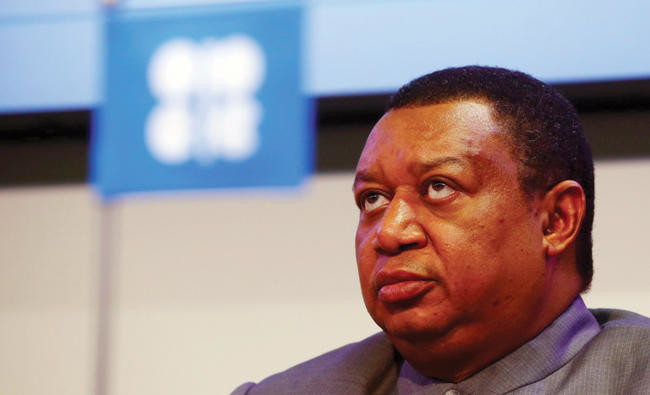
LONDON: The global oil market is tightening at an “accelerating pace,” according to OPEC Secretary-General Mohammed Barkindo.
The head of the Organization of the Petroleum Exporting Countries, speaking in London on Thursday, cited a sharp reduction in worldwide inventories as evidence that last year’s agreement by 24 OPEC and non-OPEC countries to cut supply was having an effect.
However, the head of Russia’s energy giant Rosneft, Igor Sechin, appeared to disagree. Speaking at an industry forum in Verona he said that “analysis shows the announced goal of inventories stabilization has not been fully implemented and it is too early to talk about a watershed in the global market,” Reuters reported.
Both men were speaking on Thursday during a period when the oil price has been moving back toward $60 a barrel, buoyed by geopolitical uncertainty as well as greater supply discipline, said analysts in London.
Barkindo told a conference that last year’s accord to curb supplies by 1.8 million barrels per day (bpd) had been greeted with skepticism in some quarters. Doubters pointed to OPEC’s weak conformity to past production adjustments, and the lack of past support from non-OPEC nations.
But Barkindo said, “While the process has not always been smooth given the severity of this cycle, there is no doubt the market is rebalancing; stability is steadily returning; and there is far more light at the end of the dark tunnel.”
He said OPEC stocks in September were about 160 million barrels above the five-year average, down from 340 million in January. Barkindo also said there had been a massive drainage of oil tanks across all regions, in terms of both crude and oil products. “A balanced oil market was now fully in sight,” he said.
Sechin — a close ally of Russian President Vladimir Putin, who is known for his skepticism about OPEC’s ability to regulate the market — took a different approach. He said the rebalancing of supply and demand was “fragile” and expressed concern US shale oil production may significantly increase next year if oil prices stay relatively firm.
“That’s why I think, we shouldn’t expect a jump in oil prices in the near future,” Sechin said.
Efforts to stabilize the oil market were complicated by the lack of reliable information on inventories as well as on the oil supply and demand balance, he added.
“The key task here is to create a unified system of inventory measurement and removal of stock overhang,” Sechin said.
But Barkindo said his positivity was underscored by recent data that showed global growth had been revised up from 3.1 percent at the turn of the year to 3.6 percent.
“Global oil demand growth has also been robust and there are signs of a strengthening trend. In our December monthly oil market report, we saw global oil demand growth for 2017 at a level of 1.15 million barrels per day. This has been revised and now stands at 1.5 million bpd. For 2018, the encouraging dynamic is set to continue with a forecast of 1.4 million bpd.”
Barkindo said OPEC’s upcoming World Oil Outlook 2017, to be launched in Vienna on Nov. 7, would forecast that demand would pass 100 million bpd in 2020 and reach over 111 million bpd by 2040.
“Let me stress that we see demand growing in every year of the Outlook. There is no peak oil demand for the foreseeable future.”
Last year’s supply-cut agreement lasts till March 2018, but it could be extended at OPEC’s Vienna meeting next month.
Separately, Rosneft on Thursday said it had signed a production-sharing agreement with Iraq’s autonomous Kurdistan region worth up to $400 million covering five oil blocks in the region.
A statement by Rosneft said, “The parties agreed to implement the geological exploration program and start pilot production as early as in 2018.
“In case of success, in 2021 it is planned to start full-field development of the blocks. According to conservative estimates, the total recoverable oil reserves at five blocks may be about 670 million barrels.”
The agreement comes amid tensions over Kurdish claims to sovereignty with reports of armed clashes between Kurdish forces and Iraqi government troops.


![]()
OPEC at odds with Rosneft over oil outlook
OPEC at odds with Rosneft over oil outlook
Latest updates


© 2026 SAUDI RESEARCH & PUBLISHING COMPANY, All Rights Reserved And subject to Terms of Use Agreement.