Quebec lawmakers pass law obliging citizens to uncover faces

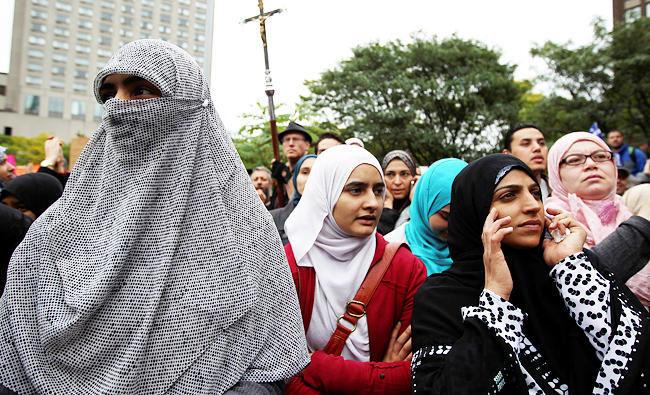
Women in traditional garb gather to protest against Quebec's proposed Charter of Values in Montreal, in this September 14, 2013 file photo. (REUTERS)
Updated 19 October 2017
Follow

Quebec lawmakers pass law obliging citizens to uncover faces

MONTREAL: Quebec legislators passed a religious neutrality bill Wednesday that will oblige citizens to uncover their faces while giving and receiving state services, triggering criticism that the law targets Muslim women.
Quebec’s two main opposition parties opposed the bill because they argued it didn’t go far enough in restricting the presence of conspicuous symbols of all religions in the public sphere.
The new law has two basic components: It bans the wearing of face coverings for people giving or receiving a service from the state and it offers a framework outlining how authorities should grant accommodation requests based on religious beliefs. While the bill doesn’t specifically mention specific clothing, it would prohibit the burka and niqab when people interact with the state, but it doesn’t extend to other religious symbols.
Premier Philippe Couillard said he expects some people to challenge the law, but he defended the legislation as necessary for reasons related to communication, identification and security.
“The principle to which I think a vast majority of Canadians by the way, not only Quebecers, would agree upon is that public services should be given and received with an open face,” he said. “I speak to you, you speak to me. I see your face. You see mine. As simple as that.”
Advocacy groups and academics have condemned the measure.
The National Council of Canadian Muslims said it is “studying its options” with regard to a possible court challenge.
The attorney general of Ontario province, Yasir Naqvi, said his province didn’t plan any similar measure and criticized Quebec’s action.
“We respect people’s right to express their religious beliefs and we disagree with the law Quebec has brought in and we will never introduce such a law in Ontario,” Naqvi said.
Quebec Justice Minister Stephanie Vallee said guidelines on how to apply the law — notably criteria touching on reasonable accommodation — would be phased in by next June 30 after consultations. Provisions regarding daycare workers will kick in by next summer to allow educators to get training, but the majority of the face-covering provisions will take effect immediately.
That means people who sit for an exam will have to do so with their faces uncovered. Asked specifically about someone getting on a bus, Vallee replied that all such services must be offered or received without a face covering.


Palestine Action hunger strikers launch legal action against UK govt

Updated 5 sec ago
Follow

Palestine Action hunger strikers launch legal action against UK govt

  • They accuse authorities of abandoning prison safety policies
  • Several of the imprisoned activists have been hospitalized

LONDON: Hunger strikers from Palestine Action in the UK have launched legal action against the government, accusing it of abandoning the policy framework for prison safety, The Independent reported.

A pre-action letter was sent to Justice Secretary David Lammy by a legal firm representing the activists.

It came as several imprisoned members of the banned organization — including one who has refused food for 51 days — were hospitalized due to their deteriorating health while on hunger strike.

They say they have sent several letters to Lammy, who is also deputy prime minister, but have received no response.

He was urged in the latest letter to respond within 24 hours as the issue is a “matter of urgency.”

The letter added: “Our clients’ health continues to deteriorate, such that the risk of their dying increases every day.”

An “urgent meeting” is needed “with the proposed defendant to discuss the deterioration of our clients’ health and to discuss attempts to resolve the situation,” it said.

Seven of the Palestine Action prisoners have been admitted to hospital since the hunger strike was launched on Nov. 2, including 30-year-old Amu Gib and Kamran Ahmed, 28.

They are being held in prisons across the country. Two members of the group have been forced to end their hunger strike due to health conditions: Jon Cink, 25, ended on day 41, while 22-year-old Umer Khalid finished on day 13.

Gib, now on day 51, was hospitalized last week and reportedly needs a wheelchair due to health concerns.

Dr. James Smith, an emergency physician, warned journalists last Thursday that some of the imprisoned activists “are dying” and need specialized medical care.

In a letter signed by more than 800 doctors, Smith said the hunger strikers were at “very high risk of serious complications, including organ failure, irreversible neurological damage, cardiac arrhythmias and death.”

The strikers are demanding that Palestine Action, which is classified as a terrorist organization, be de-proscribed.

They are also urging the government to shut down defense companies with ties to Israel, among other demands.

In response to the latest letter, a Ministry of Justice spokesperson said: “We strongly refute these claims. We want these prisoners to accept support and get better, and we will not create perverse incentives that would encourage more people to put themselves at risk through hunger strikes.”