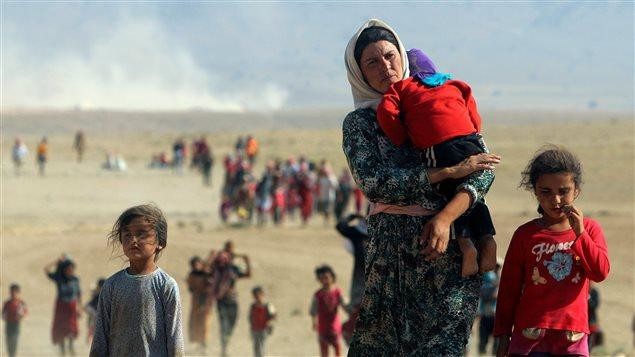
OTTAWA: Nearly 800 Yazidi women and girls and others who fled persecution by the Daesh group in northern Iraq have been resettled in Canada, the immigration minister said Thursday.
Canada’s Parliament last year, with Iraqi activist Nadia Murad on hand, declared the persecution of Yazidis a genocide and said this country would take in up to 1,200.
“Today, I am proud (to say that) almost 800 Yazidi women and girls, and other survivors of Daesh have already arrived, and have begun the process of rebuilding their lives with the assistance of private sponsors and community groups all across Canada,” Immigration Minister Ahmed Hussen told the House of Commons.
“I continue to be amazed by the generosity and compassion extended to this highly vulnerable group by all Canadians,” he added.
Thousands of women and girls, especially from the Yazidi minority, suffered horrific abuse in Daesh controlled areas, including rape, abduction, slavery and cruel, inhumane and degrading treatment.
Many were captured as spoils of war to be used as sex slaves after Daesh militants massacred Yazidis in Sinjar in 2014.
The women were sold and traded across the militants’ self-proclaimed “caliphate” in Syria and Iraq.
Around 3,000 are believed to remain in captivity, the UN Assistance Mission to Iraq (UNAMI) and the UN rights office said in an August report.
The report also raised particular concerns over the situation of hundreds of children born from the sexual violence risked facing a lifetime of discrimination and abuse.
On Tuesday, another Yazidi survivor, Shireen Jerdo Ibrahim, testified before a US congressional committee, seeking US help for her community.

800 Yazidis refugees resettled in Canada: Minister
Prabowo, Trump expected to sign Indonesia-US tariff deal in January 2026
- Deal will mean US tariffs on Indonesian products are cut from a threatened 32 percent to 19 percent
- Jakarta committed to scrap tariffs on more than 99 percent of US goods
JAKARTA: Indonesia expects to sign a tariff deal with the US in early 2026 after reaching an agreement on “all substantive issues,” Jakarta's chief negotiator said on Tuesday.
Indonesia’s Coordinating Minister for Economic Affairs Airlangga Hartarto met with US trade representative Jamieson Greer in Washington this week to finalize an Indonesia-US trade deal, following a series of discussions that took place after the two countries agreed on a framework for negotiations in July.
“All substantive issues laid out in the Agreement on Reciprocal Trade have been agreed upon by the two sides, including both the main and technical issues,” Hartarto said in an online briefing.
Officials from both countries are now working to set up a meeting between Indonesian President Prabowo Subianto and US President Donald Trump.
It will take place after Indonesian and US technical teams meet in the second week of January for a legal scrubbing, or a final clean-up of an agreement text.
“We are expecting that the upcoming technical process will wrap up in time as scheduled, so that at the end of January 2026 President Prabowo and President Trump can sign the Agreement on Reciprocal Trade,” Hartarto said.
Indonesian trade negotiators have been in “intensive” talks with their Washington counterparts since Trump threatened to levy a 32 percent duty on Indonesian exports.
Under the July framework, US tariffs on Indonesian imports were lowered to 19 percent, with Jakarta committing to measures to balance trade with Washington, including removing tariffs on more than 99 percent of American imports and scrapping all non-tariff barriers facing American companies.
Jakarta also pledged to import $15 billion worth of energy products and $4.5 billion worth of agricultural products such as soybeans, wheat and cotton, from the US.
“Indonesia will also get tariff exemptions on top Indonesian goods, such as palm oil, coffee, cocoa,” Hartarto said.
“This is certainly good news, especially for Indonesian industries directly impacted by the tariff policy, especially labor-intensive sectors that employ around 5 million workers.”
In the past decade, Indonesia has consistently posted trade surpluses with the US, its second-largest export market after China.
From January to October, data from the Indonesian trade ministry showed two-way trade valued at nearly $36.2 billion, with Jakarta posting a $14.9 billion surplus.