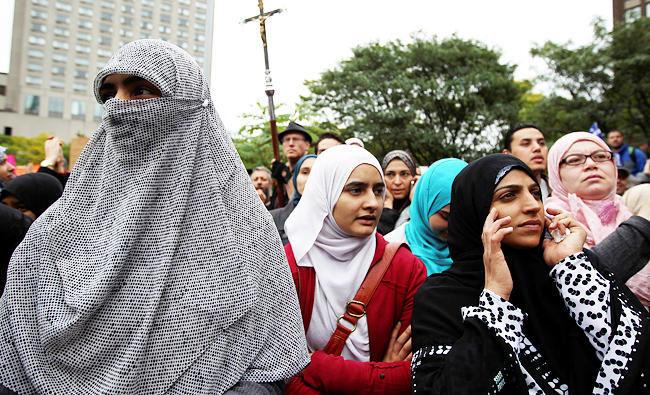
MONTREAL: Quebec legislators passed a religious neutrality bill Wednesday that will oblige citizens to uncover their faces while giving and receiving state services, triggering criticism that the law targets Muslim women.
Quebec’s two main opposition parties opposed the bill because they argued it didn’t go far enough in restricting the presence of conspicuous symbols of all religions in the public sphere.
The new law has two basic components: It bans the wearing of face coverings for people giving or receiving a service from the state and it offers a framework outlining how authorities should grant accommodation requests based on religious beliefs. While the bill doesn’t specifically mention specific clothing, it would prohibit the burka and niqab when people interact with the state, but it doesn’t extend to other religious symbols.
Premier Philippe Couillard said he expects some people to challenge the law, but he defended the legislation as necessary for reasons related to communication, identification and security.
“The principle to which I think a vast majority of Canadians by the way, not only Quebecers, would agree upon is that public services should be given and received with an open face,” he said. “I speak to you, you speak to me. I see your face. You see mine. As simple as that.”
Advocacy groups and academics have condemned the measure.
The National Council of Canadian Muslims said it is “studying its options” with regard to a possible court challenge.
The attorney general of Ontario province, Yasir Naqvi, said his province didn’t plan any similar measure and criticized Quebec’s action.
“We respect people’s right to express their religious beliefs and we disagree with the law Quebec has brought in and we will never introduce such a law in Ontario,” Naqvi said.
Quebec Justice Minister Stephanie Vallee said guidelines on how to apply the law — notably criteria touching on reasonable accommodation — would be phased in by next June 30 after consultations. Provisions regarding daycare workers will kick in by next summer to allow educators to get training, but the majority of the face-covering provisions will take effect immediately.
That means people who sit for an exam will have to do so with their faces uncovered. Asked specifically about someone getting on a bus, Vallee replied that all such services must be offered or received without a face covering.

Quebec lawmakers pass law obliging citizens to uncover faces
Only 4% women on ballot as Bangladesh prepares for post-Hasina vote
- Women PMs have ruled Bangladesh for over half of its independent history
- For 2026 vote, only 20 out of 51 political parties nominated female candidates
DHAKA: As Bangladesh prepares for the first election since the ouster of its long-serving ex-prime minister Sheikh Hasina, only 4 percent of the registered candidates are women, as more than half of the political parties did not field female candidates.
The vote on Feb. 12 will bring in new leadership after an 18-month rule of the caretaker administration that took control following the student-led uprising that ended 15 years in power of Hasina’s Awami League party.
Nearly 128 million Bangladeshis will head to the polls, but while more than 62 million of them are women, the percentage of female candidates in the race is incomparably lower, despite last year’s consensus reached by political parties to have at least 5 percent women on their lists.
According to the Election Commission, among 1,981 candidates only 81 are women, in a country that in its 54 years of independence had for 32 years been led by women prime ministers — Hasina and her late rival Khaleda Zia.
According to Dr. Rasheda Rawnak Khan from the Department of Anthropology at Dhaka University, women’s political participation was neither reflected by the rule of Hasina nor Zia.
“Bangladesh has had women rulers, not women’s rule,” Khan told Arab News. “The structure of party politics in Bangladesh is deeply patriarchal.”
Only 20 out of 51 political parties nominated female candidates for the 2026 vote. Percentage-wise, the Bangladesh Socialist Party was leading with nine women, or 34 percent of its candidates.
The election’s main contender, the Bangladesh Nationalist Party, whose former leader Zia in 1991 became the second woman prime minister of a predominantly Muslim nation — after Pakistan’s Benazir Bhutto — was the party that last year put forward the 5 percent quota for women.
For the upcoming vote, however, it ended up nominating only 10 women, or 3.5 percent of its 288 candidates.
The second-largest party, Jamaat-e-Islami, has not nominated a single woman.
The 4 percent participation is lower than in the previous election in 2024, when it was slightly above 5 percent, but there was no decreasing trend. In 2019, the rate was 5.9 percent, and 4 percent in 2014.
“We have not seen any independent women’s political movement or institutional activities earlier, from where women could now participate in the election independently,” Khan said.
“Real political participation is different and difficult as well in this patriarchal society, where we need to establish internal party democracy, protection from political violence, ensure direct election, and cultural shifts around female leadership.”
While the 2024 student-led uprising featured a prominent presence of women activists, Election Commission data shows that this has not translated into their political participation, with very few women contesting the upcoming polls.
“In the student movement, women were recruited because they were useful, presentable for rallies and protests both on campus and in the field of political legitimacy. Women were kept at the forefront for exhibiting some sort of ‘inclusive’ images to the media and the people,” Khan said.
“To become a candidate in the general election, one needs to have a powerful mentor, money, muscle power, control over party people, activists, and locals. Within the male-dominated networks, it’s very difficult for women to get all these things.”