

Arab News poll on British attitudes to Arab world raised in UK Parliament

Labour MP Paula Sherriff speaking during parliamentary questions on Tuesday. (Video grab)
Short Url
Updated 13 October 2020
Follow

Arab News poll on British attitudes to Arab world raised in UK Parliament

LONDON: An Arab News poll on British attitudes toward the Arab world has been raised in the UK Parliament.
The findings of the poll, which was conducted by Arab News in conjunction with YouGov, were announced last month at a special panel discussion held at the Council for Arab-British Understanding (Caabu) and was widely cited in British media outlets at the time.
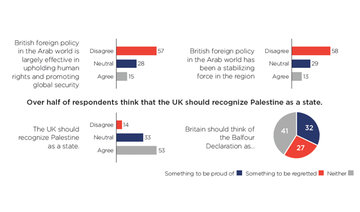
Speaking during parliamentary questions on Tuesday, Labour MP Paula Sherriff asked: “What is the UK government’s position on the recognition of Palestine? Did the minister see the recent YouGov poll, commissioned by the Council for Arab-British Understanding and Arab News, that showed a majority of respondents in favor, with only 14 percent in opposition?”
Conservative MP Alistair Burt replied: “The UK government position is that Palestine will be recognized when it is in the best interests of the peace process to do so, which leaves the matter quite open.”
Commenting on the response, Caabu Director Chris Doyle said: “This is a very small snapshot of the government’s longstanding position that they will recognize (Palestine) at a time of their choosing when they consider it will be helpful to negotiations.”
“Looking back to the historic vote in Parliament, there was a clear majority of MPs then that supported Britain recognizing a Palestine state. The question is when this will be, given that the current government of Israel is hell-bent in ensuring that there will never be a Palestinian state.”
On Nov. 2, British Prime Minister Theresa May will sit down for a celebratory dinner with Israel’s Prime Minister Benjamin Netanyahu to commemorate the centenary of the declaration in which Britain pledged its support for the creation of a “national home for the Jewish people” in Palestine.
“Many believe that the anniversary of the Balfour Declaration will be an opportune moment for Britain to recognize Palestine, in part to honor the commitment in the Balfour Declaration not to prejudice the rights of the indigenous population, in other words the Palestinians,” added Doyle.

The recent Arab News/YouGov study was held ahead of the 100-year anniversary of the Balfour Declaration, which paved the way for the creation of Israel in 1948. Earlier this year, Arab News — the Middle East’s leading English daily — had announced an exclusive regional partnership deal with global polling experts YouGov to help better understand Arab points of view on global affairs, and vice versa.
The poll found that 53 percent wanted the UK government to recognize Palestine as a state, with just 14 percent against the idea and 33 percent neutral.
“I think there is wide support for a Palestinian state and I think there would be a high percentage who would accept statehood immediately,” said Yossi Mekelberg, a professor of international relations at Regent’s University London.
“I think among the British public there is a sense that Palestinians are the underdogs and that they deserve support. The British naturally supported the underdogs,” he added.
The Balfour declaration, sent by then Foreign Secretary Arthur Balfour to Lionel Walter, Lord Rothschild, who represented the British Jewish community, pledged to support the creation of a Jewish state while asserting that nothing should be done to prejudice the “civil and religious rights of existing non-Jewish communities in Palestine, or the rights and political status enjoyed by Jews in any other country.”
The 67-word declaration has been dogged by controversy since its birth on Nov. 2, 1917, with the first of many subsequent protests against it held in 1918. Many have since come to view it as a major cause of instability in the Middle East.
In a statement released following the launch of the Arab News/YouGov poll, Alistair Carmichael MP said: “Regardless of party-political inclination, the majority of British people feel that UK foreign policy in the Arab world has failed to uphold human rights and promote global security, and that UK influence is not a stabilizing one — (by) 57 and 58 percent respectively.”
“This should give cause for great concern for past, present and future governments, that criticism of UK foreign policy and the need for a serious rethink of it, does not just come from the region itself, but from at home too.”
Speaking to Arab News, Carmichael said that the Israel-Palestine conflict is “the aspect of UK foreign policy that comes immediately to most people’s minds.”
“I come across a lot of frustration that British commentary doesn’t always get it right. They can be slow sometimes to criticize what they see as being a disproportionate action by Israel, in the most recent bombardments and continued blockade of Gaza, for example.
“At the same time, I think most people would still see a two-state solution as being the only way ahead.”
The Balfour Campaign group last year demanded that the British government “recognizes its brutal colonial practices in Palestine” and make amends to the Palestinian people for “failing to meet its obligations and to uphold Palestinian rights.”
Earlier this year, the UK released its official response to a petition signed by 13,600 people calling for an open apology.
“The Balfour Declaration is a historic statement for which (Her Majesty’s Government) does not intend to apologize,” an official statement said.
“We are proud of our role in creating the State of Israel. The task now is to encourage moves towards peace.”

MenaML hosts 2026 Winter School in Saudi Arabia to boost AI education, collaboration in region

Updated 16 January 2026
Follow

MenaML hosts 2026 Winter School in Saudi Arabia to boost AI education, collaboration in region

  • Second edition of Winter School will be hosted in partnership with KAUST

DUBAI: The Middle East and North Africa Machine Learning Winter School will host its second edition in Saudi Arabia this year, in partnership with the King Abdullah University of Science and Technology.

The non-profit held its inaugural edition in Doha last year in partnership with the Qatar Computing Research Institute.

The initiative began when like-minded individuals from Google DeepMind and QCRI came together to launch a platform connecting a “community of top-tier AI practitioners with a shared interest in shaping the future of the MENA region,” Sami Alabed, a research scientist at Google DeepMind and one of the co-founders of MenaML, told Arab News.

Along with Alabed, the core team includes Maria Abi Raad and Amal Rannen-Triki from Google DeepMind, as well as Safa Messaoud and Yazan Boshmaf from QCRI.

Maria Abi Raad

Messaoud said that the school has three goals: building local talent in artificial intelligence, enhancing employability and connection, and reversing brain drain while fostering regional opportunity.

AI has dominated boardrooms and courtrooms alike globally, but “AI research and education in MENA are currently in a nascent, yet booming, stage,” she added.

Launched at a pivotal moment for the region, the initiative was timed to ensure “regional representation in the global AI story while cultivating AI models that are culturally aligned,” said Rannen-Triki.

The school’s vision is to cultivate researchers capable of developing “sophisticated, culturally aligned AI models” that reflect the region’s values and linguistic and cultural diversity, said Messaoud.

This approach, she added, enables the region to contribute meaningfully to the global AI ecosystem while ensuring that AI technologies remain locally relevant and ethically grounded.

MenaML aims to host its annual program in a different city each year, partnering with reputable institutions in each host location.

“Innovation does not happen in silos; breakthroughs are born from collaboration that extends beyond borders and lab lines,” said Alabed.

“Bringing together frontier labs to share their knowledge echoes this message, where each partner brings a unique viewpoint,” he added.

This year, MenaML has partnered with KAUST, which “offers deep dives into specialized areas critical to the region, blending collaborative spaces with self-learning and placement programs,” said Abi Raad.

The program, developed in partnership with KAUST, brings together speakers from 16 institutions and focuses on four key areas: AI and society, AI and sciences, AI development, and regional initiatives.

“These themes align with the scientific priorities and research excellence pillars of KAUST as well as the needs of regional industries seeking to deploy AI safely and effectively,” said Bernard Ghanem, professor of electrical and computer engineering and computer science at KAUST and director of the Center of Excellence in Generative AI.

The program will also highlight efficiency in AI systems, with the overall goal of equipping “participants with the conceptual and practical understanding needed to contribute meaningfully to next-generation AI research and development,” he told Arab News.

For KAUST, hosting the MenaML Winter School aligns with Saudi Arabia’s ambition to become a global hub for AI research under Vision 2030.

By attracting top researchers, industry partners, and young talent to the Kingdom, it helps cement the Kingdom’s position as a center for AI excellence, Ghanem said.

It also aligns closely with Vision 2030’s “goals of building human capital, fostering innovation, and developing a knowledge-based economy” and “contributes to the long-term development of a world-leading AI ecosystem in Saudi Arabia,” he added.

Although the program accepts students from around the world, participants must demonstrate a connection to the MENA region, Abi Raad said.

The goal is to build bridges between those who may have left the region and those who remain, enabling them to start conversations and collaborate, she added.

A certain percentage of spots is reserved for participants from the host country, while a small percentage is allocated to fully international students with no regional ties, with the objective of offering them a glimpse into the regional AI ecosystem.

Looking ahead, MenaML envisions growing from an annual event into a sustainable, central pillar of the regional AI ecosystem, inspired by the growth trajectory of global movements like TED or the Deep Learning Indaba, a sister organization supporting AI research and education in Africa.

Boshmaf said MenaML’s long-term ambition is to evolve beyond its flagship event into a broader movement, anchored by local MenaMLx chapters across the region.

Over time, the initiative aims to play a central role in strengthening the regional AI ecosystem by working with governments and the private sector to support workforce development, AI governance and safety education, and collaborative research, while raising the region’s global visibility through its talent network and international partnerships.

He added: “If TED is the global stage for ‘ideas worth spreading,’ MenaML is to be the regional stage for ‘AI ideas worth building.’”

The MenaML Winter School will run from Jan. 24 to 29 at KAUST in Saudi Arabia.