How the 'UK attitudes toward the Arab world' survey was conducted

Updated 25 September 2017
Follow

How the 'UK attitudes toward the Arab world' survey was conducted

As part of a continued partnership between YouGov and Arab News, YouGov conducted an opinion poll among UK residents about their attitudes toward the Arab world.
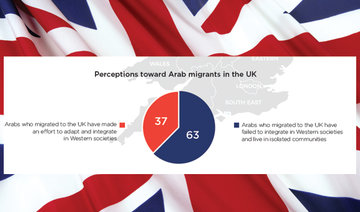
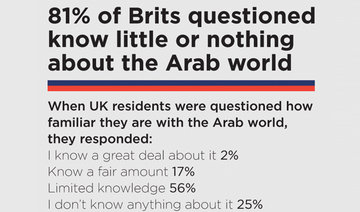
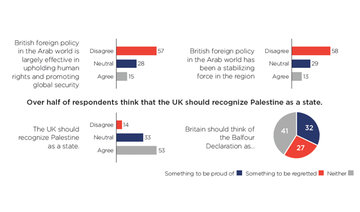
The range of questions was designed to capture views across a variety of issues, including the current level of familiarity with the Arab world, interest in learning more about Arab culture, willingness to travel, associations with Arab societies, portrayal of Arab countries in the media, migration of refugees to Europe and Britain, the issue of Islamophobia, and Britain’s military involvement in war-torn countries.
The survey was conducted using an online interview administered among members of the YouGov Plc GB panel of close to 1.02 million individuals who have agreed to take part in surveys. An email was sent to panelists selected at random from the base sample, inviting them to take part in the survey and providing a link to the survey. All figures, unless otherwise stated, are from YouGov Plc.
The figures have been weighted and are representative of all British adults aged 18 and over. YouGov weights UK political surveys by age interlocked with gender and education, political attention, social grade, 2017 recalled vote interlocked with region, and EU referendum recalled vote.
The total size was 2,142 adults. Fieldwork was undertaken between Aug. 16-17, 2017.
Overall, respondents answered 25 close-ended questions. There was a near-even gender split among respondents, with 48 percent males and 52 percent females. Of the people in the sample group, 67 percent were between the ages of 25 and 64. The overall margin of error, at 2 percent, is considered to be low.

• For full report and related articles please visit: How Brits view Arab world ​

Read the YouGov/ArabNews Topline Report:


Syrian government and SDF agree to de-escalate after Aleppo violence

Updated 9 sec ago
Follow

Syrian government and SDF agree to de-escalate after Aleppo violence

  • Turkiye views the US-backed SDF, which controls swathes of northeastern Syria, as a ⁠terrorist organization and has warned of military action if the group does not honor the agreement

DAMASCUS: Syrian government forces and the Kurdish-led Syrian Democratic Forces agreed to de-escalate on Monday evening in the northern city of Aleppo, after a wave of attacks that both sides blamed on each other left at least two civilians dead and several wounded.
Syria’s state news agency SANA, citing the defense ministry, said the army’s general command issued an order to stop targeting the SDF’s fire sources. The SDF said in a statement later that it had issued instructions to stop responding ‌to attacks ‌by Syrian government forces following de-escalation contacts.
The Syrian health ministry ‌said ⁠two ​people ‌were killed and several were wounded in shelling by the SDF on residential neighborhoods in the city. The injuries included two children and two civil defense workers. The violence erupted hours after Turkish Foreign Minister Hakan Fidan said during a visit to Damascus that the SDF appeared to have no intention of honoring a commitment to integrate into the state’s armed forces by an agreed year-end deadline.
Turkiye views the US-backed SDF, which controls swathes of northeastern Syria, as a ⁠terrorist organization and has warned of military action if the group does not honor the agreement.
Integrating the SDF would ‌mend Syria’s deepest remaining fracture, but failing to do ‍so risks an armed clash that ‍could derail the country’s emergence from 14 years of war and potentially draw in Turkiye, ‍which has threatened an incursion against Kurdish fighters it views as terrorists.
Both sides have accused the other of stalling and acting in bad faith. The SDF is reluctant to give up autonomy it won as the main US ally during the war, which left it with control of Islamic ​State prisons and rich oil resources.
SANA, citing the defense ministry, reported earlier that the SDF had launched a sudden attack on security forces ⁠and the army in the Sheikh Maqsoud and Ashrafiyah neighborhoods of Aleppo, resulting in injuries.
The SDF denied this and said the attack was carried out by factions affiliated with the Syrian government. It said those factions were using tanks and artillery against residential neighborhoods in the city.
The defense ministry denied the SDF’s statements, saying the army was responding to sources of fire from Kurdish forces. “We’re hearing the sounds of artillery and mortar shells, and there is a heavy army presence in most areas of Aleppo,” an eyewitness in Aleppo told Reuters earlier on Monday. Another eyewitness said the sound of strikes had been very strong and described the situation as “terrifying.”
Aleppo’s governor announced a temporary suspension of attendance in all public and private schools ‌and universities on Tuesday, as well as government offices within the city center.