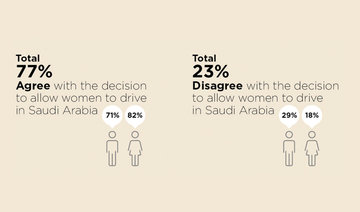
LONDON: Almost eight in 10 Saudis who reside in the Kingdom agree with the decision to allow women to drive, with the majority of females saying they plan to apply for a license, an Arab News/YouGov poll has found.
The wide-ranging poll of more than 500 adults revealed the models of car favored among Saudi women and found that most think driving will “transform” their lives.
King Salman last month issued a decree that will allow women to get behind the wheel by June next year. The current “ban” is considered a social issue in the Kingdom, as there is no actual law or religious edict that prohibits women driving.
The Arab News/YouGov poll, which was conducted in early October, found that 95 percent of Saudis are aware of the decision to allow women to drive, with a generally positive reaction to the move. The sample was representative of the online adult Saudi population in terms of age and gender.
A total of 77 percent of Saudis polled said they agree with the decision to allow women to drive — although the move was more popular with women than men. Seven in 10 males agree that women should have the right to drive, compared with 82 percent of females.
Freedom of movement for women and the belief that driving “is a basic human right” were the top reasons cited by those in agreement with the decision to lift the driving ban.
But among those who disagreed with the move, 54 percent believe “it is not safe for women to drive,” while 36 percent said “it is against local cultural traditions.”
When asked about the impact of women driving, mainly economic factors were cited by the Saudi men and women polled.
Four in 10 said the move would help boost the economy, while 35 percent said it would allow more women to work.
The poll illustrates how the decision will have a huge impact on society, with two-thirds of women questioned saying that it will significantly “transform” their lives, and half saying it will allow them to get to work more easily.
Faisal J. Abbas, editor in chief of Arab News, said that the poll reveals the true significance of the “historic” decision for Saudi society.
“Lifting the driving ban is the latest step in a raft of reforms underway in the Kingdom, both social and economic. But this change will, arguably, have the biggest positive impact on the day-to-day lives of citizens,” said Abbas.
“One of the most revealing findings of the Arab News/YouGov survey was that most women who plan to get behind the wheel will do so in order to get to work.
“That will see more of the Kingdom’s highly educated women finding fulfilling employment, boosting household incomes, and helping to meet Saudi Arabia’s ambitious economic aim of shaking its ‘addiction’ to oil.”
The automotive industry can also expect a massive financial boost from the move to allow women to drive, with 85 percent of Saudi women who plan to drive saying they will buy a car, the poll revealed.
Budget models are favored, with 44 percent saying they expect to spend just SR40,000 ($10,666) or less on a motor.
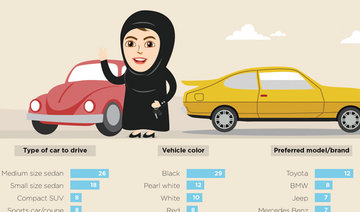
Medium-sized sedans are the most favored among Saudi women, with Toyota, BMW and Jeep named among the top brands, the poll found.
The top car colors chosen were black (29 percent) and pearl white (12 percent) with the least popular being pink, grey and brown.
• For full report and related articles please visit: #SaudiWomenCanDrivePoll