Saudi women want to drive — and fast

Updated 14 October 2017
Follow

Saudi women want to drive — and fast

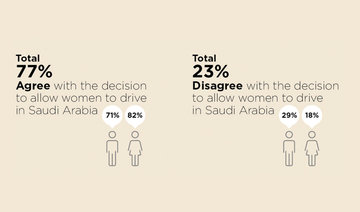
LONDON: Most Saudi women want to hit the road —  and aim to start driving as quickly as possible.
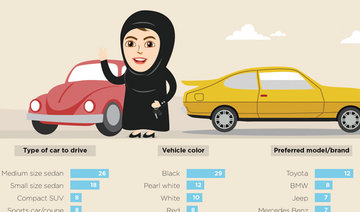
An Arab News/YouGov poll of 503 KSA nationals found that 65 percent of Saudi women plan to apply for a license, three-fifths of whom want to do so as soon as the driving ban is lifted next year.
Close to a quarter of Saudi women have driven a car in another country, with 43 percent in possession of a license obtained outside KSA, the poll found.
Despite the eagerness for Saudi women to hit the road, analysts expect there to be some lag given the licensing requirements.
“It could potentially take a while for women to get the necessary driving lessons and go through the bureaucratic hurdles of getting a license in order to actually start driving,” said Tom Rogers, an economist at Oxford Economics specializing in Saudi Arabia.
Others pointed to the cultural adjustment as Saudi society incorporates the idea of women behind the wheel. 
“The implementation of these things takes time. It’s not just a matter of issuing driving licenses,” said Crispin Hawes, managing director for the Middle East and North Africa at Teneo Intelligence, a global advisory firm.
“The government decision is the easy part. Implementation, particularly on an issue that has been sensitive, may take much longer.”
A report by Frost & Sullivan estimated that up to 90,000 to 150,000 women would get driving licenses in Saudi Arabia annually — currently up to 400,000 are issued to men — and anticipated an initial surge in the numbers as women rush to pass the test.
The report also predicted an improvement in road safety across the Kingdom as a result of the decree, due to women replacing taxi drivers and sharing driving responsibilities with other family members.
The ban on issuing women driving licenses will be officially lifted in June 2018, allowing a nine-month period to iron-out issues that remain, such as whether male driving instructors will be able to teach female pupils.

• For full report and related articles please visit: #SaudiWomenCanDrivePoll

Saudi foreign ministry welcomes second phase of Gaza peace plan, formation of transitional committee

Updated 16 January 2026
Follow

Saudi foreign ministry welcomes second phase of Gaza peace plan, formation of transitional committee

  • Ministry also thanked US President Donald Trump for his leadership and efforts to end the war in Gaza

RIYADH: The Saudi Ministry of Foreign Affairs on Friday welcomed the announcement of the second phase of a comprehensive peace plan for Gaza, the Saudi Press Agency reported.

The ministry said it also welcomed the formation of the Palestinian National Committee for the Administration of the Gaza Strip as a temporary transitional body, established under UN Security Council Resolution 2803, which met in Cairo on Friday.

In a statement, the ministry also thanked US President Donald Trump, who declared the formation of the Gaza “board of peace,” for his leadership and efforts to end the war in Gaza.

It highlighted his commitment to the withdrawal of Israeli forces, the prevention of any annexation of parts of the West Bank, and efforts to advance sustainable peace in the region.

The ministry commended the role of mediators Qatar, Egypt and Turkiye, stressing the importance of international and regional cooperation in supporting the peace process.

It underlined the need to support the work of the temporary Palestinian National Committee in managing the daily affairs of Gaza’s residents, while preserving the institutional and geographical link between the West Bank and the Gaza Strip, ensuring Gaza’s unity and rejecting any attempts to divide it.

The statement also called for consolidating the ceasefire, halting violations, ensuring the unhindered delivery of humanitarian aid, and accelerating early recovery and reconstruction efforts across Gaza.

It said these steps were essential to enabling the Palestinian National Authority to resume its responsibilities in the Gaza Strip, leading to an end to the Israeli occupation of Palestinian territory in Gaza and the West Bank and the establishment of an independent Palestinian state in line with UN resolutions, the Arab Peace Initiative and the two-state solution.