MEXICO CITY: Business leaders attending a US-Mexico CEO conference said on Wednesday that no North American Free Trade Agreement would be better than a bad deal, as industry braces for the end of a treaty that drives $1 trillion (SR3.75 trillion) in annual trade.
The CEO meeting ran in parallel to talks near Washington aimed at refreshing the 1994 agreement, with Mexico, Canada and businesses united in opposition to a number of radical US proposals they say would damage the North American economy.
US President Donald Trump said on Wednesday he would be open to bilateral trade pacts with Mexico or Canada if a deal cannot be reached to substantially revise NAFTA.
“We are all much worse off with a bad agreement than with no (NAFTA),” said Guillermo Vogel, who co-chaired the Mexico City event and is a vice president at Tenaris, a steel company.
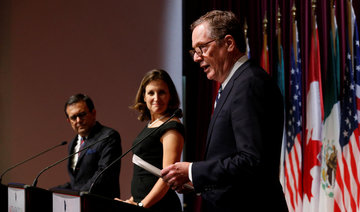
The meeting, part of a bilateral “CEO dialogue” that meets a couple of times each year, included a closed-door discussion on the NAFTA negotiations addressed by Foreign Minister Luis Videgaray and Economy Minister Idelfonso Guajardo, who are in charge of the negotiations for Mexico.
On the US side the event was co-chaired by Fedex Freight’s CEO Michael Ducker and US Chamber of Commerce President Thomas Donohue.
The event’s organizers declined to say who else attended. American Express, AT&T, GM and Delta were listed on publicity material for an event hosted by the US Chamber of Commerce in Mexico on Tuesday, where Donohue warned that several US proposals in the NAFTA talks were “poison pills” that risked dooming the agreement.
The process of renegotiating NAFTA has turned increasingly sour. Mexico accuses Trump of spoiling for a “protectionist war” with proposals aimed at balancing trade.
Those proposals include removing dispute resolution mechanisms, limiting trade in fresh produce and introducing minimum quotas for US parts in autos.
While better than a bad deal, Vogel said the failure of NAFTA would be a “lose-lose” situation, and that US-Mexico trade without it could lead to a US trade deficit larger than the current $64 billion.
Without NAFTA, Mexico trade experts say US products would face higher tariffs to enter Mexico, which could further skew the trade balance.
“The clear focus was that we have to send a message to all the different constituencies about how much of an error it would be to cancel NAFTA, or make a bad NAFTA,” Vogel said in an interview with Reuters.
He said content rules for auto parts were still negotiable, despite shock in Mexico at suggestions half of all parts in cars should be made in the United States. US Commerce Secretary Wilbur Ross said on Wednesday he expected an agreement would be reached on that issue.
On Tuesday, Donohue also singled out a “sunset clause” that would automatically terminate NAFTA every five years unless there were fresh negotiations.
“Clearly, a clause that cancels the agreement every five years totally defangs it,” Vogel said. “Starting to play with a non-market economy would be terrible for us.”
Vogel said US and Mexican businesses still believed NAFTA talks would produce a good deal and said they would continue to lobby their governments and lawmakers to negotiate a good deal.
“With an agreement, in 10 years I see a strong region that can face Asia or China, without an agreement I see a weaker region in the medium and long term.”


![]()

Business leaders say no NAFTA better than bad deal
Business leaders say no NAFTA better than bad deal

Latest updates


© 2026 SAUDI RESEARCH & PUBLISHING COMPANY, All Rights Reserved And subject to Terms of Use Agreement.