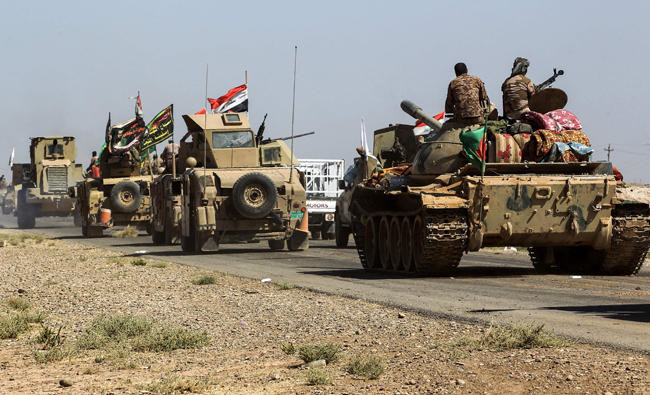
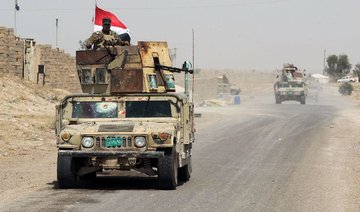
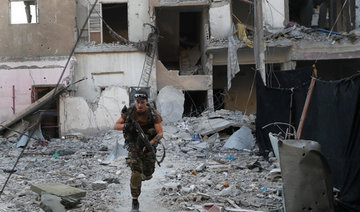
BAGHDAD: The “final large fight” in Iraq against Daesh group will take place on the border with Syria, a general in a US-led coalition against the terrorists said on Saturday.
He spoke two days after Iraqi forces recaptured the northern town of Hawija, the center of one of the terrorist group’s two remaining enclaves in Iraq.
“The next fight and the final large fight will be in the Middle Euphrates River Valley... on the Iraqi-Syrian border,” Brig. Gen. Robert Sofge, the coalition’s deputy commanding general, told AFP.
“All campaigns will aim in that direction, and it is going to happen sooner rather than later.”
Daesh seized vast areas of Iraq and Syria in 2014. Multiple offensives in both countries have since cornered it in a pocket of territory stretching from Syria’s Deir Ezzor to the Iraqi towns of Rawa and Al-Qaim.
Sofge said some 2,000 Daesh fighters were still in the area. Coalition-backed Iraqi forces ousted Daesh from second city Mosul in July, going on to inflict a string of defeats on the terrorist group.
After seizing the northern town of Tal Afar in August, they focused their efforts on Hawija and the Euphrates river area close to the Syrian frontier.
The militants are also under pressure in eastern Syria, facing separate offensives by Russian-backed regime forces and a Kurdish-Arab force supported by the US-led coalition.
Brig. Gen. Andrew A. Croft, the coalition’s deputy air force commander, said Iraqi security forces had been able to regroup and move quickly into new battles following their Mosul victory.
“We, as the coalition, are moving quickly to match,” he said.
Sofge said the terrorist group was shifting from a military mindset to that of an insurgent group with “sleeper cells” able to launch surprise attacks.
“The challenge for the years ahead is police work in Iraq and Syria,” he said.
“Daesh fighters who are not killed or captured are trying to fade back into the fabric of the society.”
While militants have tried to hide among the thousands of people displaced by fighting, Croft said some 1,000 Daesh fighters were captured in Hawija.
Many ended up in the hands of the Kurdish Peshmerga militias in Kirkuk province. Control of the province is a key sticking point in a bitter dispute between Baghdad and Kurdish authorities, fanned by a September referendum on Kurdish independence, held in defiance of the central government.
Iraqi pro-government forces have also advanced toward Kurdish positions since retaking Hawija. But Croft praised what he said was a “high degree of cooperation between Peshmergas and Iraqi security forces.”
“It is very positive,” he said. “Much of the tension is at a political level, not only does tension (between Iraqi forces and the Peshmerga) not exist, but they keep their cooperation high.”

Iraq-Syria border set for last major assault on Daesh: US general
Iran FM tells UN all military bases of ‘hostile forces’ legitimate targets
- UN chief condemns escalation, calls for immediate return to negotiating table
- Emergency session of Security Council set to convene on Saturday in New York
NEW YORK: Iran will use “all necessary defensive capabilities and means” to confront attacks by the US and Israel, and will treat “all bases, facilities, and assets of the hostile forces in the region” as legitimate military targets under its right to self-defense, Foreign Minister Abbas Araghchi said on Saturday.
In a letter to UN Secretary-General Antonio Guterres and the president of the Security Council, Araghchi said US and Israeli airstrikes are “a clear violation” of the UN Charter and amount to “an open armed aggression” against Iran.
Tehran is exercising its “inherent and lawful right of self-defense” under the UN Charter, he added.
The letter, seen by Arab News, accused the US and Israel of launching coordinated, large-scale attacks on Iranian territory, targeting defensive facilities and civilian sites in several cities.
Araghchi said Iran will continue to act “decisively and without hesitation until the aggression ceases fully and unequivocally,” adding that the US and Israel “shall bear full and direct responsibility for all ensuing consequences, including any escalation arising from their unlawful actions.”
He called on the 15-member Security Council to convene an emergency meeting to address a “breach of peace which is a real and serious threat to international peace and security,” and urged UN member states to “unequivocally condemn this act of aggression.”
An emergency session of the council is set to convene in New York on Saturday, requested by France, Bahrain, Colombia, China and Russia.
The Russian mission at the UN said in a statement that during the meeting, Moscow will demand that the US and Israel “immediately cease their illegal and escalatory actions and embark on a path toward a political and diplomatic settlement.” It added that “Russia is willing to provide all necessary assistance in this process.”
Meanwhile, Guterres condemned the military escalation, saying “the use of force by the United States and Israel against Iran, and the subsequent retaliation by Iran across the region, undermine international peace and security.”
The UN Charter clearly prohibits “the threat of the use of force against the territorial integrity or political independence of any state, or in any other manner inconsistent with the Purposes of the United Nations,” Guterres said in a statement.
He called for an immediate cessation of hostilities and de-escalation, and an immediate return to the negotiating table, adding that “failing to do so risks a wider regional conflict with grave consequences for civilians and regional stability.”
UN human rights chief Volker Turk also deplored the escalation and warned that civilians are the ones who end up paying “the ultimate price.”
He said: “Bombs and missiles are not the way to resolve differences but only result in death, destruction and human misery.”
Turk called for restraint and implored the parties “to see reason, to de-escalate, and (return) to the ‘negotiating table’ where they had been actively seeking a solution only hours earlier.”