Iraq forces oust Daesh from northern town in drive on Hawija

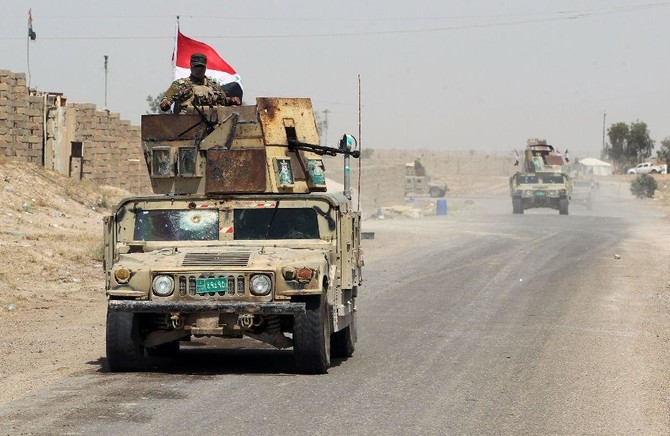
Iraqi pro-government forces reach al-Sejar village on the boundary of Fallujah, on May 28, 2016, as they take part in a major assault to retake the city from the Islamic State group Iraqi pro-government forces reach al-Sejar village on the boundary of Fallujah, on May 28, 2016, as they take part in a major assault to retake the city from the Islamic State group (AFP)
Updated 22 September 2017
Follow

Iraq forces oust Daesh from northern town in drive on Hawija

SHARQAT, Sharqat, Iraq: Iraqi forces achieved the first goal of a new offensive against the Daesh group on just its second day Friday, penetrating the northern town of Sharqat, AFP correspondents said.
Some residents celebrated in the streets as government troops and paramilitaries entered the town center and tore down the black flags of the jihadists who had ruled it with an iron fist for more than three years.
AFP correspondents saw little major damage in the town, although there had been casualties in the fighting as they saw the bodies of two jihadists in the back of a pickup.
Sharqat was the first goal of a major offensive launched on Thursday to recapture an Daesh-held enclave centered on the insurgent bastion of Hawija, one of just two pockets still controlled by the jihadists in Iraq.
Sector operations chief General Abdel Amir Yarallah said some 20 villages around Sharqat had also been recaptured from Daesh.
The next goal is Hawija itself, some 30 kilometers (20 miles) to the southeast.
After the defeat of Daesh in second city Mosul in July and the recapture of adjacent areas, Hawija and neighboring towns form the last enclave still held by Daesh in Iraq apart from a section of the Euphrates Valley downstream from the border with Syria.
The mainly Sunni Arab enclave, which was bypassed by government forces in their advance north to Mosul last year, has been a bastion of insurgency ever since the first year of the US-led occupation in 2003.
The territory still held by Daesh in the “caliphate” straddling Iraq and Syria it proclaimed in 2014 has dwindled, with stronghold after stronghold coming under assault on both sides of the border.
Iraq soldiers, police and paramilitaries launched an offensive against the jihadists’s other remaining enclave earlier this week, pushing up the Euphrates Valley toward the Daesh-held towns of Anna, Rawa and Al-Qaim.


Libya says UK to analyze black box from crash that killed general

Turkish soldier patrols as search and rescue operations continue at the wreckage site.
Updated 56 min 51 sec ago
Follow

Libya says UK to analyze black box from crash that killed general

  • General Mohammed Al-Haddad and 4 aides died after visit to Ankara, with Turkish officials saying electrical failure caused the Falcon 50 jet to crash shortly after takeoff

TRIPOLI: Libya said on Thursday that Britain had agreed to analyze the black box from a plane crash in Turkiye on December 23 that killed a Libyan military delegation, including the head of its army.
General Mohammed Al-Haddad and four aides died after a visit to Ankara, with Turkish officials saying an electrical failure caused their Falcon 50 jet to crash shortly after takeoff.
Three crew members, two of them French, were also killed.
The aircraft’s black box flight recorder was found on farmland near the crash site.
“We coordinated directly with Britain for the analysis” of the black box, Mohamed Al-Chahoubi, transport minister in the Government of National Unity (GNU), said at a press conference in Tripoli.
General Haddad was very popular in Libya despite deep divisions between west and east.
The North African country has been split since a NATO-backed revolt toppled and killed longtime leader Muammar Qaddafi in 2011.
Haddad was chief of staff for the internationally recognized GNU, which controls the west. The east is run by military ruler Khalifa Haftar.
Chahoubi told AFP a request for the analysis was “made to Germany, which demanded France’s assistance” to examine the aircraft’s flight recorders.
“However, the Chicago Convention stipulates that the country analizing the black box must be neutral,” he said.
“Since France is a manufacturer of the aircraft and the crew was French, it is not qualified to participate. The United Kingdom, on the other hand, was accepted by Libya and Turkiye.”
After meeting the British ambassador to Tripoli on Tuesday, Foreign Minister Taher Al-Baour said a joint request had been submitted by Libya and Turkiye to Britain “to obtain technical and legal support for the analysis of the black box.”
Chahoubi told Thursday’s press briefing that Britain “announced its agreement, in coordination with the Libyan Ministry of Transport and the Turkish authorities.”
He said it was not yet possible to say how long it would take to retrieve the flight data, as this depended on the state of the black box.
“The findings will be made public once they are known,” Chahoubi said, warning against “false information” and urging the public not to pay attention to rumors.