Deadly tropical storm Nate kills 22 in Central America, heads for US

A man walks near houses damaged by a mudslide during heavy rains of Tropical Storm Nate that affects the country in San Jose, Costa Rica on Friday, October 5, 2017. (REUTERS/Juan Carlos Ulate)
Updated 06 October 2017
Follow

Deadly tropical storm Nate kills 22 in Central America, heads for US

SAN JOSE, Costa Rica: Tropical Storm Nate has killed at least 22 people in Central America with torrential rains that forced thousands from their homes, uprooted trees, knocked out bridges and turned roads into rivers, officials said Thursday.
Forecasters predicted it will strengthen into a hurricane headed for Mexico and the United States.
The country hardest hit by the storm that began Wednesday was Nicaragua, with 11 dead and seven missing, Vice President Rosario Murillo told state media.
Officials in Costa Rica said eight people died including a three-year-old girl after they were hit by falling trees and mudslides, and two young Nicaraguan farm workers. At least 17 people were missing.
Costa Rica declared a national emergency as it struggled with mudslides, washed out roads and overflowing rivers.
Schools, universities, government offices and banks across the Central American nation were closed.
Three other people were killed in Honduras.
Nicaragua’s Murillo added that 800 people had been evacuated, nearly 600 homes were flooded and 14 communities were isolated because of rains that had been falling for days.
More than 5,000 people were being put up in shelters in Costa Rica after having to abandon their homes because of flooding and the risk of unstable ground giving way, the director of the National Emergency Commission, Ivan Brenes, said.
At least 18 main roads were closed and another dozen were only partially open. In Costa Rica’s northwest Guanacaste region popular with tourists many roads were so flooded as to be impassable to all but four-wheel-drive vehicles and horses.
As of Thursday night Nate was moving northwest along the east coast of Honduras and was expected to reach hurricane strength when it reaches the central Gulf of Mexico some time late Friday or early Saturday.
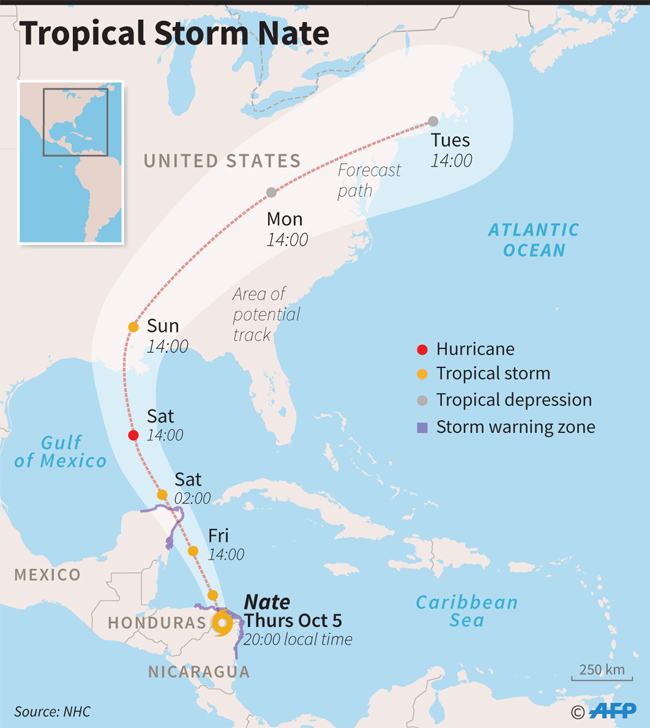
 

Storm or hurricane watches have been issued from Louisiana east through Mississippi and Alabama, the US National Hurricane Center said in a bulletin at 0300 GMT.
Some offshore oil and gas rigs in the Gulf of Mexico were being evacuated ahead of the storm, the US government Bureau of Safety and Environmental Enforcement said in a statement.
The United States is recovering from two major hurricanes: Hurricane Harvey that tore through Texas in August, and Hurricane Irma in September.
Another powerful storm, Hurricane Maria, ripped through the Caribbean in late September, wreaking destruction on several islands, including Dominica and Puerto Rico.

World Cup match postponed
In Costa Rica, an alert was issued for people to be wary of crocodiles that might be roaming after rivers and estuaries flooded.
Concerned football officials were monitoring the situation and postponed a World Cup qualifying match between Costa Rica and Honduras from Friday to Saturday.
Costa Rica’s main international airport was open, but with multiple flight cancelations and delays.

The annual rainy season is currently underway in Central America, a five-month period typically ending in November in which the risk of flooding and mudslides rise.
This year’s has been intense, with some areas in the region getting up to 50 percent more rain than average for September and October.

Palestinian protester, detained for nearly a year, says ‘inhumane’ jail conditions prompted seizure

Updated 5 sec ago
Follow

Palestinian protester, detained for nearly a year, says ‘inhumane’ jail conditions prompted seizure

A Palestinian woman who has been held in an immigration jail for nearly a year after she attended a protest in New York City said she suffered a seizure after fainting and hitting her head last week, an episode she linked to “filthy” and “inhumane” conditions inside the privately run detention facility.
Leqaa Kordia, 33, was hospitalized for three days following the seizure, which she said was the first of her life. She has since returned to the Prairieland Detention Facility in Texas, where she has been held since March.
In a statement released through her lawyers on Thursday, Kordia said she was shackled the entire time she was hospitalized and prevented from calling family or meeting with her lawyers.
“For three days in the emergency room, my hands and legs were weighed down by heavy chains as they drew my blood and gave me medications,” Kordia said. “I felt like an animal. My hands are still full of marks from the heavy metal.”
Her doctors, she said, told her the seizure may have been the result of poor sleep, inadequate nutrition and stress. Her lawyers previously warned that Kordia, a devout Muslim, had lost 49 pounds (22 kilograms) and fainted in the shower, in part because the jail had denied her meals that comply with religious requirements.
“I’ve been here for 11 months, and the food is so bad it makes me sick,” the statement continued. “At Prairieland, your daily life — whether you can have access to the food or medicine you need or even a good night’s sleep — is controlled by the private, for-profit business that runs this facility.”
Department of Homeland Security spokesperson Tricia McLaughlin didn’t immediately respond to a request for comment from The Associated Press, but said in a statement to The New York Times that Kordia wasn’t being mistreated and was receiving proper medical care.
A resident of New Jersey who grew up in the West Bank, Kordia was among around 100 people arrested outside Columbia University during protests at the school in 2024.
The charges against her were dismissed and sealed. But information about her arrest was later given to the Trump administration by the New York City police department, which said it was told the records were needed as part of a money laundering investigation.
Last year, Kordia was among the first pro-Palestinian protesters arrested in the Trump administration’s crackdown on noncitizens who had criticized Israel’s military actions in Gaza. She is the only one who remains jailed.
She has not been accused of a crime and has twice been ordered released on bond by an immigration judge. The government has challenged both rulings, an unusual step in cases that don’t involve serious crimes, which triggers a lengthy appeals process.
Kordia was taken into custody during a March 13 check-in with US Immigrations and Customs Enforcement. At the time, federal officials touted her arrest as part of the sweeping crackdown on pro-Palestinian campus activists, pointing to her 2024 arrest outside of Columbia as proof of “pro-Hamas” activities.
Kordia said she joined the demonstration after Israel killed scores of her relatives in Gaza, where she maintains deep personal ties. “My way of helping my family and my people was to go to the streets,” she told The Associated Press in October.
Federal officials have accused Kordia of overstaying her visa, while casting scrutiny on payments she sent to relatives in the Middle East. Kordia said the money was meant to help family members whose homes were destroyed in the war or were otherwise suffering.
An immigration judge later found “overwhelming evidence” that Kordia was telling the truth about the payments. Attorneys for Kordia say she was previously in the US on a student visa, but mistakenly surrendered that status after applying to remain in the country as the relative of a US citizen.
In her statement on Thursday, Kordia said the detention facility was “built to break people and destroy their health and hope.”
“The best medicine for me and everyone else here is our freedom,” she added.