

Daesh: Defeating the virtual caliphate

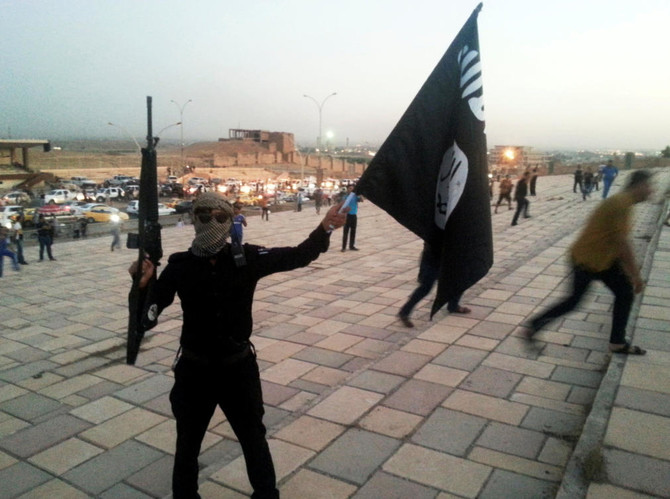
A fighter of Daesh holds a Daesh flag and a weapon on a street in the city of Mosul, Iraq, June 23, 2014. (Reuters)
Updated 06 October 2017
Follow

Daesh: Defeating the virtual caliphate

PARIS: Daesh may soon be defeated in Iraq and Syria but a “virtual caliphate” could be harder to conquer, experts and officials have warned.
The jihadist propaganda machine will continue to exist in hidden corners of the dark web, inciting sympathizers to action, they say.
“Defeating ISIL on the physical battlefield is not enough,” General Joseph Votel, the top commander for US military forces in the Middle East, warned in a paper earlier this year using another acronym for Daesh.
“Following even a decisive defeat in Iraq and Syria, ISIL will likely retreat to a virtual safe haven — a virtual caliphate — from which it will continue to coordinate and inspire external attacks as well as build a support base until the group has the capability to reclaim physical territory,” said Votel.
He described this online network as “a distorted version of the historic Islamic caliphate: it is a stratified community of Muslims who are led by a caliph (currently Abu Bakr Al-Baghdadi), aspire to participate in a state governed by sharia, and are located in the global territory of cyberspace.”
The Daesh group’s loss of almost all its territory in Iraq and in Syria has damaged its online communication efforts, following a boom in propaganda operations in 2014-2015.
But it has not put an end to it completely.
The Daesh “news agency” and propaganda machine Amaq continues to claim responsibility for attacks and incite further violence.
Most recently, it claimed that Stephen Paddock, the gunman who massacred 58 people in Las Vegas on Sunday, was a Daesh “soldier” — an assertion met with widespread skepticism.
One theory is that Daesh is seeking to keep up publicity efforts to maintain relevance with its sympathizers and continue to recruit support, even as it faces military defeat on the ground in Iraq and Syria.

Researcher Charlie Winter, who wrote a report on Daesh’s web presence for British think tank Quilliam, says the group will work to persuade followers that the idea of a caliphate is more important that its physical presence.
“Censoring the Internet is not going to work,” he told AFP.
“Policy makers are focusing their attention on the wrong part of the Internet, and that’s problematic given that it’s going to be a phenomenon to be dealt with in the next few years.
“Terrorists are now hiding in the deep web using encryption.
“There will always be a safe place for them on the Internet regardless of what politicians like to say.”
Under pressure from public authorities, Internet providers and major online players are beginning to put in place measures and procedures to disrupt IS’s exploitation of the web.
“But despite the increased vigilance of authorities and social networks the Islamic State has demonstrated significant resilience due to its flexibilty and ability to adapt when facing the suppression of online jihadist content,” according to French researchers Laurence Binder and Raphael Gluck.
“It manages to still disseminate sufficiently to reach a pool of sympathizers and recruits.”

Qatari minister reaffirms support for Lebanon, calls stability a regional priority

Updated 5 sec ago
Follow

Qatari minister reaffirms support for Lebanon, calls stability a regional priority

  • Mohammed bin Abdulaziz Al-Khulaifi said Lebanon remains key foreign policy priority, reveals economic, development and humanitarian measures
  • US ambassadors to Lebanon, Israel meet in Jordan to discuss peace efforts amid latest escalations

BEIRUT: Qatar’s Minister of State Mohammed bin Abdulaziz Al-Khulaifi on Monday reaffirmed Doha’s support for Lebanon during a meeting with President Joseph Aoun.

In a press conference he said that “Lebanon’s stability is a fundamental pillar for the stability of the entire region” and announced a package of economic, development and humanitarian measures.

The Qatari minister’s visit to Beirut coincided with Israeli military escalation in southern Lebanon, including the assassination of Hezbollah members by drones, incursions into the border area, and the demolition of more residences.

While the date for the meeting of the Ceasefire Monitoring Committee (Mechanism) agreement has yet to be confirmed, the US Embassy in Lebanon said in a press release on Monday that Washingt’s ambassadors to Beirut and Israel met in Jordan to discuss peace efforts through diplomacy and dialogue.

The meeting, hosted by the US Embassy in Amman last weekend, focused on the steps needed to achieve a more peaceful and prosperous region.

The visit by Qatar’s minister to Lebanon was made “upon the instructions of Emir Tamim bin Hamad Al-Thani,” according to Aoun’s media office.

“It is crucial to involve Lebanon in regional discussions, and Qatar is keen on this matter, as well as on following the situation in the country, especially the internal developments, Israeli attacks, the work of the committee, the dialogue, and efforts to find the necessary solutions,” Al-Khulaifi said.

Aoun expressed his thanks and appreciation to the Qatari minister for the visit and initiatives.

He said that the Lebanese military is carrying out its duties south of the Litani River in full, while Israeli attacks on southern villages and towns continue, destroying residential areas and displacing residents, at times extending to villages in the Bekaa Valley.

“Israel has not responded to repeated calls to abide by the agreement announced in November 2024 and implement Resolution 1701. This Israeli stance prevents the return of security and safety to the south, in addition to its repercussions on all levels,” he stated.

Aoun revealed that “contacts are ongoing before the meeting of the Mechanism committee scheduled for next month to reach practical results that will expedite the restoration of stability to the south, the withdrawal of Israeli forces, the return of prisoners, and enable the army to deploy to the internationally recognized southern border.”

He stressed that “pressuring Israel to facilitate the work of the Mechanism committee is essential to achieving the full implementation of Resolution 1701 in all its aspects.”

Aoun also spoke about the Lebanese military’s “need for equipment, vehicles, and supplies that would enable it to carry out its required tasks not only in the south but throughout all Lebanese territory.”

Regarding relations with Syria, Aoun affirmed that the situation on the Lebanese-Syrian border is better than before, and that negotiations are ongoing between the two countries to address several issues, particularly the return of Syrian refugees.

He added that Lebanon welcomes any Arab support in general, and Qatari support in particular, to help facilitate this return.

Al-Khulaifi also met with Parliament Speaker Nabih Berri and Prime Minister Nawaf Salam, and in a joint press conference stressed “the necessity for all parties to adhere to UN Security Council Resolution 1701 and respect the full sovereignty of the Lebanese Republic over its territory.

“We reiterate our complete condemnation of the Israeli attacks on Lebanese territory, which constitute an infringement on the sovereignty of our sister nation, Lebanon, and we emphasize the need for the Security Council to assume its responsibilities to stop these violations and to preserve Lebanon’s stability,” he said.

The minister announced a Qatar Fund for Development package — coordinated with Lebanese authorities within legal frameworks — including a $40 million grant and $360 million economic project to bolster Lebanon’s electricity sector, benefiting 1.5 million people nationwide.

Other measures include 185 scholarships over three years for Lebanese youth, the Sports for Development and Peace initiative to protect 4,400 children and young people in conflict areas, and reconstruction of Beirut’s Karantina Hospital, destroyed in the port explosion, with further health projects under review.

Qatar will also fund a $20 million first phase, in partnership with the International Organization for Migration, to support the voluntary return of 100,000 Syrian refugees. It guarantees housing upon return, plus three months of food and medicine to ensure stability and social reintegration.

“We thank the Syrian government for its constructive cooperation in facilitating the implementation of this humanitarian and development project,” the minister said.

Elsewhere on Monday, the Syrian Internal Security Directorate said it thwarted an attempt to smuggle missiles and ammunition through the Syrian town of Breij into Lebanon, according to SANA.

Breij, located east of Talkalakh on the border with Lebanon’s Akkar region, is considered a smuggling hub, according to a Lebanese security source.