GAZA CITY: A new round of Palestinian reconciliation talks experienced its first sign of trouble on Tuesday as the Hamas militant group said it would not give up its vast weapons arsenal, putting it at odds with both the rival Fatah movement and Israel.
The tough comments by the Hamas supreme leader, Ismail Haniyeh, provided a reminder of the long road that lies ahead after this week’s launch of talks with President Mahmoud Abbas’ Fatah movement, according to The Associated Press.
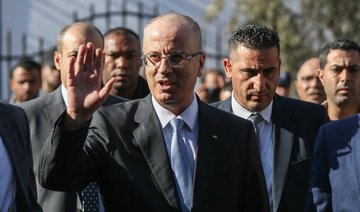
The Palestinian government on Tuesday held its weekly Cabinet meeting in Gaza for the first time in three years. Abbas’ Prime Minister Rami Hamdallah arrived in Hamas-controlled Gaza earlier on Monday as a practical step in the Palestinian national reconciliation agreement that was achieved through Egyptian mediation.
In a speech before the beginning of the meeting, Hamdallah said that the Fatah delegation came to Gaza to address administrative issues. “I urge everybody to unite and support the Palestinian leadership, and to prioritize the public interest over the factional one,” he said.
“We appreciate the important job Egypt did to grant the achievement of the reconciliation.”
Head of the Egyptian intelligence Khaled Fawzy traveled to Gaza to meet the Palestinian government, following a meeting in Ramallah with Abbas. Fawzy is the highest ranking Egyptian official to visit Gaza since 2007.
“I’m convinced that you are able to implement your promises for the benefit of your people,” he said. “I’m waiting for you in Cairo, your home, and you will do it and succeed. History will register that you have unified your people.”
In a televised speech, Egyptian President Abdel Fattah El-Sisi stressed that Egypt seeks to fulfill the demands of the Palestinian people, and that disagreements must be resolved with the cooperation of all Arab countries.
Hamas congratulated the Palestinian people on the development, saying, “We, as the Hamas movement, are looking to flip the chapter of division, and to open a new chapter full of tolerance.”
In a TV interview, Hamas leader Ismail Haniyeh said his group would never give up its armed struggle against Israel.
“As long as there is occupation on the ground, our people have the right to possess weapons and resist the occupation with all forms of resistance,” he told a private TV channel.
In a gesture to Abbas, he said Hamas will not go back to war against Israel unilaterally. “We are ready to negotiate with the Palestinian factions and Fatah on unifying the decision of peace and war,” he said.
Such concessions are unlikely to satisfy Abbas, who issued his own tough statement late Monday saying that “everything must be in the hands of the Palestinian Authority.”
He said he would not agree to reproduce the “Hezbollah model” of Lebanon, where the armed militant group acts freely under the watch of a weak central government.
Israeli Prime Minister Benjamin Netanyahu, meanwhile, said his government will not accept a reconciliation deal between rival Palestinian factions that puts Israel at risk.
He said any deal must include recognizing Israel, disbanding Hamas’ military wing and cutting ties with Hamas’ patron Iran.
While previous reconciliation attempts have failed, years of international isolation and steadily worsening conditions in Gaza have pushed Hamas toward compromise.
The real work begins next week in Cairo, where Egyptian mediators will host talks between the Palestinian rivals. There is no set time frame for the negotiations.


![]()

First rifts emerge in Palestinian reconciliation talks
First rifts emerge in Palestinian reconciliation talks


Latest updates


© 2026 SAUDI RESEARCH & PUBLISHING COMPANY, All Rights Reserved And subject to Terms of Use Agreement.