Palestinian government meets in Gaza for first time since 2014

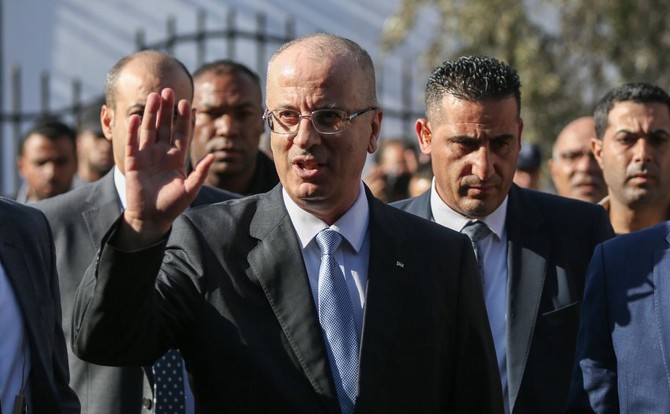
Palestinian Prime Minister Rami Hamdallah arrives to attend a cabinet meeting in Gaza City on October 3, 2017. The Palestinian reconciliation government met in Gaza for the first time since 2014 as moves intensify to end the decade-old rift between the main political factions. (AFP/Mohammed Abed)
Updated 03 October 2017
Follow

Palestinian government meets in Gaza for first time since 2014

GAZA CITY, Palestinian Territories: The Palestinian cabinet met in Gaza on Tuesday for the first time since 2014 in a further step toward the internationally recognized Palestinian Authority (PA) retaking control of the territory.
In an opening speech, Prime Minister Rami Hamdallah renewed his pledge to end a decade-long split between the Islamist Hamas movement that controls Gaza and his West Bank-based government.
“We are here to turn the page on division, restore the national project to its correct direction and establish the (Palestinian) state,” he said.
The session took place at the official Gaza residence of Palestinian president Mahmud Abbas in the cabinet office, hung with portraits of Abbas and historic Palestinian leader Yasser Arafat.
It was the first meeting of the cabinet in Gaza since November 2014, although Hamdallah visited a year later without his ministers.
Hamas ousted the PA from Gaza after bloody street fighting in 2007, but finally agreed last month to its return, under pressure from the territory’s powerful neighbor Egypt.
A visiting Egyptian official told AFP that his country’s intelligence chief, Khaled Fawzi, was expected to meet Hamas leader Ismail Haniya in Gaza later on Thursday.
UN Middle East envoy Nickolay Mladenov said on Monday that he was “carefully optimistic” about the reconciliation talks.
“If the region stays engaged, if Egypt’s role continues and if the political parties themselves continue to show the willingness they are currently showing to work with us on this process, then it can succeed,” he told AFP.


UN rights chief Shocked by ‘unbearable’ Darfur atrocities

Updated 18 January 2026
Follow

UN rights chief Shocked by ‘unbearable’ Darfur atrocities

  • Mediation efforts have failed to produce a ceasefire, even after international outrage intensified last year with reports of mass killings, rape, and abductions during the RSF’s takeover of El-Fasher in Darfur

PORT SUDAN: Nearly three years of war have put the Sudanese people through “hell,” the UN’s rights chief said on Sunday, blasting the vast sums spent on advanced weaponry at the expense of humanitarian aid and the recruitment of child soldiers.
Since April 2023, Sudan has been gripped by a conflict between the army and the paramilitary Rapid Support Forces that has left tens of thousands of people dead and around 11 million displaced.
Speaking in Port Sudan during his first wartime visit, UN Human Rights commissioner Volker Turk said the population had endured “horror and hell,” calling it “despicable” that funds that “should be used to alleviate the suffering of the population” are instead spent on advanced weapons, particularly drones.
More than 21 million people are facing acute food insecurity, and two-thirds of Sudan’s population is in urgent need of humanitarian aid, according to the UN.
In addition to the world’s largest hunger and displacement crisis, Sudan is also facing “the increasing militarization of society by all parties to the conflict, including through the arming of civilians and recruitment and use of children,” Turk added.
He said he had heard testimony of “unbearable” atrocities from survivors of attacks in Darfur, and warned of similar crimes unfolding in the Kordofan region — the current epicenter of the fighting.
Testimony of these atrocities must be heard by “the commanders of this conflict and those who are arming, funding and profiting from this war,” he said.
Mediation efforts have failed to produce a ceasefire, even after international outrage intensified last year with reports of mass killings, rape, and abductions during the RSF’s takeover of El-Fasher in Darfur.
“We must ensure that the perpetrators of these horrific violations face justice regardless of the affiliation,” Turk said on Sunday, adding that repeated attacks on civilian infrastructure could constitute “war crimes.”
He called on both sides to “cease intolerable attacks against civilian objects that are indispensable to the civilian population, including markets, health facilities, schools and shelters.”
Turk again warned on Sunday that crimes similar to those seen in El-Fasher could recur in volatile Kordofan, where the RSF has advanced, besieging and attacking several key cities.
Hundreds of thousands face starvation across the region, where more than 65,000 people have been displaced since October, according to the latest UN figures.