New agreements signal improved Jordan-Palestine relations

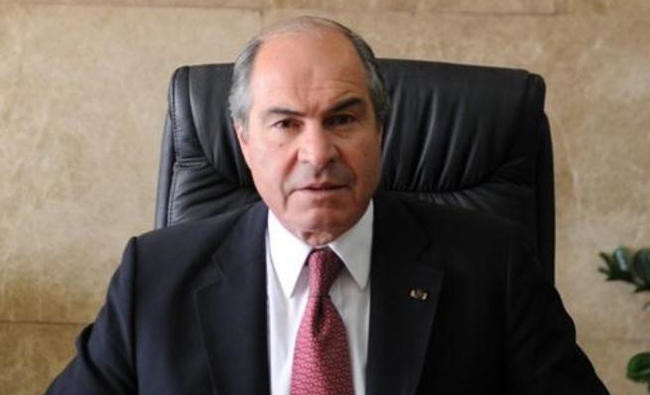
Jordanian Prime Minister Hani Mulki. (AFP file photo)
Updated 29 September 2017
Follow

New agreements signal improved Jordan-Palestine relations

AMMAN: Jordanian-Palestinian relations witnessed a marked improvement Wednesday with the signing of five agreements.
The deals were signed during a meeting headed by Jordanian Prime Minister Hani Mulki and his Palestinian counterpart Rami Hamdallah, which included ministers and businesspeople from both sides.
Jordanian government spokesman Mohammed Momani told Arab News that the deals cover the energy, education, health, infrastructure, housing, tenders and social development sectors.
Mulki expressed hope for increased trade between the two sides, which stood at $176 million in 2016 and $90 million in the first half of 2017, Jordan’s Petra news agency reported.
Palestinian news agency WAFA quoted Hamdallah as saying: “Under these circumstances — a military occupation and a 70 percent drop in foreign assistance — the Palestinian government has been working on maximizing the benefits of local resources, and rationalizing expenditure and the use of available resources.”
Former Jordanian MP Hamadeh Farneh told Arab News that the meeting “is a sign of improving relations between both sides.”
Attendees stressed the need to complete joint projects. Jordan’s Industry, Trade and Supply Minister Yarub Qudah said the two sides exhibited a high degree of “determination” to take cooperation to a new level, Petra reported.
Palestinian Economy Minister Abeer Oudah said both sides agreed to do more to encourage the private sector to increase its investments, with Palestinians expressing interest in benefiting from Jordan’s experience in industrial estates.
Petra reported that deals were reached to establish a joint company to organize the transport of Palestinian Hajj and Umrah pilgrims, and a joint company to market agricultural produce.
Maha Sayegh, economic attache at the Palestinian Embassy in Amman, told Arab News: “We were able to cancel or simplify most of the obstacles that existed in terms of economic trade between Palestine and Jordan.”


Iraqi army fully takes over key base following US withdrawal

Updated 6 sec ago
Follow

Iraqi army fully takes over key base following US withdrawal

BAGHDAD: US forces have fully withdrawn from an air base in western Iraq in implementation of an agreement with the Iraqi government, Iraqi officials said Saturday.
Washington and Baghdad agreed in 2024 to wind down a US-led coalition fighting the Daesh group in Iraq by September 2025, with US forces departing bases where they had been stationed.
However, a small unit of US military advisers and support personnel remained. Iraqi Prime Minister Mohammed Shia Al-Sudani in October told journalists that the agreement originally stipulated a full pullout of US forces from the Ain Al-Asad air base in western Iraq by September. But “developments in Syria” since then required maintaining a “small unit” of between 250 and 350 advisers and security personnel at the base.
Now all US personnel have departed.
Iraqi Army Chief of Staff Lt. Gen. Abdul Amir Rashid Yarallah oversaw the assignment of tasks and duties to various military units at the base on Saturday following the withdrawal of US forces and the Iraqi Army’s full assumption of control over the base, the military said in a statement.
The statement added that Yarallah “instructed relevant authorities to intensify efforts, enhance joint work, and coordinate between all units stationed at the base, while making full use of its capabilities and strategic location.”
A Ministry of Defense official who spoke on condition of anonymity because he was not authorized to comment publicly confirmed that all US forces had departed the base and had also removed all American equipment from it.
There was no statement from the US military on the withdrawal.
US forces have retained a presence in the semi-autonomous Kurdish region in northern Iraq and in neighboring Syria.
The departure of US forces may strengthen the hand of the government in discussions around disarmament of non-state armed groups in the country, some of which have used the presence of US troops as justification for keeping their own weapons.
Al-Sudani said in a July interview with The Associated Press that once the coalition withdrawal is complete, “there will be no need or no justification for any group to carry weapons outside the scope of the state.”