

MANILA: The Philippine military has released aerial footage showing Daesh-backed Maute militants looting houses and other establishments in Marawi, confirming an earlier Arab News story about looting in the strife-torn city.
In the undated video footage, which was shown to media over the weekend, armed men believed to be members of the Maute group can be seen pillaging what appears to be a residential building in city’s main conflict zone.
The military said this reinforces earlier testimony from rescued hostages that suggested the terrorists are looting the area for valuable items. “We can see items, boxes, sacks being taken from a seemingly residential building,” said Col. Romeo Brawner, Jr., deputy commander of Task Force Ranao.
He said the exact location of the structures caught on the video being ransacked by the terrorists is now being determined with the help of local officials.
On July 25, Arab News ran an exclusive story on how the Maute group had amassed weapons and cash amounting to approximately 1.2 billion pesos ($23.7 million).
This was based on information provided by a high-ranking government official who said the group amassed this wealth from the different banks and houses they looted in Marawi, bagging gold and jewelry, as well as from drug money. The information, according to the source, was confirmed by a military general who is serving in Western Mindanao Command (Wesmincom).
Speaking on condition of anonymity, the source said the military has drone footage that shows several sacks of money being loaded into a pickup truck.
In this footage, he said, you can see one of the sacks falling down from the truck and paper bills scattering. The 1.2 billion pesos estimate was made based on the footage.
At the start of the crisis in Marawi, the military quoted residents — who had been held hostage, but managed to escape from the Maute group — as saying that they were forced to loot houses and government buildings.
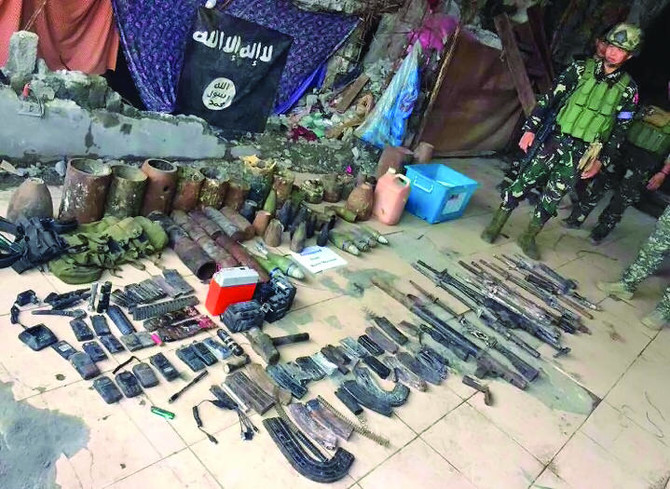
During a press briefing in Marawi last Friday, the military also showed the media recovered coins contained in six sacks. The coins, along with other metals, were reportedly being used as shrapnel by the terrorists in making improvised explosive devices (IEDs).
One official remarked that this explains why some of the government troops wounded in the ongoing clashes in Marawi had coins in their wounds.
Philippine President Rodrigo Duterte earlier expressed hope that the Marawi conflict would be over by the end of September, but this did not happen as expected.
The military vowed to fight harder to rescue remaining hostages, neutralize the Maute group, and regain control of Marawi in the shortest possible time to ensure that the rehabilitation of the city continues unhampered.
Col. Edgard Arevalo, chief of the Armed Forces of the Philippines (AFP) Public Affairs Office, said government forces are prepared to hunt down the remaining members of the Maute group.
“We will pursue them to the edges of the earth,” Arevalo said. “We believe that they are going to fight.”
This, he said, is because “there’s a lot of money and jewelry that (the militants) looted and we know that they are still hoping to get out of Marawi.”


