MANILA: Philippine troops rescued a catholic priest held hostage for almost four months by Daesh-linked rebels after an offensive that captured a stronghold of the militants in southern Marawi City, defense officials said on Monday.
Marawi’s vicar-general Father Teresito “Chito” Soganub was kidnapped along with other Christians as militants rampaged through the city on May 23, burning churches and schools, releasing prisoners and seizing arms in a well-planned assault.
Soganub, flanked by Defense Secretary Delfin Lorenzana and military chief General Eduardo Ano, appeared to be in good health and high spirits when he was presented to the media in Manila. He expressed his thanks but gave no statement.
“Our troops gained the upper hand, the terrorists were forced to withdraw to nearby structures on the periphery of the mosque,” Lorenzana told a media briefing in Manila, referring to the Bato mosque held by the rebels for 117 days.
“Troops had opportunity to snatch Father Chito...”
The appearance of Soganub is some rare good news for a military that has suffered a string of setbacks in Marawi, from deadly accidents during a controversial campaign of air strikes to repeatedly missing deadlines on when the battle would be won.
The siege of the city by an alliance of rebels from the island of Mindanao, and numerous foreign fighters, has been the biggest internal security crisis in years for the Philippines, a country used to separatist and communist rebellions.
Soganub made an appearance under duress in a militant propaganda video about a week after his capture, urging the government to stop the military operation in Marawi in exchange for sparing lives of hostages.
The priest was among scores held by militants at the Bato mosque, one of Marawi’s largest, which troops captured on Saturday afternoon. He was rescued along with another hostage, Lordvin Ocopio.
The rebels who laid siege to Marawi are from an extremist faction of the Abu Sayyaf group, led by Isnilon Hapilon, the so-called “emir” of Southeast Asia, and members of the militant Maute family, which has deep clan connections in the lakeside town and surrounding areas.
Military chief Ano said about 10 foreigners were still in the battle among some 50-60 rebels, who were holding 45-50 hostages.
Hapilon was among those still fighting but several of the Maute brothers were likely dead, Ano added, citing information provided by civilians who escaped and some captured rebels.
As of Monday, 149 members of government forces had died in combat, along with 47 civilians.
More than 670 militants have been killed, according to a military estimate of bodies recovered and targets hit.


![]()
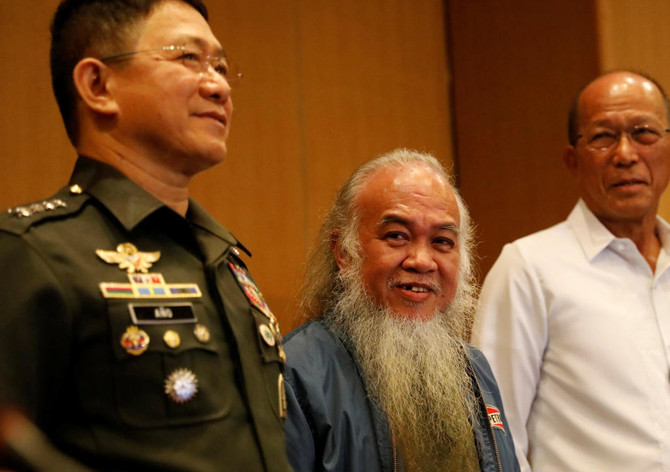
Priest rescued as Philippine troops retake Marawi militant stronghold
Priest rescued as Philippine troops retake Marawi militant stronghold


Latest updates


Recommended


© 2026 SAUDI RESEARCH & PUBLISHING COMPANY, All Rights Reserved And subject to Terms of Use Agreement.