India, US deepen defense ties during Mattis visit

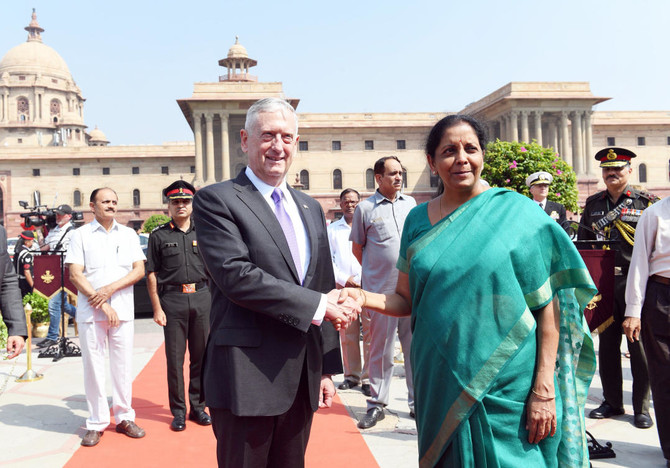
US Defense Secretary Jim Mattis, left, shakes hands with Indian Defense Minister Nirmala Sitharaman at the Indian Ministry of Defense prior to a meeting in New Delhi on Tuesday. (AFP)
Updated 27 September 2017
Follow

India, US deepen defense ties during Mattis visit

NEW DELHI: India and the US have agreed to enhance maritime cooperation in the Indian Ocean, deepen defense ties and undertake joint efforts against terrorism.
In a day-long visit on Tuesday, US Defense Secretary James Mattis met with his Indian counterpart Nirmala Sitharaman in New Delhi.
“It’s a historic opportunity to reshape the relationship, and the US recognizes India as a core of regional stability and security, and it reflects our desire for long-term strategic partnership in the 21st century,” Mattis said in a statement after the meeting.
Sitharaman said: “Defense cooperation between India and the US has grown significantly in recent years, and has emerged as a key pillar of our strategic partnership.”
Mattis, the Trump administration’s first Cabinet secretary to visit India, said “as global leaders, India and the United States resolve to work together to eradicate this scourge” of terrorism.
Mattis expressed appreciation over India’s role in “promoting democracy and security” in Afghanistan, but Sitharaman said: “There shall not be any Indian boots on the ground.”
An Indian Defense Ministry source told Arab News: “The US wants New Delhi to play a proactive role, but India isn’t willing to do that. This is a point of difference between the two countries.”
There was no announcement on the sale of Guardian unmanned drones to India. Washington had offered to sell them during Prime Minister Narendra Modi’s visit to the US in June.
“The deal on the Guardian drones depends on the US Congress. The White House has just approved it,” Dhruva Jaishankar, a fellow in foreign policy studies at Brookings India, told Arab News.
There was no statement on the proposal to manufacture F-16 and F-18A fighter planes in India, as was anticipated.
“Secretary Mattis and I agreed that we need to expand on the progress already made by encouraging co-production and co-development efforts,” said Sitharaman. “I reiterated India’s deep interest in enhancing defense manufacturing in India.”
Chintamani Mohapatra, an academic at the New Delhi-based Jawaharlal Nehru University, said: “Defense deals take time to mature. The important partnership between India and the US is important for global peace and stability, particularly in the Indo-Pacific region.”
Mattis said: “Maritime engagement is our top priority. Annual maritime security dialogue is an important mechanism to develop shared understanding of the challenges we face.”
Some experts say this is aimed at counterbalancing China’s growing maritime presence in the Indian Ocean.
“Beijing is using its maritime power to block freedom of navigation for other parties. That’s a major concern for both New Delhi and Washington,” said Jaishankar.


Afghan returnees in Bamiyan struggle despite new homes

Updated 58 min 44 sec ago
Follow

Afghan returnees in Bamiyan struggle despite new homes

  • More than five million Afghans have returned home since September 2023, according to the International Organization for Migration

BAMIYAN, Afghanistan: Sitting in his modest home beneath snow-dusted hills in Afghanistan’s Bamiyan province, Nimatullah Rahesh expressed relief to have found somewhere to “live peacefully” after months of uncertainty.
Rahesh is one of millions of Afghans pushed out of Iran and Pakistan, but despite being given a brand new home in his native country, he and many of his recently returned compatriots are lacking even basic services.
“We no longer have the end-of-month stress about the rent,” he said after getting his house, which was financed by the UN refugee agency on land provided by the Taliban authorities.
Originally from a poor and mountainous district of Bamiyan, Rahesh worked for five years in construction in Iran, where his wife Marzia was a seamstress.
“The Iranians forced us to leave” in 2024 by “refusing to admit our son to school and asking us to pay an impossible sum to extend our documents,” he said.
More than five million Afghans have returned home since September 2023, according to the International Organization for Migration (IOM), as neighboring Iran and Pakistan stepped up deportations.
The Rahesh family is among 30 to be given a 50-square-meter (540-square-foot) home in Bamiyan, with each household in the nascent community participating in the construction and being paid by UNHCR for their work.
The families, most of whom had lived in Iran, own the building and the land.
“That was crucial for us, because property rights give these people security,” said the UNHCR’s Amaia Lezertua.
Waiting for water
Despite the homes lacking running water and being far from shops, schools or hospitals, new resident Arefa Ibrahimi said she was happy “because this house is mine, even if all the basic facilities aren’t there.”
Ibrahimi, whose four children huddled around the stove in her spartan living room, is one of 10 single mothers living in the new community.
The 45-year-old said she feared ending up on the street after her husband left her.
She showed AFP journalists her two just-finished rooms and an empty hallway with a counter intended to serve as a kitchen.
“But there’s no bathroom,” she said. These new houses have only basic outdoor toilets, too small to add even a simple shower.
Ajay Singh, the UNHCR project manager, said the home design came from the local authorities, and families could build a bathroom themselves.
There is currently no piped water nor wells in the area, which is dubbed “the dry slope” (Jar-e-Khushk).
Ten liters of drinking water bought when a tanker truck passes every three days costs more than in the capital Kabul, residents said.
Fazil Omar Rahmani, the provincial head of the Ministry of Refugees and Repatriation Affairs, said there were plans to expand the water supply network.
“But for now these families must secure their own supply,” he said.
Two hours on foot
The plots allocated by the government for the new neighborhood lie far from Bamiyan city, which is home to more than 70,000 people.
The city grabbed international attention in 2001, when the Sunni Pashtun Taliban authorities destroyed two large Buddha statues cherished by the predominantly Shia Hazara community in the region.
Since the Taliban government came back to power in 2021, around 7,000 Afghans have returned to Bamiyan according to Rahmani.
The new project provides housing for 174 of them. At its inauguration, resident Rahesh stood before his new neighbors and addressed their supporters.
“Thank you for the homes, we are grateful, but please don’t forget us for water, a school, clinics, the mobile network,” which is currently nonexistent, he said.
Rahmani, the ministry official, insisted there were plans to build schools and clinics.
“There is a direct order from our supreme leader,” Hibatullah Akhundzada, he said, without specifying when these projects will start.
In the meantime, to get to work at the market, Rahesh must walk for two hours along a rutted dirt road between barren mountains before he can catch a ride.
Only 11 percent of adults found full-time work after returning to Afghanistan, according to an IOM survey.
Ibrahimi, meanwhile, is contending with a four-kilometer (2.5-mile) walk to the nearest school when the winter break ends.
“I will have to wake my children very early, in the cold. I am worried,” she said.