Lebanon's president says Syrian refugees must return home

Lebanon's President Michel Aoun with Paris Mayor Anne Hidalgo in Paris on Tuesday. (Reuters)
Updated 26 September 2017
Follow

Lebanon's president says Syrian refugees must return home

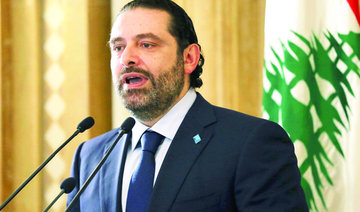
PARIS: Lebanese President Michel Aoun said he wanted some 1.5 million Syrian refugees living in his country to henceforth start returning to their homes, voluntarily or not.
Aoun, in a state visit to France, said UN assistance given to aid Syrian refugees in “camps of misery” in Lebanon would be better used to return them to their country “from now on.”
“We don’t want to wait for their voluntary return,” Aoun insisted, speaking at the Elysee Palace alongside French President Emmanuel Macron.
Aoun said that most of the Syrian regions from which the refugees hail are “now secure.”
Macron distanced himself from his counterpart’s viewpoint, saying that the absence of a political solution in Syria prevents refugees from returning back home permanently.
In a separate development, hundreds of Lebanese civil servants protested in front of the government’s capital building Tuesday, on the second day of strikes demanding pay in line with a stalled wage hike.
Prime Minister Saad Hariri’s Cabinet, which approved the wage hike earlier this summer, put off any decrees until Thursday, when it will reconvene with President Aoun to discuss the matter.
The Union Coordination Committee vowed to extend its strike through Thursday after forcing government offices and many schools to stay closed through the start of the week.
“We can’t make a dignified living on our salaries,” said Hoda Ghazi, a teacher at the protest outside the government’s Grand Serail building. “We’re not able to raise this generation properly.”
Public school teachers have not seen a cost of living increase or salary hike since 2012, according to Mahmoud Haidar, a former board member of the UCC.
The wage hike was supposed to be financed by an unpopular tax bill passed this summer.
Opposition parties and unions have demanded that politicians instead recover revenues by combatting corruption.
Lebanon’s top court ruled the new tax law unconstitutional last week because it was passed without a budget.
The decision left the government scrambling for ways to finance the wage bill, costing an estimated $800 million, as public servants expected to see raises this month.
Lebanon has been unable to agree on a state budget since 2005, financing itself instead through ad hoc budgetary measures. Its public debt stands near 150 percent of national income, according to the Ministry of Finance, making Lebanon one of the most indebted nations globally.
Poultry workers were also present at Tuesday’s demonstration, demanding higher tariffs on imports of frozen chicken.


Saudi intervention ends Socotra power crisis

Updated 5 sec ago
Follow

Saudi intervention ends Socotra power crisis

  • Sudden shutdown of the power plants after the operating company withdrew and disabled control systems
  • Saudi engineering and technical teams moved immediately after receiving an appeal from local authorities

ADEN: Electricity has returned to Yemen’s Socotra archipelago after urgent Saudi intervention ended days of outages that disrupted daily life and crippled vital institutions, including the general hospital, the university and the technical institute.

The breakthrough followed a sudden shutdown of the power plants after the operating company withdrew and disabled control systems, triggering widespread blackouts and deepening hardship for residents.

The Saudi Development and Reconstruction Program for Yemen said that its engineering and technical teams moved immediately after receiving an appeal from local authorities. Specialists were dispatched to reactivate operating systems that had been encrypted before the company left the island.

Generators were brought back online in stages, restoring electricity across most of the governorate within a short time.

The restart eased intense pressure on the grid, which had faced rising demand in recent weeks after a complete halt in generation.

Health and education facilities were among the worst affected. Some medical departments scaled back services, while parts of the education sector were partially suspended as classrooms and laboratories were left without power.

Socotra’s electricity authority said that the crisis began when the former operator installed shutdown timers and password protections on control systems, preventing local teams from restarting the stations. Officials noted that the archipelago faced a similar situation in 2018, which was resolved through official intervention.

Local sources said that the return of electricity quickly stabilized basic services. Water networks resumed regular operations, telecommunications improved, and commercial activity began to recover after a period of economic disruption linked to the outages.

In the health sector, stable power, combined with operational support, secured the functioning of Socotra General Hospital, the archipelago’s main medical facility.

Funding helped to provide fuel and medical supplies and support healthcare staff, strengthening the hospital’s ability to receive patients and reducing the need to transfer cases outside the governorate, a burden that had weighed heavily on residents.

Medical sources said that critical departments, including intensive care units and operating rooms, resumed normal operations after relying on limited emergency measures.

In education, classes and academic activities resumed at Socotra University and the technical institute after weeks of disruption.

A support initiative covered operational costs, including academic staff salaries and essential expenses, helping to curb absenteeism and restore the academic schedule.

Local authorities announced that studies at the technical institute would officially restart on Monday, a move seen as a sign of gradual stabilization in public services.

Observers say that sustained technical and operational support will be key to safeguarding electricity supply and preventing a repeat of the crisis in a region that depends almost entirely on power to run its vital sectors.