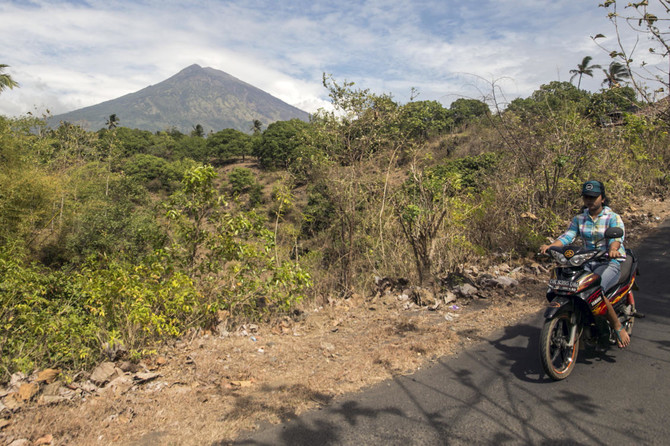
KARANGASEM, Indonesia: Nearly 50,000 people have evacuated their homes amid fears of an imminent volcanic eruption on the Indonesian resort island of Bali, disaster officials said Monday.
Mount Agung, about 75 kilometers (47 miles) from the tourist hub of Kuta, has been rumbling since August, threatening to erupt for the first time in more than 50 years.
Indonesia’s disaster mitigation agency said Monday 48,540 people had fled, although the number was expected to rise because more than 60,000 people lived in the danger zone.
“There are still people who don’t want to be evacuated,” Sutopo Purwo Nugroho, a spokesman for the disaster mitigation agency, said at a press conference.
“The reason is firstly, the mountain hasn’t erupted yet. Secondly, they are worried about their livestock.”
Officials announced the highest possible alert level on Friday following the increasing volcanic activity, and told people to stay at least nine kilometers away from the crater.
Evacuees have packed into temporary shelters or moved in with relatives.
Some 2,000 cows have been also evacuated from the flanks of the volcano.
Nengah Satiya, who left home with his wife three days ago, said he had been returning to the danger zone to tend to his pigs and chickens.
“There are many livestock in our village but nobody is taking them,” Nengah Satiya told AFP. “We take turns going back to feed them.”
The airport in Bali’s capital Denpasar, through which millions of foreign tourists pass every year, has not been affected.
More than 1,000 people died when Mount Agung last erupted in 1963.

Nearly 50,000 flee amid fears of Bali volcanic eruption
Chile wildfires leave 19 dead amid extreme heat as scores evacuated
- Fast-moving wildfires being worsened by intense heat, winds
- Firefighters battling 23 active blazes spreading toward cities
CONCEPCION, Chile: Wildfires in Chile have left at least 19 people dead, authorities said on Monday, as the government carried out mass evacuations and fought nearly two dozen blazes exacerbated by intense heat and high winds.
While weather conditions overnight helped control some fires, the largest were still active, with adverse conditions expected throughout the day, security minister, Luis Cordero, said at a news briefing on Monday.
“The projection we have today is of high temperatures,” Cordero said, and the main worry was that new fires would be triggered throughout the region.
Parts of central and southern Chile were under extreme heat warnings with temperatures expected to reach up to 37 Celsius (99 Fahrenheit).
STATE OF EMERGENCY DECLARED IN NUBLE, BIO BIO
As of late Sunday, Chile’s CONAF forestry agency said firefighters were combating 23 fires across the country, the largest of which were in regions of Ñuble and Bío Bío, where President Gabriel Boric declared a state of catastrophe.
Over 20,000 hectares (77 square miles) have been razed so far, an area about the size of Seattle, with the largest fire surpassing 14,000 hectares on the outskirts of the coastal city Concepcion.
The fast-moving blaze tore through the towns of Penco and Lirquen over the weekend, destroying hundreds of homes and killing several people, with authorities still assessing the damage.
HEAT, BLAZES ALSO IMPACT ARGENTINA
Authorities are currently battling the fire as it threatened Manzano prison on the edge of Concepcion and the town of Tome to the north.
Both Chile and Argentina rang in the new year with heat waves which have continued into January. Earlier this month, wildfires broke out in Argentina’s Patagonia, burning around 15,000 hectares.
While weather conditions overnight helped control some fires, the largest were still active, with adverse conditions expected throughout the day, security minister, Luis Cordero, said at a news briefing on Monday.
“The projection we have today is of high temperatures,” Cordero said, and the main worry was that new fires would be triggered throughout the region.
Parts of central and southern Chile were under extreme heat warnings with temperatures expected to reach up to 37 Celsius (99 Fahrenheit).
STATE OF EMERGENCY DECLARED IN NUBLE, BIO BIO
As of late Sunday, Chile’s CONAF forestry agency said firefighters were combating 23 fires across the country, the largest of which were in regions of Ñuble and Bío Bío, where President Gabriel Boric declared a state of catastrophe.
Over 20,000 hectares (77 square miles) have been razed so far, an area about the size of Seattle, with the largest fire surpassing 14,000 hectares on the outskirts of the coastal city Concepcion.
The fast-moving blaze tore through the towns of Penco and Lirquen over the weekend, destroying hundreds of homes and killing several people, with authorities still assessing the damage.
HEAT, BLAZES ALSO IMPACT ARGENTINA
Authorities are currently battling the fire as it threatened Manzano prison on the edge of Concepcion and the town of Tome to the north.
Both Chile and Argentina rang in the new year with heat waves which have continued into January. Earlier this month, wildfires broke out in Argentina’s Patagonia, burning around 15,000 hectares.
© 2026 SAUDI RESEARCH & PUBLISHING COMPANY, All Rights Reserved And subject to Terms of Use Agreement.