55% of Brits support racial profiling of Muslims: Arab News/YouGov poll

Updated 25 September 2017
Follow

55% of Brits support racial profiling of Muslims: Arab News/YouGov poll

LONDON: The majority of Britons agree with racial profiling of Arabs and Muslims, and 69 percent think the UK should take in fewer refugees from Syria and Iraq, an Arab News/YouGov poll has found.
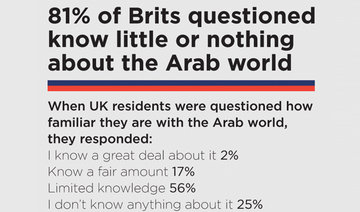
The wide-ranging poll of 2,142 adults found that UK residents have strong feelings about key Middle East issues — including the fight against Daesh and war in Iraq — but 81 percent admitted to knowing little or nothing about the Arab world.
The results of the “UK attitudes toward the Arab world” survey are published today in Arab News and are being unveiled at a media event held in London.
One of the main findings of the poll, which was conducted in conjunction with the Council for Arab-British Understanding (CAABU), was that 55 percent of Brits agree with racial profiling against Arabs and Muslims for security reasons.
The “UK attitudes toward the Arab world” poll, which was conducted in mid-August, illustrates a disparity in UK public opinion on the Arab world.
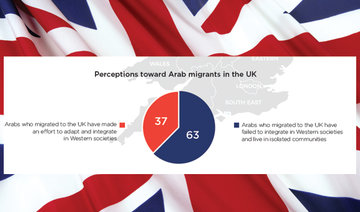
Seven in 10 believe the UK should take in fewer refugees from Syria and Iraq, rising to 91 percent among those who voted for the UK to leave the EU in the 2016 referendum. More than six in 10 of the respondents feel that Arabs who migrated to the UK and Europe have failed to integrate in Western societies.
But 72 percent also point to the problem of rising Islamophobia in the UK, with 70 percent saying anti-refugee statements from politicians and others risk sparking more hate crimes.
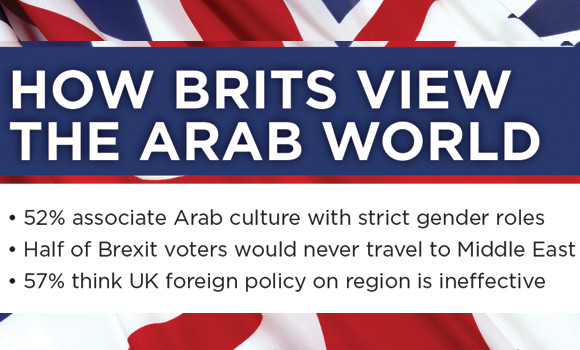
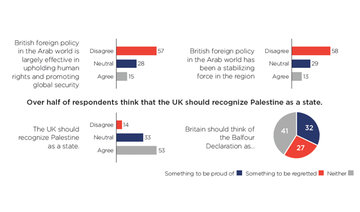
The poll found that 53 percent of respondents believe the UK should recognize Palestine as a state. Most Brits are dissatisfied with UK foreign policy on the Arab world, with 57 percent saying it has been largely ineffective in upholding human rights and promoting global security. More than half of those polled support Britain’s current military intervention against Daesh, while eight in 10 Brits believe going to war in Iraq in 2003 was wrong.
Despite holding strong views on these key topics, most Brits admit to knowing little or nothing about the Arab world, and 41 percent say they would never travel to the region.
“The poll results strongly suggest that the UK public is dissatisfied with British diplomatic intervention in the Arab world, but that Brits also lack knowledge about some of the complexities of the region,” said Faisal J. Abbas, the editor in chief of Arab News.
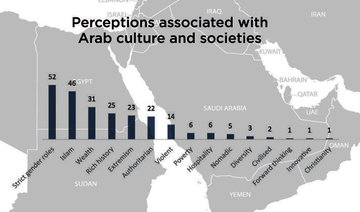
“The Arab world is home to some of the poorest countries in the world, yet nearly a third of Brits associate it with being wealthy. One may ask what impact such perceptions might have on aid decisions made by Western governments.”
Chris Doyle, director of CAABU, said the apparent lack of a broader awareness in the UK about the Arab world was cause for concern.
“Considering the enormous importance of the Arab world to Britain, it is alarming that 81 percent of the British population say they know little or nothing about this vital region. Whilst a third want to learn more, a massive 41 percent would not visit the region,” he said.
“At a time when mutual understanding is more needed than ever, this chasm must be addressed — something we at CAABU intend to do.”

• For full report and related articles please visit: How Brits view Arab world

First responders enter devastated Aleppo neighborhood after days of deadly fighting

Updated 12 January 2026
Follow

First responders enter devastated Aleppo neighborhood after days of deadly fighting

  • The US-backed SDF, which have played a key role in combating the Daesh group in large swaths of eastern Syria, are the largest force yet to be absorbed into Syria’s national army

ALEPPO, Syria: First responders on Sunday entered a contested neighborhood in Syria’ s northern city of Aleppo after days of deadly clashes between government forces and Kurdish-led forces. Syrian state media said the military was deployed in large numbers.
The clashes broke out Tuesday in the predominantly Kurdish neighborhoods of Sheikh Maqsoud, Achrafieh and Bani Zaid after the government and the Syrian Democratic Forces, the main Kurdish-led force in the country, failed to make progress on how to merge the SDF into the national army. Security forces captured Achrafieh and Bani Zaid.
The fighting between the two sides was the most intense since the fall of then-President Bashar Assad to insurgents in December 2024. At least 23 people were killed in five days of clashes and more than 140,000 were displaced amid shelling and drone strikes.
The US-backed SDF, which have played a key role in combating the Daesh group in large swaths of eastern Syria, are the largest force yet to be absorbed into Syria’s national army. Some of the factions that make up the army, however, were previously Turkish-backed insurgent groups that have a long history of clashing with Kurdish forces.
The Kurdish fighters have now evacuated from the Sheikh Maqsoud neighborhood to northeastern Syria, which is under the control of the SDF. However, they said in a statement they will continue to fight now that the wounded and civilians have been evacuated, in what they called a “partial ceasefire.”
The neighborhood appeared calm Sunday. The United Nations said it was trying to dispatch more convoys to the neighborhoods with food, fuel, blankets and other urgent supplies.
Government security forces brought journalists to tour the devastated area, showing them the damaged Khalid Al-Fajer Hospital and a military position belonging to the SDF’s security forces that government forces had targeted.
The SDF statement accused the government of targeting the hospital “dozens of times” before patients were evacuated. Damascus accused the Kurdish-led group of using the hospital and other civilian facilities as military positions.
On one street, Syrian Red Crescent first responders spoke to a resident surrounded by charred cars and badly damaged residential buildings.
Some residents told The Associated Press that SDF forces did not allow their cars through checkpoints to leave.
“We lived a night of horror. I still cannot believe that I am right here standing on my own two feet,” said Ahmad Shaikho. “So far the situation has been calm. There hasn’t been any gunfire.”
Syrian Civil Defense first responders have been disarming improvised mines that they say were left by the Kurdish forces as booby traps.
Residents who fled are not being allowed back into the neighborhood until all the mines are cleared. Some were reminded of the displacement during Syria’s long civil war.
“I want to go back to my home, I beg you,” said Hoda Alnasiri.