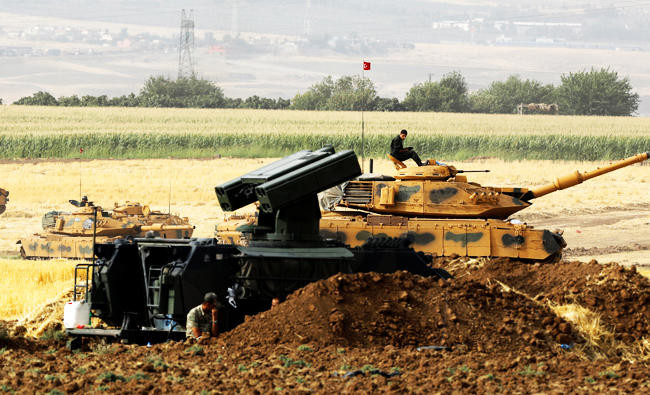
ANKARA: Turkey’s military deployment along its southern border suggests an imminent operation in Syria’s Idlib province alongside the Ankara-backed Free Syrian Army (FSA).
During talks last week in the Kazakh capital Astana, Russia, Iran and Turkey agreed to establish “de-escalation zones” in various parts of Syria for six months, including rebel-held Idlib, where Ankara will send troops to monitor implementation of the deal.
Turkey’s pro-government newspaper Yeni Safak on Friday reported that the army has ordered FSA-linked groups to prepare for an operation in Idlib.
Under the plan, 25,000 Turkish troops will reportedly be accompanied by about 5,000 FSA fighters, although military experts say the number of Turkish troops is exaggerated.
Hayat Tahrir Al-Sham (HTS), a rebel alliance that controls much of Idlib and is dominated by former Al-Qaeda affiliate Jabhat Fateh Al-Sham, has said it does not recognize the Astana agreement and would resist any operation in the province.
Serhat Erkmen, a Middle East expert at the Ankara-based 21st Century Turkey Institute, said he expects a Turkish military operation in Idlib very soon.
“Initially, elements linked to the FSA will play a greater role. Whether they can accomplish the expected result depends on the intensity of the fighting,” Erkmen told Arab News.
“The strategy Turkey adopts for this operation will determine whether HTS resists. If HTS feels the main objective is to clear it and its supporters from Idlib instead of de-escalating conflict between the regime and opposition forces, a fierce battle is inevitable,” he said.
“I don’t expect a serious flow of militants into Turkey following this operation, because Ankara has already taken tight security measures along the border.”
Turkey has almost finished a 700-km-long wall along its border with Syria, backed by unmanned drones, sophisticated surveillance cameras, fiber optic sensors and watchtowers.
Mete Sohtaoglu, an expert on Middle East and global jihadist movements, said Ankara has given FSA fighters Special Forces and commando training, as well as weapons and military vehicles.
“FSA units, which will be formed by local fighters, will act as spearhead forces,” he told Arab News.
“They’ll stand at checkpoints and crossroads in Idlib to provide security for the Turkish military,” Sohtaoglu added.
“During the first stage, 500-600 Turkish troops and commando units may be expected to enter Idlib,” he said.
“Since July, the Turkish army has been carrying out feasibility studies there. There are three military camps in Idlib probably to deploy Turkish troops, and the FSA will be supported from there if necessary,” Sohtaoglu added. “The only disadvantage is that frequent assassinations and bombings occur in the region.”
He said armed groups are likely to negotiate with Ankara because no one wants to fight the Turkish army.
“If Turkey prefers a military installation in Idlib, HTS will move to other regions to fight regime or Kurdish forces, or it will disband for the sake of Idlib’s residents,” he added.
But other experts said if HTS decides to fight Turkish troops, the conflict will likely be long and intense.
Ankara conducted Operation Euphrates Shield between August 2016 and March 2017 to expel Daesh from the border and prevent Syrian Kurdish forces from establishing a territorial belt.
During that operation, Turkey lost 67 soldiers and the FSA 600 fighters, mainly due to Daesh suicide attacks.

Turkish military prepares for Idlib operation
Israel to partially reopen Gaza’s Rafah crossing
- Reopening comes amid ongoing violence in the Palestinian territory
- Gaza’s civil defense agency says dozens killed in Israeli attacks on Saturday
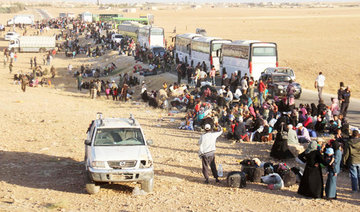
RAFAH, Palestinian Territories: Israel is set to partially reopen the Rafah crossing between the war-devastated Gaza Strip and Egypt on Sunday, following months of urging from humanitarian organizations, though access will be limited to the movement of people.
The reopening comes amid ongoing violence in the Palestinian territory, with Gaza’s civil defense agency reporting dozens killed in Israeli attacks on Saturday, while the Israeli military said it was retaliating against ceasefire violations.
The Rafah crossing is a vital gateway for both civilians and aid, but has remained closed since Israeli forces seized control of it in May 2024 during the war with Hamas, aside from a brief and limited reopening in early 2025.
Israel had previously said it would not reopen the crossing until the remains of Ran Gvili — the last Israeli hostage held in Gaza — were returned.
His remains were recovered days ago and he was laid to rest in Israel on Wednesday.
“The Rafah Crossing will open this coming Sunday (February 1st) in both directions, for limited movement of people only,” COGAT, an Israeli defense ministry body overseeing civil affairs in the occupied Palestinian territories, said on Friday.
Entry and exit “will be permitted in coordination with Egypt, following prior security clearance of individuals by Israel, and under the supervision of the European Union mission,” it added.
However, key details remain unclear, including how many people will be allowed to cross and whether those seeking to return to Gaza will be permitted entry.
A source at the border told AFP that Sunday would be largely devoted to preparations and logistical arrangements.
The crossing is set to open on Sunday on a trial basis to allow the passage of wounded individuals, ahead of a regular reopening scheduled for Monday, three sources at the crossing said.
However, no agreement has yet been reached on the number of Palestinians permitted to enter or exit, the sources added, noting that Egypt plans to admit “all Palestinians whom Israel authorizes to leave” the territory.
“Every day that passes drains my life and worsens my condition,” said Mohammed Shamiya, 33, who suffers from kidney disease and requires dialysis treatment abroad.
“I’m waiting every moment for the opening of the Rafah land crossing.”
Anxious wait
Safa Al-Hawajri, who has received a scholarship to study overseas, is also eagerly awaiting the reopening on Sunday.
“I’m waiting in the hope of fulfilling my ambition, which is tied to the reopening of the crossing,” said Hawajri, 18.
“I hope to be able to travel as soon as it opens.”
Located on Gaza’s southern border with Egypt, Rafah is the only crossing into and out of the territory that does not pass through Israel.
The crossing lies in an area held by Israeli forces following their withdrawal behind the so-called “Yellow Line” under the terms of a US-brokered ceasefire that came into effect on October 10.
Israeli troops still control more than half of Gaza, while the rest remains under Hamas authority.
The ceasefire has now entered its second phase and calls for reopening the crossing following the release or return of all Israeli hostages held by Palestinian militants.
Hamas had called for its full reopening in both directions after the remains of Gvili were brought back to Israel.
The reopening is expected to facilitate the entry of a 15-member Palestinian technocratic body, the National Committee for the Administration of Gaza (NCAG), established to oversee the day-to-day governance of the territory’s 2.2 million residents.
The committee is to operate under the supervision of the so-called “Board of Peace” chaired by US President Donald Trump.
The NCAG, headed by former Palestinian Authority deputy minister Ali Shaath, is expected to enter the Gaza Strip once the Rafah crossing reopens.
Violence continued ahead of the crossing’s reopening.
At least 32 people, including children, were killed on Saturday in Israeli air strikes in Gaza, reported the civil defense agency, which operates as a rescue force under the Hamas authority.
Israel’s military said the strikes were retaliation for an incident on Friday in which eight Palestinian fighters exited a tunnel in the city of Rafah, which it said violated the ceasefire.