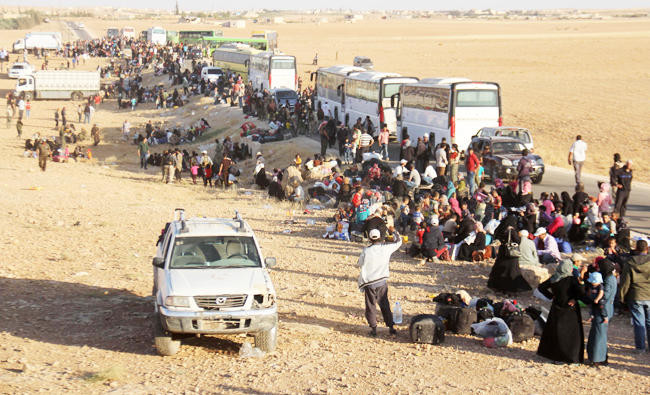
BEIRUT: Lebanon has rejected suggestions that refugees from the Syrian conflict could be permanently resettled there.
The Lebanese constitution said the country was “one for all Lebanese; and there will be no classification of people or land and there will be no settlements,” the parliamentary Speaker Nabih Berri said. “The Parliament has already rejected resettlement calls several times before,” and “amending the constitution is out of question.”
Lebanon currently hosts more than 1.5 million displaced Syrians and 450,000 Palestinian refugees, earning the gratitude of US President Donald Trump in his speech to the UN General Assembly in New York on Tuesday.
“We especially thank Jordan, Turkey and Lebanon for their role in hosting refugees from the Syrian conflict,” Trump said. But he continued: “We support recent agreements of the G-20 nations that will seek to host refugees as close to their home countries as possible. This is the safe, responsible and humanitarian approach.”
His remarks were viewed as suggesting that Syrian refugees could resettle permanently in Lebanon, but Lebanese Prime Minister Saad Hariri said: “No one is talking about resettlement in Lebanon; we have our constitution and our sovereignty.
“What was said at the United Nations represents a political idea and does not compel anyone to comply. There is no international resolution about this matter and there won’t be any binding resolution that would oblige us to naturalize Syrian refugees or others. There is no need for all this over-emphasis on the subject.”
Former Lebanese President Michel Sleiman called for “a plan to ensure the safe return of displaced Syrians to their country, especially now that the Syrian barrens are safe and calm.
“The Lebanese consensus is the strongest weapon for facing any fait accompli. This consensus must be upheld to ensure the safe return of Syrians to their homes.”
Lebanon’s Justice Minister Salim Jreissati said: “There will be no resettlement of any displaced person in Lebanon.” He called on “other countries to take the position that is appropriate to their sovereignty.”
Samir Al-Jisr, an MP from Al-Mustaqbal bloc, said: “Lebanon is involved in the solution for Syria and any new move will have repercussions on Lebanon; we should keep Lebanon as far as possible out of regional problems.
“There should be new solutions for displaced Syrians without burdening Lebanon on economic, social and political levels. Those who call for the normalization of relations between the Syrian and Lebanese governments in order to find a proper solution for the return of the displaced do not really want them to return to Syria.
“We cannot afford to send them to specific areas and exclude other areas due to demographic issues in Syria. The Lebanese government does not prevent anyone from returning to Syria; hundreds have already left Lebanon and returned to Syria.”


![]()
Lebanon rejects calls to resettle Syrian refugees
Lebanon rejects calls to resettle Syrian refugees

Latest updates





© 2026 SAUDI RESEARCH & PUBLISHING COMPANY, All Rights Reserved And subject to Terms of Use Agreement.