Children flee, fight amid Congo’s growing Kasai violence

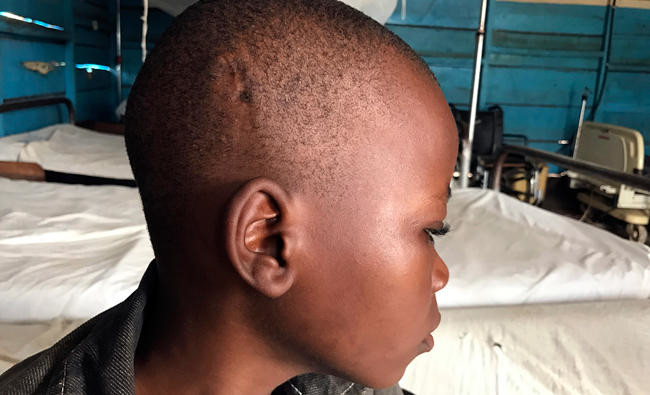
A boy displays a scar from a tracer bullet in this file photo taken on Aug. 29 in Mbuji Mayi, Kasai province, Democratic Republic of the Congo. (AP)
Updated 17 September 2017
Follow

Children flee, fight amid Congo’s growing Kasai violence

DAKAR, Senegal: Congo’s Kasai region is the latest deadly hotspot in the vast Central African country that has had violent rebellions for decades. Once again, children are among the most vulnerable victims.
Well over 1 million people have fled the fighting that began a year ago when Congo’s military killed the regional tribal leader of the Kamwina Nsapu militia. More than 3,300 people in the region have died, according to estimates by the Catholic church. The UN has counted more than 80 mass graves.
Across the once-peaceful region, children are forced to take up weapons, either recruited by militias or to defend their homes. Children make up more than half of the displaced people, said Yvon Edoumou, spokesman for the UN humanitarian office in Congo.
“We see families who say they are fleeing because militias were going into their villages, and most of the time we have one mother and two to four young kids, even toddlers and babies in their arms,” Edoumou said. “The men are almost nowhere to be seen. So children are taking a very heavy toll from all this violence.”
Children in the Kasai region are being forced to endure horrific ordeals such as abuse and recruitment into militia groups, the UN children’s agency says, with more than 850,000 left without basic services.
One 12-year-old told the agency he escaped from a militia group where he was a combatant. Now in a UN-backed safe house, he is trying to deal with the trauma.
“I was given things to swallow. Afterwards, they took a machete and hit me three times on the chest. Next they gave me plastic bags to swallow, saying that if I concentrate on something, I can become it,” he said. “After that, they hurt me all over to show that even if I am attacked, I can’t be hurt. In the end, they gave me a knife and stick to go and fight.”
He said he decided to leave “because promises weren’t kept. Also, lots of people had been killed.”
The boy wants to return to his family and go to school but faces the risk of stigma and violent reprisals.
About 440,000 children in the Kasai region could not complete their schooling last year, largely due to the violence and insecurity, UNICEF says. It has launched a campaign to get 150,000 children back into school.
Another boy, 16-year-old Edouard, was taking exams when the fighting reached his hometown. His school is among the 400 that UNICEF says have been attacked.
“There was the noise of gunfire. We had never experienced that in our lives. When we heard it for the first time, we were scared and we ran,” he told the agency. He said he lived in the forest with his family, surviving on leaves and edible roots.
With so many lives affected, the UN and other humanitarian organizations have been trying to gain a footing in the remote and impoverished Kasai region. And security concerns soared after the murder of two UN experts in March.
The biggest needs are water, food and medicine, particularly for children, Edoumou said. But funding is low. A $64.5 million UN request for support is not even halfway funded, he said.
Both Congolese and the international community are watching in dismay as the initial fighting between government forces and militias has shifted and made the region even more precarious.
“It has evolved into fighting between communities who up until months ago had been living together in a peaceful way,” Edoumou said.
Communities, including children, have turned to defending their homes and whatever ethnic rights their area demands, he said.
The UN’s human rights office has warned of ethnic cleansing and urged Congo’s government to prevent further violence in the Kasai region, which has been a stronghold of opposition to President Joseph Kabila’s administration. Security forces have been known to back local leaders seen as loyal to Kabila, while militia groups have supported those believed to back the opposition.
Congo’s long-delayed presidential elections contribute to the tensions. Though voter registration finally began this week for millions in the Kasai region, the electoral commission says the work won’t be completed until next year — defying an agreement with the opposition that called for a vote by the end of 2017.


Two high-speed trains derail in Spain, police sources say 21 people killed

Updated 19 January 2026
Follow

Two high-speed trains derail in Spain, police sources say 21 people killed

  • The accident happened near Adamuz, in Cordoba province. So far, 21 people ​have been confirmed dead by police

MADRID: A high-speed train derailed and smashed into another oncoming train in southern Spain on Sunday, pushing the second train off the tracks in a collision that police sources confirmed to Reuters had killed at least 21 people.
The accident happened near Adamuz, in Cordoba province. So far, 21 people ​have been confirmed dead by police, with state broadcaster Television Espanola adding that 100 people had been injured, 25 seriously. The driver of one of the trains, which was traveling from Madrid to Huelva, was among those who died, the TV station added.
“The Iryo 6189 Malaga — (to Madrid) train has derailed from the track at Adamuz, crashing onto the adjacent track. The (Madrid) to Huelva train which was traveling on the adjacent track has also derailed,” said Adif, which runs the rail network, in a social media post.
Adif said the accident happened at 6:40 p.m. (1740 GMT), about 10 minutes after the Iryo train left Cordoba heading toward Madrid.
Iryo is a private rail operator, majority-owned by Italian state-controlled railway group Ferrovie dello Stato. The train involved was a Freccia 1000 train which was traveling between ‌Malaga and Madrid, ‌a spokesperson for Ferrovie dello Stato said.
The company said in a statement that it ‌deeply ⁠regretted what ​had happened ‌and had activated all emergency protocols to work closely with the relevant authorities to manage the situation.
The second train was operated by Renfe, which also did not respond to a request for comment.
Adif has suspended all rail services between Madrid and Andalusia.

HORRIFIC SCENE
The Iryo train had more than 300 passengers on board, while the Renfe train had around 100.
Paco Carmona, Cordoba fire chief, told TVE the first train heading to Madrid from Malaga had been evacuated.
The other train’s carriages were badly damaged, he said, with twisted metal and seats. “There are still people trapped. We don’t know how many people have died and the operation is concentrating on getting people out of areas which are very narrow,” he ⁠said. “We have to remove the bodies to reach anyone who is still alive. It is proving to be a complicated task.”
Transport Minister Oscar Puente said he was following events ‌from rail operator Adif’s headquarters in Madrid.
“The latest information is very serious,” ‍he posted on X. “The impact was terrible, causing the first two ‍carriages of the Renfe train to be thrown off the track. The number of victims cannot be confirmed at this time. ‍The most important thing now is to help the victims.”
The mayor of Adamuz, Rafael Moreno, told El Pais newspaper that he had been among the first to arrive at the scene of the accident alongside the local police and saw what he believed to be a badly lacerated body several meters from the accident site.
“The scene is horrific,” he said. “I don’t think they were on the same track, but it’s not clear. Now ​the mayors and residents of the area are focused on helping the passengers.”

CALLS FOR MEDICS
Images on local television showed a reception center set up for passengers in the town of Adamuz, population 5,000, with locals coming ⁠and going with food and blankets amid nighttime temperatures of around 42 degrees Fahrenheit (6 degrees Celsius).
A woman named Carmen posted on X that she had been on board the Iryo train to Madrid. “Ten minutes after departing (from Cordoba) the train started to shake a lot, and it derailed from coach 6 behind us. The lights went out.”
Footage posted by another Iryo train passenger, also on X, showed an Iryo staffer in a fluorescent jacket instructing passengers to remain in their seats in the darkened carriages, and those with first aid training to keep watch over fellow passengers. He also urged people to maintain mobile phone batteries to be able to use their torches when they disembarked.
Salvador Jimenez, a journalist for RTVE who was on board the Iryo train, shared images showing the nose of the rear carriage of the train lying on its side, with evacuated passengers sitting on the side of the carriage facing upwards.
Jimenez told TVE by phone from beside the stricken trains that passengers had used emergency hammers to smash the windows and climb out, and they had seen two people taken ‌out of the overturned carriages on stretchers.
“There’s a certain uncertainty about when we’ll get to Madrid, where we’ll spend the night, we’ve had no message from the train company yet,” he said. “It’s very cold but here we are.”