LONDON: The author of a landmark review of extremism in British prisons has defended a controversial strategy to separate “subversive offenders” from other inmates.
The UK Ministry of Justice opened its first separation center in July and plans to open two more in the coming months — housing a total of 28 inmates.
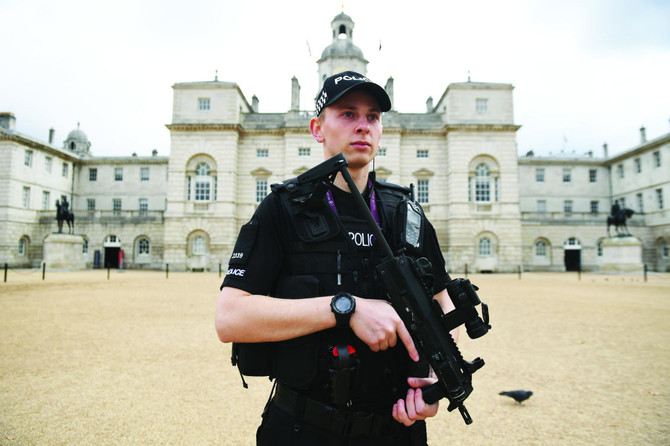
It comes as Prime Minister Theresa May put Britain on its highest security footing following a London commuter train bombing that injured 30 people on Friday.
Separating inmates was one of the central recommendations of a review into extremism in prisons led by Ian Acheson, a former prison governor, in 2016.
But the strategy has attracted criticism from some experts who claim it will fuel radicalization.
“Our view to separate extremist prisoners was born of an expert team looking at this very carefully over an extended period of time,” said Acheson in an exclusive interview with Arab News conducted before Friday’s terror attack, the fifth in Britain this year.
“If we thought this solution would exacerbate the problem, then clearly we would have been mad to implement it,” Acheson added.
“Given the scale of the problem, we believe it’s right to segregate a very small number of people whom intelligence suggests are actively subverting the prison system and national security by recruiting (potential extremists).”
Acheson added that separation is necessary to remove hate preachers from the rest of the prison population. “Anyone who says otherwise is completely wrong.”
Acheson said his review offered 69 recommendations to former Secretary of State for Justice Michael Gove, based on key findings. The Ministry of Justice has since publicly announced nine new anti-extremism measures for prisons.
As Britain’s first prison “separation center” is trialed at HMP Frankland, some experts have warned the move could make the problem worse.
John Horgan, professor at the Global Studies Institute and Department of Psychology, Georgia State University, told Arab News: “The idea of segregating radical prisoners from the rest of the prison population is a terrible idea. In an attempt to solve one problem it will create another, focusing and amplifying radicalization rather than curbing it.”
Smart monitoring
He continued: “It reeks of a knee-jerk political response and just isn’t very smart. Smart monitoring, supervision, program development, resourcing and staff training represent far better solutions.”
Denis MacEoin, a British analyst and writer and a senior fellow at New York’s Gatestone Institute, has previously described the British prison system as “Harvard for radicals.” He recommended extremists be housed in isolated units to stem further “plot making” even if it requires erecting new buildings.
One man who is serving a 24-year sentence in a UK prison told Arab News that prayer times were exploited by recruiters inside prison to lure vulnerable inmates.
“The extremists only recruit at Muslim prayer time, away from the other inmates,” said the prisoner, who spoke to Arab News on condition of anonymity.
“They get invited with a smile and promises of extra food and a nice environment. They become part of a gang and it’s the same as any other group in jail. You get fake friends.”
Acheson agreed with this analysis. “Prisoners make pragmatic decisions about their safety when they enter prisons, which are increasingly volatile environments. There is a slang called ‘Prislam’ which is a saying about a convert who reverts back to their own identity when the door is closed and nobody is observing them.”
He said: “Some people convert because it brings a sense of order and discipline to their lives and there’s nothing wrong with that. They find meaning through faith, but there is a small number of people, often in relation to substance abuse or mental health problems, who are at risk of becoming converted and then exploited and manipulated into becoming a next-generation terrorist.”
Along with the separation centers, other measures introduced in UK prisons include a crackdown on extremist literature and the tightened vetting of prison chaplains. Front-line prison officers will also be equipped to crack down on extremist behavior with new training, skills and powers.
Acheson said: “A lot of the recommendations stayed below the water line because of issues with national security. But I am led to believe that the vast majority of the recommendations are being implemented.”
Acheson said the need for training among prison staff is pressing. “It was quite clear to us that officers felt unconfident about tackling extremist language and beliefs.”
MacEoin, who authored the controversial report “The Hijacking of British Islam” for the right-wing think-tank Policy Exchange, emphasized that countering extremism in prisons is important for both Muslim and non-Muslim communities.
“Let’s say a young Muslim goes to prison for shoplifting, he could be taken under the wing of a militant Muslim. They will be very friendly but then they gradually work on him and radicalize him. We know that this has happened in very many cases,” he said.
“It’s a concern for the general public because these people turn into terrorists but it’s also a concern for the Muslim population because normal young Muslims may come out of prisons with radicalized views. Muslims don’t want extremists within their population.”
Acheson said a very complex set of factors inform prisoner decisions to convert to Islam. “Some people will convert to Islam for pragmatic reasons; in effect it’s the biggest gang in some prisons.
“If you’re a young man coming into prison for the first time, you will search for meaning and security and you may convert at least out of convenience and for fellowship and protection.
“For some vulnerable individuals, it goes further as they are exploited and become proselytizers for Islamic extremism. It’s those people we are very concerned about. They could be converted to becoming terrorists when released and radicalized.”
Andrew Neilson, director of campaigns at the Howard League for Penal Reform, told Arab News: “The jury is out on whether these anti-radicalization measures will be successful, as it is very early days.
“We are encouraged, however, that the prison authorities are moving cautiously and that only very small numbers of prisoners are being separated from the general population. Talk of ‘jihadi jails’ are wide of the mark.
“Whether or not this approach proves to be effective, there are broader problems in the English and Welsh prison system that urgently need addressing. Prisons are violent and overcrowded, with record levels of suicide and self-harm.”
A Ministry of Justice spokesperson said in a statement: “We have delivered on our plans to house the most subversive prisoners in separation centers — preventing their influence over others — and have also boosted the ability of front-line staff to challenge extremist views by providing over 7,000 staff with enhanced training to tackle this evolving threat.”