UK nurses bid for 3.9 percent salary rise in latest push against pay cap

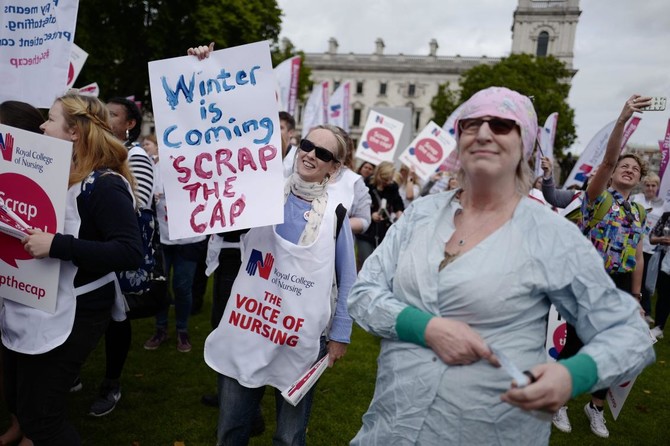
Demonstrators hold placards as they participate in a protest organized by nurses against the British government’s pay cap on public sector workers. (AFP)
Updated 15 September 2017
Follow

UK nurses bid for 3.9 percent salary rise in latest push against pay cap

LONDON: Nurses, midwives and cleaners working in Britain’s publicly-funded National Health Service (NHS) called on ministers to boost their salaries by 3.9 percent, in the latest push against a government-imposed cap on pay rises.
Public-sector pay was frozen for all but the lowest earners in 2010 and increases were limited to 1 percent a year from 2013 while inflation currently stands at 2.9 percent, having risen since last year’s Brexit vote.
Prime Minister Theresa May has been under increasing pressure to end the cap since her party lost its parliamentary majority in a snap election in June. Earlier this week, the government said it would boost pay for police and prison officers.
On Friday, fourteen unions wrote to finance minister Philip Hammond asking for a 3.9 percent pay rise and a further £800 pounds to reflect lost spending power over the last seven years of pay restraint.
“Health workers have gone without a proper pay rise for far too long. Their wages continue to fall behind inflation as food and fuel bills, housing and transport costs rise,” said the head of health at trade union UNISON Sara Gorton.
“NHS staff and their families need a pay award that stops the rot and starts to restore some of the earning that have been missing out on,” she said.


Nigerian president vows security reset in budget speech

Updated 6 sec ago
Follow

Nigerian president vows security reset in budget speech

  • Government plans to buy 'cutting-edge' equipment to boost the fighting capability of military


ABUJA: Nigeria’s president vowed a national security overhaul as he presented the government budget, allocating the largest share of spending to defense after criticism over the handling of the country’s myriad conflicts.
Nigeria faces a long-running insurgency in the northeast, while armed “bandit” gangs commit mass kidnappings and loot villages in the northwest, and farmers and herders clash in the center over dwindling land and resources.
President Bola Tinubu last month declared a nationwide security emergency and ordered mass recruitment of police and military personnel to combat mass abductions, which have included the kidnapping of hundreds of children at their boarding school.
He told the Senate that his government plans to increase security spending to boost the “fighting capability” of the military and other security agencies by hiring more personnel and buying “cutting-edge” equipment.
Tinubu promised to “usher in a new era of criminal justice” that would treat all violence by armed groups or individuals as terrorism, as he allocated 5.41 trillion naira ($3.7 billion) for defense and security.
Security officials and analysts say there is an increasing alliance between bandits and extremists from Nigeria’s northeast, who have in recent years established a strong presence in the northwestern and central regions.
“Under this new architecture, any armed group or gun-wielding non-state actors operating outside state authority will be regarded as terrorists,” said Tinubu, singling out, among others, bandits, militias, armed gangs, armed robbers, violent cult groups, and foreign-linked mercenaries.
He said those involved in political or sectarian violence would also be classified as terrorists.
On the economic front, Tinubu hailed his “necessary” but not “painless” reforms that have plunged Nigeria into its worst economic crisis in a generation.
He said inflation has “moderated” for eight successive months, declining to 14.45 percent in the last month from 24.23 percent in March this year.
He projected that the budget deficit will drop next year to 4.28 percent of GDP from around 6.1 percent of GDP in 2023, the year he came into office.