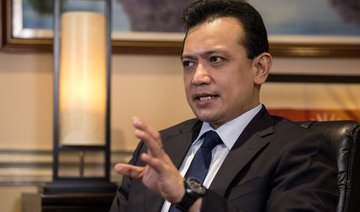
MANILA: Philippine President Rodrigo Duterte on Saturday asked the head of the country’s Commission on Human Rights (CHR) if he was a pedophile for focusing on the killing of teenagers in the government’s bloody war on drugs.
Duterte also suggested to lawmakers using CHR’s proposed 678 million pesos budget to buy the police body cameras if they don’t want to restore funding for the agency, which he has clashed with repeatedly over his anti-drugs campaign.
The CHR requested a budget of 1.72 billion pesos for 2018, but the government proposed 678 million instead. Duterte’s allies in the lower house of Congress then voted to allocate it just 1,000 pesos ($20), in what critics of the drugs war said was retaliation for its efforts to investigate thousands of killings in the past 15 months, including those of two teenagers in August.
“Why is this guy so pre...suffocated with the issue of young people, especially boys? Are you a pedophile?” Duterte asked, referring to CHR head Chito Gascon.
“Why are you smitten with teenagers? Are you? I’m having my doubts. Are you gay or a pedophile?,” he said.
Gascon did not immediately reply to a request for comment.
Duterte also accused Gascon of being a spokesman for the opposition and criticized his scrutiny of police anti-drug activities.
“Why can’t you move on to other issues that are besetting this country?” Duterte said, citing the suffering of the people in the besieged southern city of Marawi.
Critics say police are executing suspects, and say the government has what is effectively a kill policy. Duterte has rejected that, and police say they kill only in self-defense.
The CHR has long said it lacks the manpower and resources to fully investigate the killings, the majority of which activists say are of users and small-time peddlers, with few high-profile arrests.
Vice President Leni Robredo, who was not Duterte’s running mate and has locked horns with him numerous times, said the lawmakers’ move regarding CHR’s budget effectively abolishes the constitutional body.
Filipinos are largely supportive of the crackdown as a solution to tackling rampant crime, which Duterte says stems from drug addiction.
Duterte reiterated there will be no let up in the campaign, which he said was targeted at organized criminals trafficking drugs and not at “teenagers without a sin.”
The firebrand leader, who is also fighting communist rebels following a breakdown in peace talks with the government, said he remained open to resuming negotiations to end nearly five decades of that conflict.

Philippines’ Duterte asks head of human rights agency: “Are you a pedophile?”
Justice Department says it’s releasing 3 million pages from its Jeffrey Epstein files
- The documents were disclosed under the Epstein Files Transparency Act
- “Today’s release marks the end of a very comprehensive document identification and review process to ensure transparency to the American people,” Blanche said
NEW YORK: The Justice Department said Friday that it was releasing many more records from its investigative files on Jeffrey Epstein, resuming disclosures under a law intended to reveal what the government knew about the millionaire financier’s sexual abuse of young girls and his interactions with rich and powerful people including Donald Trump and Bill Clinton.
Deputy Attorney General Todd Blanche said the department was releasing more than 3 million pages of documents in the latest Epstein disclosure, as well as more than 2,000 videos and 180,000 images.
The files, which were being posted to the department’s website, include some of the several million pages of records that officials said were withheld from an initial release of documents in December.
The documents were disclosed under the Epstein Files Transparency Act, the law enacted after months of public and political pressure that requires the government to open its files on the late financier and his confidant and onetime girlfriend, Ghislaine Maxwell.
“Today’s release marks the end of a very comprehensive document identification and review process to ensure transparency to the American people and compliance with the act,” Blanche said at a news conference announcing the disclosure.
The prospect of previously unseen records tying Epstein to famous figures has long animated online sleuths, conspiracy theorists and others who have clamored for a full accounting that even Blanche acknowledged might not be met by the latest document dump.
“There’s a hunger, or a thirst, for information that I don’t think will be satisfied by review of these documents,” he said.
He insisted that, “We did not protect President Trump. We didn’t protect — or not protect — anybody,” Blanche said.
After missing a Dec. 19 deadline set by Congress to release all of the files, the Justice Department said it tasked hundreds of lawyers with reviewing the records to determine what needs to be redacted, or blacked out.
Among the materials being withheld from release Friday is information that could jeopardize any ongoing investigation or expose the identities of potential victims of sex abuse. All women other than Maxwell have been redacted from videos and images being released Friday, Blanche said.
The number of documents subject to review has ballooned to roughly six million, including duplicates, the department said.
The Justice Department released tens of thousands of pages of documents just before Christmas, including photographs, interview transcripts, call logs and court records. Many of them were either already public or heavily blacked out.
Those records included previously released flight logs showing that Trump flew on Epstein’s private jet in the 1990s, before they had a falling out, and several photographs of Clinton. Neither Trump, a Republican, nor Clinton, a Democrat, has been publicly accused of wrongdoing in connection with Epstein, and both have said they had no knowledge he was abusing underage girls.
Also released last month were transcripts of grand jury testimony from FBI agents who described interviews they had with several girls and young women who said they were paid to perform sex acts for Epstein.
Epstein killed himself in a New York jail cell in August 2019, a month after he was indicted on federal sex trafficking charges.
In 2008 and 2009, Epstein served jail time in Florida after pleading guilty to soliciting prostitution from someone under the age of 18. At the time, investigators had gathered evidence that Epstein had sexually abused underage girls at his home in Palm Beach, but the US attorney’s office agreed not to prosecute him in exchange for his guilty plea to lesser state charges.
In 2021, a federal jury in New York convicted Maxwell, a British socialite, of sex trafficking for helping recruit some of his underage victims. She is serving a 20-year prison sentence at a prison camp in Texas, after being moved there from a federal prison in Florida. She denies any wrongdoing.
US prosecutors never charged anyone else in connection with Epstein’s abuse of girls, but one of his victims, Virginia Roberts Giuffre, accused him in lawsuits of having arranged for her to have sexual encounters at age 17 and 18 with numerous politicians, business titans, noted academics and others, all of whom denied her allegations.
Among the people she accused was Britain’s Prince Andrew, now known as Andrew Mountbatten-Windsor after the scandal led to him being stripped of his royal titles. Andrew denied having sex with Giuffre but settled her lawsuit for an undisclosed sum.
Giuffre died by suicide at her farm in Western Australia last year at age 41.