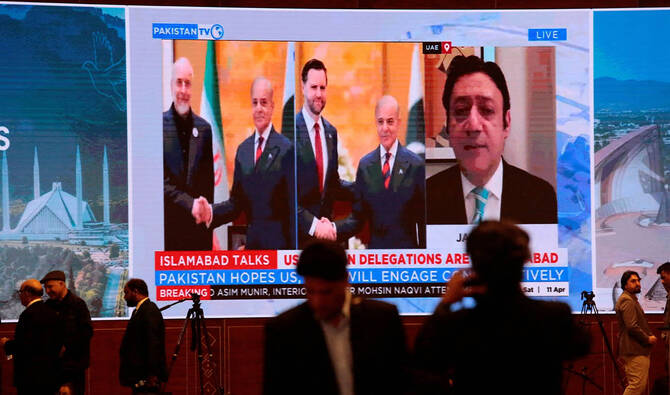

ISLAMABAD: US-Iran talks in Islamabad to try to end their six-week war will continue for another round on Sunday after a pause, Iranian state media said, as negotiations stretched late into Saturday night with no clear timeline for conclusion despite direct engagement between the two sides.
At least two rounds were held on Saturday, one through intermediaries and another involving direct talks, as Pakistan hosted negotiations aimed at building on a fragile ceasefire announced earlier this week.
The outcome of the Islamabad talks could determine the fate of the two-week ceasefire and the reopening of the Strait of Hormuz, a chokepoint for about 20% of global energy supplies that Iran has blocked since the war began on Feb. 28.
“At Pakistan’s proposal and with the agreement of the negotiating teams of Iran and the US, talks mediated by Pakistan will continue for another round after a pause on Sunday,” the Iranian government said on X.
But despite the start of direct engagement between an Iranian delegation and a US side led by Vice President JD Vance, the talks process remains deeply uncertain, with major sticking points threatening to derail progress.
Iran has demanded that the ceasefire extend to Lebanon and that sanctions be lifted, while the United States has ruled out concessions on uranium enrichment and signaled skepticism over reopening key oil routes such as the Strait of Hormuz that Iran has effectively blocked since the war began on Feb. 28 and which US President Donald Trump has vowed to reopen.
Disagreements also persist over Iran’s missile program and the broader scope of the truce, underscoring the fragile nature of the talks and the risk that negotiations could stall or require multiple rounds to make progress.
“There has been 47 years of tension between the United States and Iran,” Pakistan’s Law Minister Azam Nazeer Tarar told Geo TV. “Such matters are not resolved in just a one- or two-hour sitting.”
By 430am on Sunday morning, the US delegation led by Vice President JD Vance had been at the Serena Hotel in Islamabad for more than 15 hours, with no clear indication of when the talks would conclude or how long Vance would stay in Pakistan.
Pakistan is hosting the talks after weeks of diplomatic outreach led by Prime Minister Shehbaz Sharif, Deputy Prime Minister and Foreign Minister Ishaq Dar and Field Marshal Asim Munir, positioning Islamabad as a key intermediary in a conflict that began with US-Israeli strikes on Iran on Feb. 28.
The war has caused the biggest oil supply shock on record, damaging regional energy production and raising fears of inflation, food insecurity and a potential global economic slowdown.
Trump, ahead of midterm elections later this year, faces pressure to find an off-ramp from the conflict after announcing a ceasefire on Tuesday.
Three Pakistani officials told Arab News direct talks between the US and Iran began on Saturday afternoon - the first direct US-Iranian meetings in more than a decade and the highest-level discussions since the 1979 Islamic Revolution.
One Pakistani official, a member of cabinet, said PM Sharif was not in the negotiations, which were being chaired by army chief Munir. They were attended by Vance and Trump’s special envoy Steve Witkoff and son-in-law Jared Kushner on the American side. Parliament Speaker Mohammad Baqer Ghalibaf and Foreign Minister Abbas Araghchi led the delegation from Tehran.
An Iranian government account said talks had “entered the expert-level stage as economic, military, legal, and nuclear committees joined,” adding that negotiations were continuing at a hotel in the capital.
The two delegations had earlier communicated through intermediaries and held separate meetings with Sharif.
The negotiations took place as Islamabad, a city of about 2 million people, remained under tight security, with hundreds of military, paramilitary and police personnel deployed across the capital.
But even as talks continued, Trump said his military was starting the process of clearing the Strait of Hormuz.
Iran's semi-official Tasnim news agency said the waterway remains among the main points of "serious disagreement" in talks between the Iranian and US delegations.
The US military said two of its warships had passed through the strait and conditions were being set to clear mines, while Iran's state media denied any US ships had transited the waterway.
"We're now starting the process of clearing out the Strait of Hormuz as a favor to Countries all over the World," Trump posted on social media.
With additional inputs from agencies