

Egyptian billionaire businessman says Qatar situation is a ‘stand against terror’ not a diplomatic row

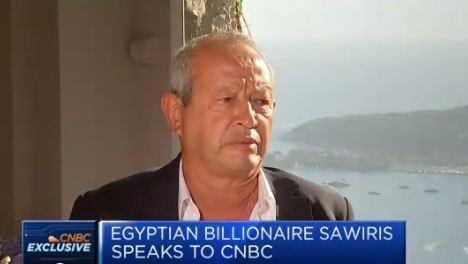
Egyptian billionaire Naguib Sawiris speaks to CNBC
Updated 15 September 2017
Follow

Egyptian billionaire businessman says Qatar situation is a ‘stand against terror’ not a diplomatic row

DUBAI: The dispute with Qatar is not a diplomatic row, but instead a stand against terrorism, the Egyptian billionaire and chairman of the telecoms company Weather Investments, Naguib Sawiris has said in a television interview.
Speaking to the cable news channel CNBC, Sawiris, was asked about the situation in the region where the Anti-Terror Quartet (ATQ) severed diplomatic relations in June with Qatar amid claims that it supported terror.
The outspoken businessman said the situation was not a row, because the country was “hosting advocates of terror.”
“It’s not a diplomatic row. It’s a position against terrorism. I mean people have not spent enough time figuring out who is really financing all what is happening,” he said.
“When a country is hosting all the advocates of terror, whether they are the leaders of the Muslim Brotherhood, or Hamas, or other terror organizations.”
“When they host clergymen, that are illiterate, but tell young people ‘listen, go and blow up this place, kill innocent people, it’s okay and you’ll end up in heaven,’ Then there is no more to talk about. It is not a diplomatic row. It’s just a stand against terrorism saying enough is enough.”
The ATQ was created in June by the four Arab nations, which immediately severed ties with Qatar, accusing it of supporting extremist groups and of being too close to Iran, which has been accused by the Gulf Cooperation Council (GCC) of fomenting strife in various parts of the region.
The four nations that make up the ATQ are Saudi Arabia, the UAE, Bahrain and Egypt.
The ATQ also shut down air, maritime and land links and imposed economic sanctions on Qatar.
A defiant Qatar rejected the quartet’s demands, even though these were reduced from an initial 13 to six. Doha also restored diplomatic ties with Tehran, further widening the rift.
On Tuesday ATQ diplomats slammed Doha for its latest “provocations” after Qatar’s state minister for foreign affairs praised Iran and blamed the bloc for a humanitarian crisis caused by their blockade of Qatar.

During a meeting of ministers at the Arab League, Sultan Saad Al-Muraikhi, Qatar’s permanent envoy to the Arab League, also challenged the quartet to present evidence that his country was supporting extremist groups and terrorists.
Lebanese finance minister denies any plans for a Kushner-run economic zone in the south

Updated 45 min 44 sec ago
Follow

Lebanese finance minister denies any plans for a Kushner-run economic zone in the south

  • Proposal was made by US Envoy Morgan Ortagus but was ‘killed on the spot’
  • Priority is to regain control of state in all aspects, Yassine Jaber tells Arab News

DAVOS: Lebanon’s finance minister dismissed any plans of turning Lebanon’s battered southern region into an economic zone, telling Arab News on the sidelines of the World Economic Forum’s meeting in Davos that the proposal had died “on the spot.”

Yassine Jaber explained that US Envoy to Lebanon Morgan Ortagus had proposed the idea last december for the region, which has faced daily airstrikes by Israel, and it was immediately dismissed.

Jaber’s comments, made to Arab News on the sidelines of the World Economic Forum in Davos, were in response to reports which appeared in Lebanese media in December which suggested that parts of southern Lebanon would be turned into an economic zone, managed by a plan proposed by Jared Kushner, US President Donald Trump’s son in law.

Meanwhile, Jaber also dismissed information which had surfaced in Davos over the past two days of a bilateral meeting between Lebanese ministers, US Middle East Envoy Steve Witkoff and Kushner.

Jaber said that the meeting on Tuesday was a gathering of “all Arab ministers of finance and foreign affairs, where they (Witkoff and Kushner) came in for a small while, and explained to the audience the idea about deciding the board of peace for Gaza.”

He stressed that it did not develop beyond that.

When asked about attracting investment and boosting the economy, Jaber said: “The reality now is that we need to reach the situation where there is stability that will allow the Lebanese army, so the (Israeli) aggression has to stop.”

Over the past few years, Lebanon has witnessed one catastrophe after another: one of the world’s worst economic meltdowns, the largest non-nuclear explosion in its capital’s port, a paralyzed parliament and a war with Israel.

A formal mechanism was put in place between Lebanon and Israel to maintain a ceasefire and the plan to disarm Hezbollah in areas below the Litani river.

But, the minister said, Israel’s next step is not always so predictable.

“They’re actually putting pressure on the whole region. So, a lot of effort is being put on that issue,” he added.

“There are still attacks in the south of the country also, so stability is a top necessity that will really succeed in pushing the economy forward and making the reforms beneficial,” he said.

Lawmakers had also enacted reforms to overhaul the banking sector, curb the cash economy and abolish bank secrecy, alongside a bank resolution framework.

Jaber also stressed that the government had recently passed a “gap law” intended to help depositors recover funds and restore the banking system’s functionality.

“One of the priorities we have is really to deal with all the losses of the war, basically reconstruction … and we have started to get loans for reconstructing the destroyed infrastructure in the attacked areas.”

As Hezbollah was battered during the war, Lebanon had a political breakthrough as the army’s general, Joseph Aoun, was inaugurated as president. His chosen prime minister was the former president of the International Court of Justice, Nawaf Salam.

This year marks the first time a solid delegation from the country makes its way to Davos, with Salam being joined by Jaber, Economy and Trade Minister Amr Bisat, and Telecoms Minister Charles Al-Hage.

“Our priority is to really regain the role of the state in all aspects, and specifically in rebuilding the institutions,” Jaber said.