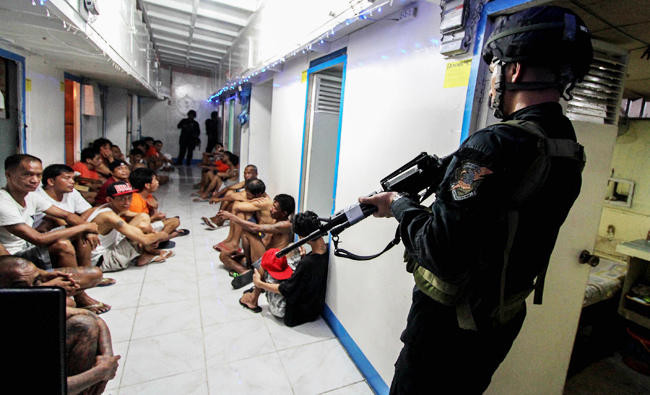
MANILA: The aim of President Rodrigo Duterte’s war on drugs is “to preserve the lives of the Filipino people, to prevent the destruction of Filipino families, and to protect the Philippines from becoming a narco-state,” said his spokesman Ernesto Abella.
Abella was responding to criticism from the UN High Commissioner for Human Rights Zeid Ra’ad Al-Hussein that Duterte lacked respect for Filipinos’ right to due process.
In a speech delivered at the 36th session of the Human Rights Council on Monday, Al-Hussein identified the Philippines as among 40 countries where the human rights situation has become “darker and more dangerous.”
He added: “In the Philippines, I continue to be gravely concerned by the president’s open support for a shoot-to-kill policy against suspects, as well as by the apparent absence of credible investigations into reports of thousands of extrajudicial killings, and the failure to prosecute any perpetrator.”
Al-Hussein cited the case of 17-year-old Kian Loyd Delos Santos, a student who was dragged into an alley and shot in the head by plain-clothed policemen during an anti-drug operation in Caloocan City on Aug. 16.
Justice Secretary Vitaliano Aguirre described the killing as “an isolated case.” But Al-Hussein said suspicion of extrajudicial killings in the country has become so widespread that the initials EJK have reportedly become a verb in some communities, as in “he was EJK’d.”
He added that even as hundreds of people turned out for the teenager’s funeral, “the president again told police they would not be punished for killing suspects who resist arrest. This lack of respect for the due process rights of all Filipinos is appalling.”
Al-Hussein also expressed shock at Duterte’s threat to bomb schools for indigenous children in the southern Philippines, which the president accused of teaching children to revolt against the government.
Al-Hussein said Duterte’s order to police to shoot any human rights workers who “are part of” the drug trade or who “obstruct justice” is yet “another blow to his country’s reputation and his people’s rights.”
The UN remains concerned about the case of Sen. Leila De Lima, a staunch critic of Duterte who is in jail for alleged involvement in the illicit drug trade, Al-Hussein added.
Many human rights activists face a growing number of death threats. Al-Hussein urged the government to ensure they are accorded full protection and the right to freedom of expression and peaceful assembly without reprisals.
Measures taken toward reintroducing the death penalty threaten yet another step back, he said.
He urged the government to “uphold the Philippines’ international human rights obligations, amid deeper reflection about the values that the Philippines stands for.”
The presidential palace said it is deeply concerned by Al-Hussein’s sweeping statements and their lack of basis in fact.
Duterte has “categorically and repeatedly said there is no shoot-to-kill order. All drug killings are subject to investigations,” Abella said.
“On the issue of indigenous schools, it would be better to focus on the Duterte administration’s efforts to educate the indigenous people,” Abella added.
“On the issue of human rights workers who are part of the drug trade or human rights workers who obstruct justice, the president is referring to human rights activists who aid or abet acts of violence during legitimate police operations where authorities have the right of self-defense.”
Abella said De Lima’s incarceration is due to criminal, not political, issues, adding: “It is the court, which is independent from the executive, which ordered the arrest of Sen. De Lima for drug trafficking charges and for allegedly receiving money from drug dealers at the national penitentiary.”


![]()
Manila slams UNHCR chief over human rights criticisms
Manila slams UNHCR chief over human rights criticisms

Latest updates


© 2026 SAUDI RESEARCH & PUBLISHING COMPANY, All Rights Reserved And subject to Terms of Use Agreement.