Manila extends martial law in south until year end

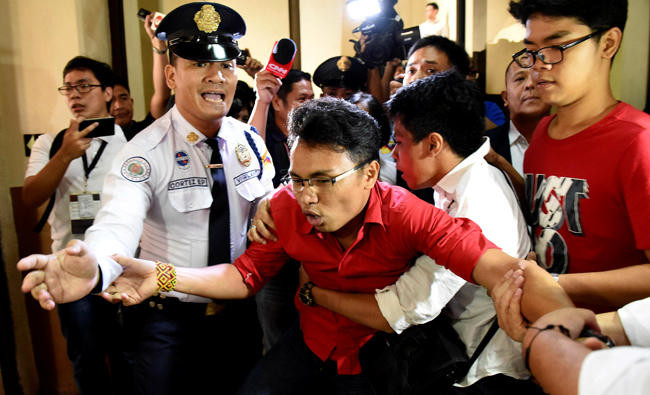
An anti martial law protestor is held by security during the special session on the extension of martial law at the House of Representatives in Quezon City, metro Manila, Philippines on Saturday. (REUTERS)
Updated 22 July 2017
Follow

Manila extends martial law in south until year end

MANILA: The Philippine Congress on Saturday voted to extend President Rodrigo Duterte’s declaration of martial law in the south until the end of the year to defeat gunmen.
In a special joint session of the House and the Senate, legislators overwhelmingly backed Duterte’s bid to have martial law remain in force in the Mindanao region until Dec. 31.
The vote came as troops continued their two-month long fight to wrest back the southern city of Marawi from Daesh-inspired militants.
Duterte first declared martial law in Mindanao on May 23 shortly after the gunmen, waving the black flags of Daesh, occupied parts of Marawi, triggering weeks of bloody fighting.
The vote was largely a foregone conclusion as Duterte enjoy majorities in both houses of Congress.
But opposition lawmakers dragged out the debate, questioning why martial law was needed for the whole of Mindanao when the fighting was limited to only one city.
“I fear that the plan to extend the martial law in Mindanao will pave the way for a Philippines-wide martial law,” said Sen. Risa Hontiveros ahead of the vote.
A slide presentation accompanying Duterte’s request, seen by AFP, compared the Marawi crisis to Daesh takeover of the Iraqi city of Mosul.
Marawi itself could now become a magnet for foreign fighters in Iraq and Syria, it said.
Most of the militants’ leaders remain at large, the presentation added, while about 90 of the gunmen have slipped past security cordons and can link up with other armed groups in the region to mount similar wide-scale attacks.
At the hearing, defense and security officials justified the extended martial law, saying that aside from Marawi, militants were planning attacks in other parts of Mindanao.
They said almost a thousand pro-Daesh militants, holding 23 hostages, were still active elsewhere in the south.
In Marawi, the military said only about 60 gunmen were left in a 49-hectare area of Marawi, but Duterte said he needed martial law powers to rebuild the city and ensure the war did not spread elsewhere.
“I cannot afford to be complacent,” Duterte told reporters Friday, adding the military would be conducting further “mopping up operations” even after they recapture Marawi.
“If there is a spillage it will not be as bad if you have this stopgap,” he added.
Duterte imposed 60-day martial rule — the maximum period allowed by the constitution — over the Mindanao region on May 23 within hours of the gunmen beginning their rampage.
On Monday he asked Congress to extend it until the end of the year, along with the continued suspension of a constitutional safeguard against warrantless arrests.
Martial law allows the military to establish control with measures such as curfews, checkpoints and gun controls in a country where civilians are authorized to keep licensed firearms in their homes.
However, any martial law extension must be approved by Congress.
The subject remains sensitive in the Philippines, decades after the late dictator Ferdinand Marcos put the country under military rule for part of his 20-year term.
Thousands of critics, political opponents as well as communist guerrillas were killed, detained or arrested during the period, according to historians.
About a dozen protesters in the gallery interrupted Saturday’s hearing, chanting “never again, never again to martial law” before being escorted out.
Duterte had already beaten back a Supreme Court petition to declare martial law in Mindanao illegal.
“Once he feels that there is not enough opposition to a nationwide martial law declaration, he will go for it,” Sen. Antonio Trillanes told AFP on Tuesday.
This is part of a bid to stay in office beyond his mandated six years, he warned.
Duterte, 72, insists he has no plan to stay in office beyond his term.


Autopsy finds Cuban immigrant in ICE custody died of homicide due to asphyxia

Updated 2 sec ago
Follow

Autopsy finds Cuban immigrant in ICE custody died of homicide due to asphyxia

  • Witness: Lunas Campos was handcuffed as at least five guards held him down and one put an arm around his neck and squeezed until he was unconscious
  • The US Immigration and Customs Enforcement said Diaz was detained by ICE earlier this month during the immigration crackdown in Minneapolis
WASHINGTON: A Cuban migrant held in solitary confinement at an immigration detention facility in Texas died after guards held him down and he stopped breathing, according to an autopsy report released Wednesday that ruled the death a homicide.
Geraldo Lunas Campos died Jan. 3 following an altercation with guards. US Immigration and Customs Enforcement said the 55-year-old father of four was attempting suicide and the staff tried to save him.
But a witness said last week that Lunas Campos was handcuffed as at least five guards held him down and one put an arm around his neck and squeezed until he was unconscious.
His death was one of at least three reported in little more than a month at Camp East Montana, a sprawling tent facility in the desert on the grounds of Fort Bliss, an Army base.
The autopsy report by the El Paso County Medical Examiner’s Office found Lunas Campos’ body showed signs of a struggle, including abrasions on his chest and knees. He also had hemorrhages on his neck. The deputy medical examiner, Dr. Adam Gonzalez. determined the cause of death was asphyxia due to neck and torso compression.
The report said witnesses saw Lunas Campos “become unresponsive while being physically restrained by law enforcement.” It did not elaborate on what happened during the struggle but cited evidence of injuries to his neck, head and torso associated with physical restraint. The report also noted the presence of petechial hemorrhages — tiny blood spots from burst capillaries that can be associated with intense strain or injury — in the eyelids and skin of the neck.
Dr. Victor Weedn, a forensic pathologist who reviewed the autopsy report for AP, said the presence of petechiae in the eyes support the conclusion that asphyxia caused the death. Those injuries suggest pressure on the body and are often associated with such deaths, he said.
He said the contusions on Lunas Campos’ body may reflect physical restraint and the neck injuries were consistent with a hand or knee on the neck.
The autopsy also found the presence of prescription antidepressant and antihistamine medications, adding that Lunas Campos had a history of bipolar disorder and anxiety. It made no mention of him attempting suicide.
Government provided changing accounts of what happened
ICE’s initial account of the death, which included no mention of an altercation with guards, said Lunas Campos had become disruptive and staff moved him into a cellblock where detainees are held away from others.
“While in segregation, staff observed him in distress and contacted on-site medical personnel for assistance,” the agency said in its Jan. 9 statement. “Medical staff responded, initiated lifesaving measures, and requested emergency medical services.”
Lunas Campos was pronounced dead after paramedics arrived.
Last Thursday, after Lunas Campos’ family was first informed the death was likely to be ruled a homicide, Department of Homeland Security spokesperson Tricia McLaughlin amended the government’s account, saying he had attempted suicide and guards tried to help him.
“Campos violently resisted the security staff and continued to attempt to take his life,” she said. “During the ensuing struggle, Campos stopped breathing and lost consciousness.”
After the final autopsy report was released Wednesday, McLaughlin issued a statement emphasizing that Lunas Campos was “a criminal illegal alien and convicted child sex predator.”
New York court records show Lunas Campos was convicted in 2003 of sexual contact with a person under 11, a felony for which he was sentenced to one year in jail and placed on the state’s sex offender registry. Lunas Campos was also sentenced to five years in prison and three years of supervision in 2009 after being convicted of attempting to sell a controlled substance, according to the New York corrections records. He completed the sentence in January 2017.
“ICE takes seriously the health and safety of all those detained in our custody,” McLaughlin said Wednesday, adding that the agency was investigating the death. DHS has not responded to questions about whether any outside law enforcement agency was also investigating.
Deaths put a spotlight on Camp East Montana
The AP reported in August that the $1.2 billion contract to build and operate Camp East Montana, expected to become the largest detention facility in the US, was awarded to a private contractor headquartered in a single-family home in Richmond, Virginia. The company, Acquisition Logistics LLC, had no prior experience running a corrections facility and has subcontracted with other companies to help operate the camp.
It was not immediately clear whether the guards present when Lunas Campos died were government employees or those of a private contractor.
A final determination of homicide by the medical examiner would typically be critical in determining whether any guards are held criminally or civilly liable. The fact that Lunas Campos died on an Army base could limit state and local officials’ legal jurisdiction to investigate.
Lunas Campos was among the first detainees sent to Camp Montana East, arriving in September after ICE arrested him in Rochester, New York, where he lived for more than two decades. He was legally admitted to the US in 1996, part of a wave of Cuban immigrants seeking to reach Florida by boat.
ICE said he was picked up in July as part of a planned immigration enforcement operation due to criminal convictions that made him eligible for removal.
In addition to Lunas Campos, ICE announced that on Dec. 3 an immigrant from Guatemala held in Camp East Montana died after being transferred to a El Paso hospital for care. While the cause of death was still pending, the agency said Francisco Gaspar-Andres, 48, was suspected to have died of liver and kidney failure.
On Sunday, ICE announced that Victor Manuel Diaz, a 36-year-old immigrant from Nicaragua, died at Camp East Montana on Jan. 14 of a “presumed suicide.” The agency said Diaz was detained by ICE earlier this month during the immigration crackdown in Minneapolis.
Unlike with the two prior deaths, Diaz’s body wasn’t sent to the county medical examiner in El Paso. McLaughlin said Wednesday that the autopsy for Diaz is being performed at the Army medical center at Fort Bliss. DHS again did not respond to questions about whether any agency other than ICE will investigate the death.
Rep. Veronica Escobar, a Democrat whose district includes El Paso, called on DHS Secretary Kristi Noem and acting ICE Director Todd M. Lyons to brief Congress about the recent deaths.
“DHS must preserve all evidence — including halting their effort to deport the witnesses,” Escobar said Wednesday. “I reiterate my call for Camp East Montana to be shut down and for the contract with the corporation running it to be terminated.”